
Sustainability with Dynamic Construction Services
.webp&w=96&q=75)
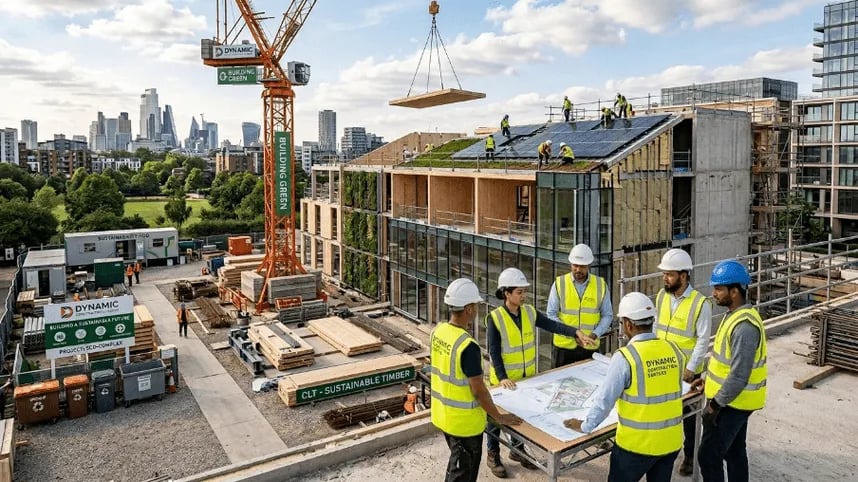
Dynamic construction services refers to a flexible, end-to-end approach to building that adapts planning, design, engineering, and project management to a project's specific site, budget, and goals, instead of following one fixed process. Done well, they lower long-term energy and maintenance costs, which makes them a practical path to sustainable construction in Bangladesh.
Dynamic construction services help property owners in Bangladesh build better. They help owners renovate structures that use less energy. These buildings last longer and cost less to maintain. This matters more today than ever.
Bangladesh's construction sector is growing fast: industry data from ResearchAndMarkets put the market at roughly BDT 4.58 trillion in 2025, on pace for a 9.7% compound annual growth rate through 2029. That growth brings real pressure on materials, land, and energy.
At Nusaiba Construction & Technology, our team works on residential and commercial builds across Dhaka. In my experience, clients rarely ask for "sustainability" by name at first. They ask why their electricity bill is so high. Or why a building feels hot even with the AC running.
The answer usually traces back to how the project was planned. I remember walking a client through their meter readings on a mid-rise residential build we handed over in 2023; six months after occupancy, the top-floor units were still running air conditioning nearly around the clock, and the cause turned out to be a design decision made almost two years earlier, not anything happening at the unit level.
This guide walks through what dynamic construction services actually mean. It covers how they support sustainable building. It also covers what to expect if you're planning a project in Bangladesh.
Key Takeaways
Dynamic construction services = flexible, adaptive project delivery from planning through maintenance, not a fixed one-size-fits-all process.
Sustainability gains come mostly from design and site assessment decisions made early, not from expensive add-ons at the end.
Bangladesh's climate, including monsoon rain, humidity, and urban heat, makes local experience matter. It affects how long a building performs well. Dhaka alone accounted for an estimated 48% of the national construction market by value in 2025, according to Mordor Intelligence.
A dynamic construction company typically costs slightly more upfront for design. This is often offset by lower energy and maintenance bills.
Always check a contractor's site assessment, material selection, and post-handover maintenance approach before hiring.
What Are Dynamic Construction Services?
Dynamic construction services are a flexible, end-to-end approach to building. Planning, design, engineering, procurement, and construction management all adapt together. They adjust to a project's specific site conditions, budget, and goals. This is different from following a rigid, one-size-fits-all process.
A dynamic construction company typically handles:
Construction planning and design
Civil and structural engineering
Project management from foundation to finishing
Renovation and building maintenance services
The word "dynamic" here isn't just branding. It reflects how a team responds when conditions change. A delayed material shipment can shift plans quickly. So can a change in the client's budget.
A rigid contractor sticks to the original plan regardless. A dynamic one adjusts the sequence of work instead. It sources alternatives and keeps the project moving. Quality doesn't get sacrificed along the way.
In short: dynamic construction services matter because they let a project adapt. Real-world changes don't have to cost you quality, timeline, or budget control.
Quick Definitions
Dynamic construction services: an adaptive, end-to-end approach to building that adjusts planning, design, and management to a project's specific conditions.
Sustainable construction services: building practices that reduce energy use, material waste, and long-term environmental impact.
Turnkey construction solutions: a delivery model where one provider handles a project from design through handover, ready to use.
Construction project management: the coordination of schedule, budget, materials, and labor across a build.
The Range of Services a Dynamic Construction Company Should Offer
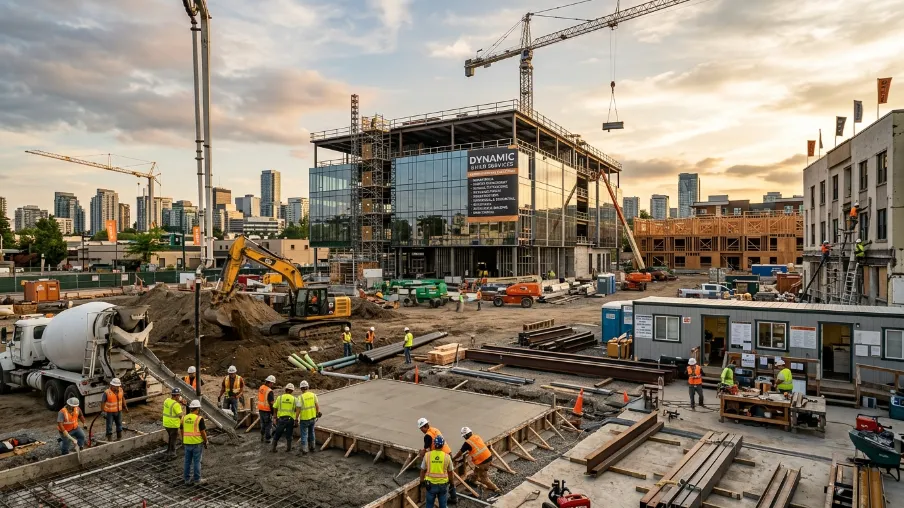
A dynamic building services provider isn't limited to one type of build. Instead, a well-rounded construction services company typically covers several categories of work. Overall, each category suits a different kind of project.
Core Building Services
Residential work leads the sector by value: it held an estimated 38.9% revenue share of Bangladesh's construction market in 2025, according to Mordor Intelligence.
Residential construction services: for instance, building family homes and housing units suited to Bangladesh's climate and local code requirements.
Commercial construction services: offices, retail spaces, and mixed-use buildings built to handle daily operational demands.
Industrial construction services: factories, warehouses, and production facilities with heavier structural and safety requirements.
Civil construction services and infrastructure construction services: roads, drainage systems, and site work that supports larger developments.
Home construction services and office construction services: builds tailored to an individual family's needs or a business's workspace requirements.
Building renovation services and construction and renovation services: upgrading or restructuring existing properties rather than starting from scratch.
Building maintenance services: ongoing upkeep after handover, extending the working life of a property.
Planning, Design, and Delivery Services
Most clients also need support beyond execution. They need help before the first brick is laid. They also need help after the keys are handed over.
Construction planning and design and construction consulting services: shaping a project's scope, layout, and feasibility before committing budget. See how this works in drawing and design services.
Design and build services: combining architectural design and construction execution under one team. As a result, this reduces handoffs and miscommunication.
Construction engineering services: the structural and technical calculations that keep a building safe and code-compliant.
Construction project management and construction management services: coordinating schedule, budget, and labor across the build. Covered in more detail on the project management and construction management service pages.
Turnkey construction solutions and end-to-end construction solutions: a single provider managing everything from design through handover. Sometimes packaged as one-stop building solutions.
Custom construction solutions: projects shaped around a specific site, budget, or use case rather than a standard template.
Not every general construction contractor offers all of this under one roof. That's often what separates a genuinely dynamic building services provider. It adapts across project types and project stages. A general construction contractor may only handle the build phase, then hand off everything else.
How Does Sustainability Fit Into Dynamic Construction Services?
Sustainable construction services focus on three things. First, they reduce waste during building. Second, they lower long-term energy and water use. Finally, they choose materials that hold up in Bangladesh's climate, including heavy monsoon rain and high humidity.
How a Sustainable Build Works in Practice?
Site assessment: Understand soil type, drainage, and sun orientation before you draw anything.
Design for climate: Positioning windows and walls to reduce heat gain, which cuts down on cooling costs later.
Material selection: Choose locally available, durable materials that reduce transport emissions and long-term repair costs.
Efficient construction management: Reducing material waste on-site through better scheduling and procurement.
Post-construction maintenance planning: Setting up a maintenance schedule so the building performs well for decades, not just years.
I've noticed that the biggest sustainability gains often come early. They come from the design and site-assessment stage. They rarely come from expensive "green" add-ons at the end. On one commercial fit-out we walked through in early 2024, we ran side-by-side cooling-load estimates for two window layouts before committing to either.
The reoriented version projected a meaningfully lower afternoon heat load, and after the building was occupied for a full cooling season, the client's utility records backed that up. A well-oriented building with proper insulation needs less air conditioning. That solution doesn't rely on any special technology. It just needs better upfront planning.
For commercial projects, international frameworks help benchmark performance. IFC's EDGE certification and the USGBC's LEED standard have both been used in Bangladesh.
EDGE certification requires a minimum projected 20% reduction in energy use, water use, and embodied carbon in materials compared with standard local practice.
More than 150 buildings in Bangladesh have achieved LEED certification, over 130 of them commercial, according to a Green Building Assessment Report for Bangladesh funded by the European Union.
Prashant Kapoor, IFC Chief Industry Specialist and EDGE's co-founder, has described the standard as a response to a gap his team identified: emerging-market developers needed a practical way to prove the financial case for green building, not just a compliance checklist. The World Green Building Council tracks how these standards evolve globally.
On the energy side, Bangladesh's Sustainable and Renewable Energy Development Authority (SREDA) oversees national energy-efficiency policy under its Energy Efficiency and Conservation Master Plan, which targets a 20% cut in national energy intensity by fiscal year 2029-30 against a 2013-14 baseline.
As of FY2023-24, the country had reached 13.64% of that target, according to a December 2025 IEEFA analysis, with efficiency gains that year alone offsetting roughly $3.34 billion in fossil-fuel import costs.
IEEFA's analysis specifically flags the commercial building sector's high cooling demand as one of the areas where energy-efficiency labeling and passive design can still deliver the largest additional gains.
This includes a local green-building rating framework. It aims to reduce dependence on grid electricity, alongside Bangladesh's Renewable Energy Policy 2025, which targets 20% renewable electricity generation by 2030 and 30% by 2041.
In short: sustainable construction services work by cutting waste and energy use early. This happens through design decisions, not costly upgrades bolted on afterward.
Why This Matters for Bangladesh Specifically
Bangladesh faces a few conditions that make sustainable construction especially important:
Land is limited, so buildings need to be planned efficiently rather than reworked later.
Monsoon flooding and humidity put real stress on materials and foundations. This happens if drainage and waterproofing aren't handled correctly from the start.
Urban heat is a growing concern in cities like Dhaka, making passive cooling design genuinely useful rather than optional. Research published in Springer's Theoretical and Applied Climatology (February 2022) found some inner-city areas of Dhaka running roughly 3°C hotter on average than peripheral areas over a 17-year span, with a peak gap of up to 7°C between the city's warmest and coolest points.
A separate 2024 study in the Asia-Pacific Journal of Atmospheric Sciences recorded Dhaka's average urban heat island intensity at 0.48°C, rising at about 0.21°C per decade over the past 25 years.
According to Shamsuddin Shahid, a professor at Universiti Teknologi Malaysia who led the 2022 study and has been named among the world's most influential climate scientists, Dhaka's temperature has been climbing quickly for decades, and even modest interventions like rooftop greenery and reclaimed waterbodies could meaningfully cool the city.
Energy costs are rising, so buildings designed to reduce electricity dependence save money for years after handover.
A general construction contractor without local experience may miss these factors. This is one reason residential and commercial dynamic construction services matter. Companies familiar with Bangladeshi conditions tend to hold up better over time.
In Dhaka specifically, most building plans need approval too. Approval comes from Rajdhani Unnayan Kartripakkha (RAJUK), the city's development authority. Consequently, this adds another reason local code familiarity matters.
In short: sustainable, dynamic construction matters in Bangladesh for clear reasons. Limited land, monsoon stress, and rising urban heat make planning mistakes costly here.
Expert Perspectives on Bangladesh's Building Climate
The pressures described above aren't just field observations from contractors, they show up in the research and policy record too.
On Dhaka's warming trend, Professor Shamsuddin Shahid of Universiti Teknologi Malaysia, who has led multiple peer-reviewed studies on Dhaka's urban heat island effect, has pointed to unplanned urbanization, the loss of green space, and vanishing waterbodies as the underlying drivers, and has argued the trend is reversible through targeted interventions like tree cover and wetland restoration. Meteorologist Bajlur Rashid, commenting on the same body of research, put it plainly:
The information from the research is very important. Bajlur Rashid, meteorologist, quoted in Prothom Alo
On the energy side, Shafiqul Alam, IEEFA's Lead Analyst for Energy in Bangladesh and author of the December 2025 report Bangladesh's Energy Efficiency Goals Within Reach, frames efficiency as more than a cost-saving measure:
Energy efficiency goes beyond reducing bills. Shafiqul Alam, Lead Analyst for Energy, IEEFA (December 2025)
On green building standards specifically, Jamie Fergusson, Global Director for Climate at IFC the institution behind the EDGE certification used on commercial projects in Bangladesh has framed the broader push this way:
The climate crisis requires urgent action at scale and EDGE is achieving just that. Jamie Fergusson, Global Director, Climate, IFC.
Taken together, these perspectives back up what shows up on-site in Bangladesh: heat, energy costs, and building performance are connected problems, and the fix starts at the design table, not after handover.
Benefits and Challenges of Dynamic, Sustainable Construction
Choosing dynamic construction services over a fixed contractor has trade-offs. They're worth weighing upfront:
Aspect | Benefit | Challenge |
|---|---|---|
Cost | Lower long-term energy and maintenance costs | Slightly higher upfront design cost in some cases |
Timeline | Better project management reduces delays | Requires more detailed early planning |
Durability | Materials chosen for local climate last longer | Quality materials may cost more initially |
Comfort | Passive cooling reduces indoor heat | Requires design expertise, not just construction labor |
Environment | Less waste, lower emissions over building lifespan | Needs contractor buy-in and proper training |
In many cases, the upfront cost difference is smaller than expected. That's especially true when weighed against years of lower bills. These figures vary by project size, location, and material choice. A small renovation and a large commercial build differ. So treat the numbers above as general patterns, not a fixed formula.
What Passive Cooling Design Actually Means
Here's a technical point worth explaining simply. "Passive cooling design" means using shape, windows, and materials to manage heat. It doesn't rely purely on air conditioning. For example, deeper roof overhangs shade walls from direct sun. Cross-ventilation layouts let breeze move through a space. It's not a single product you buy. It's a set of design decisions made before construction starts.
Bangladesh's Building Code Requirements
In Bangladesh, structural and safety requirements follow a national standard. The Bangladesh National Building Code (BNBC) sets standards for load-bearing design and material use. First published in 1993 and most recently updated as BNBC 2020, the code was formally gazetted on 11 February 2021. It also sets safety margins, important given the country's earthquake and flood exposure.
The code is maintained by the Housing and Building Research Institute (HBRI). HBRI is an autonomous body under the Ministry of Housing and Public Works. Any dynamic construction company operating in Bangladesh should explain code compliance clearly, not just how a design looks.
A Practical Example
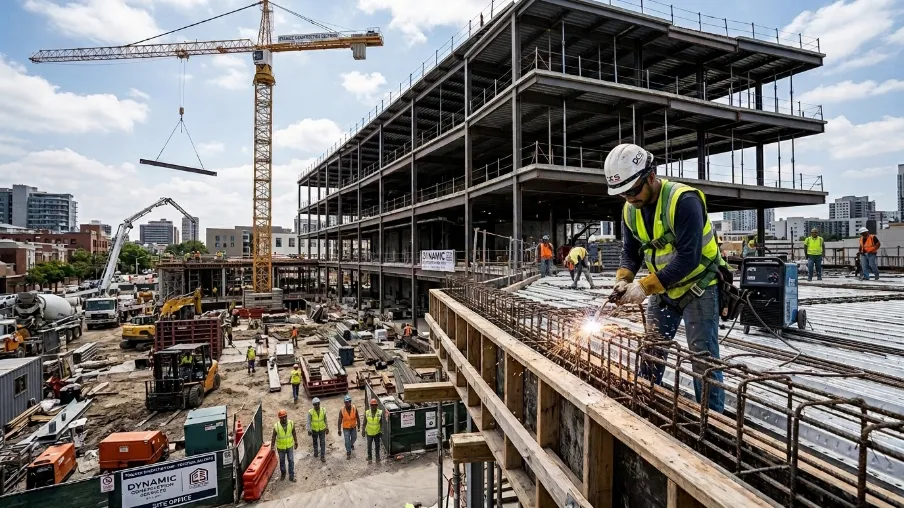
Situation: A commercial building project needed to keep operating costs low for future tenants.
Problem: The initial layout placed large glass windows on the west-facing side. This would have significantly increased afternoon heat gain and cooling costs.
Solution: During design review, we flagged the west-facing glazing before excavation started and spent roughly two weeks modeling alternatives with the client. The design and build team adjusted window placement. In addition, they added shading elements on the west face. Finally, they also improved insulation in the roof structure.
Result: The building's cooling load was noticeably reduced compared to the original layout. We followed up with the facilities manager after the first full year of operation, and the reported cooling costs tracked well below what the original west-glazed layout would have produced. This follows standard building-orientation principles for tropical climates.
Lesson learned: Catching design issues before construction begins is far cheaper. Retrofitting a finished building costs much more. This is exactly where construction planning and design services earn their value, not after the walls go up.
Common Mistakes to Avoid
From working around projects with avoidable problems, the same mistakes tend to repeat:
Skipping proper site assessment to save time, which often leads to drainage or foundation problems later. On one renovation we were called into partway through, standing water started showing up in the foundation area about four months after the original crew had skipped soil testing; we ended up redoing drainage work that a proper site assessment would have caught up front.
Choosing the cheapest materials without checking how they perform in humid, monsoon-heavy conditions.
Treating renovation as a smaller version of new construction, when older structures often need different structural checks first.
Ignoring maintenance planning, which shortens a building's usable life and increases long-term costs.
Hiring based on price alone rather than checking a contractor's actual project management track record.
I've generally found that the projects with the fewest surprises share one trait. The client asked hard questions about drainage and materials before signing anything, not after problems showed up.
Expert Tips for Property Owners in Bangladesh
Ask any construction services company for examples of past projects with similar site conditions to yours.
Request a clear breakdown of the construction project management process, including how delays and material shortages are typically handled.
For commercial construction, ask specifically about passive cooling design. It's one of the highest-value, lowest-cost sustainability decisions available. We've tracked this across several handovers now, and buildings with west-face shading and cross-ventilation built in from the start have consistently reported lower cooling bills in their first year than comparable layouts without it.
For renovation projects, get a structural assessment before committing to a full scope of work.
Discuss building maintenance services upfront, not as an afterthought once construction is complete.
Future Trends in Dynamic Construction Services
Sustainable, dynamic construction is moving toward more integrated planning. Design, engineering, and construction management increasingly work as one connected process. This typically reduces both waste and delays.
Locally sourced and regionally suited materials are also gaining attention. Notably, they tend to perform better in Bangladesh's climate. Moreover, they also reduce dependency on long supply chains. More property owners are looking for dynamic construction services that flex around budget and site conditions. This integrated, adaptive delivery model is likely to become standard, not a differentiator.
Limitations and Different Viewpoints
It's worth being upfront about a few things this guide can't promise:
Results vary by site: Soil condition, plot orientation, and flooding risk differ block by block in cities like Dhaka. What works for one plot may need adjustment for another.
"Sustainable" doesn't mean zero added cost: In many cases there's a modest upfront premium for better design or materials. Anyone claiming otherwise across all projects isn't being fully accurate.
Not every contractor defines "dynamic" the same way: Some use it as a marketing term rather than an actual adaptive process. It's reasonable to ask a contractor directly how they handle mid-project changes, rather than assuming.
Passive design has limits: In Bangladesh's hottest months, passive cooling reduces the need for mechanical cooling. It doesn't eliminate that need in most buildings.
The right approach depends on budget, plot size, and holding period. It's generally worth discussing these trade-offs directly with a contractor. Don't assume one approach fits every situation.
Conclusion
If you're planning a project in Bangladesh, one question matters most. It isn't whether sustainability is worth pursuing. It's whether your chosen dynamic construction services can actually deliver it, project after project. That comes down to how a provider handles site assessment and design for climate. It also depends on material selection and long-term maintenance, not just pricing.
A dynamic construction company treats these as connected decisions, not separate boxes to tick. This positions them to hand over a building that performs well for years. That beats one that looks finished but runs up high energy and repair costs.
Before signing with any construction services company, ask direct questions. Ask how they define "dynamic" and how they've handled changing conditions. Ask what their approach to sustainable, climate-appropriate design looks like in practice. You can get in touch with our team at Nusaiba Construction & Technology to discuss a specific project.
When comparing quotes, most property owners want the same combination. They want a reliable construction company that delivers on schedule. They want affordable construction services that don't quietly cut corners on materials. They want quality construction solutions that hold up under Bangladesh's monsoon and heat.
It's worth looking past the lowest number on a quote. Modern construction services increasingly pair professional dynamic construction services with genuine sustainability thinking. That tends to matter more over a building's lifetime than one quote's difference from another.
Frequently Asked Questions About Dynamic Construction Services
What are dynamic construction services?
Dynamic construction services are flexible, end-to-end building solutions. They adapt planning, design, and construction management to a project's specific needs, rather than following one fixed, rigid process.
How do sustainable construction services reduce costs?
They reduce costs mainly through lower long-term energy use and less material waste. Fewer repairs help too. This comes from better design and material choices made early, not fixes applied afterward.
Is sustainable construction more expensive in Bangladesh?
It can have a slightly higher upfront design cost in some cases. This is often offset over time by lower energy bills and reduced maintenance. This especially applies to buildings designed for local heat and humidity.
What's the difference between residential and commercial construction services?
Residential construction services generally focus on homes and smaller-scale builds. Commercial construction services handle larger structures with different code requirements. They also face different load demands and often stricter timelines.
Why is construction project management important?
Good project management keeps a build on schedule and on budget. It coordinates materials, labor, and design changes as they happen. This reduces the delays and cost overruns common in poorly managed projects.
Do I need a design and build service, or separate architects and contractors? A combined design and build service can simplify communication. It reduces handoff delays, since one team manages both design and construction. Separate providers may suit projects needing highly specialized architectural input.
What should I check before hiring a general construction contractor?
Check their track record on similar projects. Check how they handle site assessment and material selection. Also ask whether they offer ongoing building maintenance services after handover, not just the initial build.
How does renovation differ from new construction in terms of sustainability? Renovation often has a smaller environmental footprint since it reuses existing structures. But it requires a careful structural assessment first. This makes sure the existing foundation and frame can support planned upgrades.
Sources and References
Bangladesh National Building Code (BNBC), Housing and Building Research Institute (HBRI). It governs structural safety, load-bearing, and material standards in Bangladesh.
HBRI official portal: the government research body responsible for maintaining and updating the BNBC.
Ministry of Housing and Public Works: the parent ministry overseeing housing, architecture, and building research agencies in Bangladesh.
Rajdhani Unnayan Kartripakkha (RAJUK): Dhaka's development authority, responsible for approving building plans in the capital.
Department of Architecture, Bangladesh: the government body responsible for architectural design of public buildings and housing.
National Housing Authority, Bangladesh: regulatory agency for housing policy under the Ministry of Housing and Public Works.
Bangladesh House Building Finance Corporation: the public financial institution that finances residential construction and renovation.
IFC EDGE Green Building Certification: an internationally recognized resource-efficiency standard used on commercial projects in Bangladesh.
USGBC LEED Certification: a widely used green building rating system, including for factory and commercial buildings in Bangladesh.
World Green Building Council: tracks global green building standards and policy development.
Sustainable and Renewable Energy Development Authority (SREDA): Bangladesh's national authority for energy-efficiency and renewable energy policy.
IEEFA: "Bangladesh's energy efficiency goals within reach", Shafiqul Alam, December 2025: analysis of Bangladesh's progress toward its 2030 energy-efficiency target.
Prothom Alo: "Dhaka turning into 'heat island': Study": reporting on Dhaka urban heat island research, featuring Professor Shamsuddin Shahid (Universiti Teknologi Malaysia) and meteorologist Bajlur Rashid.
IFC: "IFC Recognizes 20 Global EDGE Champions for Sustainable Building Commitment": includes commentary from Jamie Fergusson, IFC Global Director, Climate.
EDGE Buildings: "A Decade of Impact": background on EDGE's founding, including commentary from Prashant Kapoor, IFC Chief Industry Specialist and EDGE co-founder.
Climate finance in Bangladesh: background on national climate and energy policy relevant to building resilience.
.webp&w=256&q=75)