
Spanish Tile Designs That Enhance Home Value and Beauty
.webp&w=96&q=75)
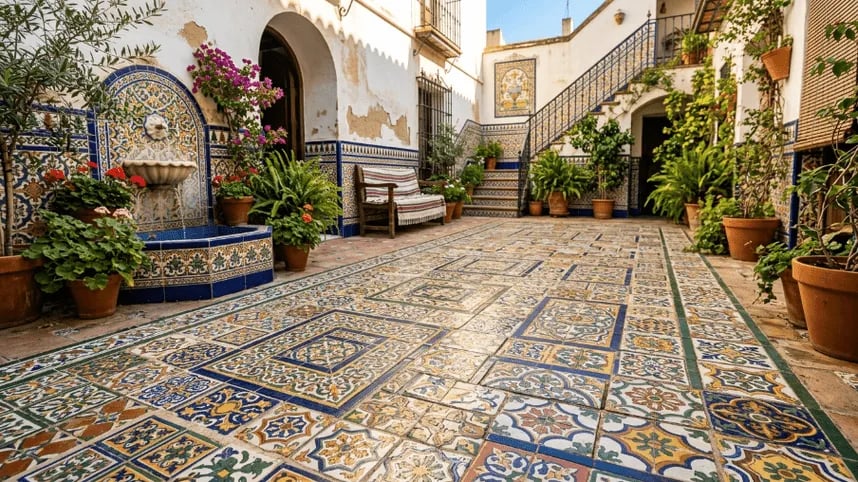
Spanish Tile Designs refers to ceramic or terracotta tiles featuring hand-painted or patterned motifs rooted in Andalusian and Moorish traditions. They typically work best as accents, such as backsplashes, feature walls, patios, or bathroom floors, rather than covering an entire room. Glazed versions generally hold up well in Bangladesh's humid climate, making them a practical as well as decorative choice.
Written with input from Nusaiba Construction & Technology's interior finishing team, based on tiling and interior projects completed for residential clients in Dhaka. Last reviewed July 2026.
Key Takeaways
What they are: Ceramic or terracotta tiles carrying hand-painted or patterned designs drawn from Andalusian and Moorish traditions.
Where they work best: As accents, such as kitchen backsplashes, feature walls, patio floors, or a single bathroom, rather than an entire room.
Climate fit: Glazed ceramic versions resist Bangladesh's monsoon humidity well; unglazed terracotta needs periodic sealing.
Cost range: Handmade tiles cost more and show natural variation; printed ceramic versions replicate the look at a lower price.
Biggest planning risk: Pattern misalignment during installation. A dry-lay test and a layout drawing before adhesive goes down prevents most problems.
Spanish tile designs add warmth, colour, and timeless character to any home. Their handcrafted patterns and durable ceramic construction make them a popular choice for floors, walls, kitchens, and bathrooms. With the right glaze, they also perform well in Bangladesh's climate. In this guide, I'll explain what makes Spanish tile designs unique, where they work best, and what to consider before buying so you can choose a style that's both beautiful and practical.
What Are Spanish Tile Designs?
Direct answer: Spanish tile designs are ceramic or terracotta tiles decorated with patterns from Spanish, especially Andalusian and Moorish, architectural traditions.
Spanish tile designs refer to ceramic or terracotta tiles rooted in Spanish decorative traditions. They draw heavily on Andalusian and Moorish influences from centuries past. These influences shaped much of Spanish architecture over a long period. The tiles are known for geometric patterns and bold colour combinations.
Hand-painted details are another signature feature of this style. Much of this tradition traces back to sites like the Alhambra in Granada. The Alhambra is a UNESCO World Heritage property in southern Spain. Its tilework remains one of the most studied examples of this craft.
There are a few main categories worth knowing:
Traditional Spanish tiles – hand-painted with floral or geometric motifs, often in blue, yellow, and terracotta tones
Spanish encaustic tiles – patterned tiles made by inlaying different colours of clay, giving a matte, vintage look
Spanish mosaic tile designs – small tiles arranged into larger repeating patterns, common in courtyards and pools
Modern Spanish tile designs – simplified patterns with muted colours, made for contemporary interiors
Spanish colonial tile designs – curved, symmetrical layouts often seen in colonial-style villas and heritage buildings
These decorative categories are sometimes grouped together as Spanish decorative tiles. But the differences matter once you start choosing Spanish tiles for home interiors. A pattern that suits a courtyard does not always suit a living room wall.
However, authentic Spanish tiles tend to show small natural variations. This applies whether the tiles are hand-painted or hand-inlaid. Machine-made versions rarely show that same natural variation.
In my experience, clients often start by asking for Spanish style tiles. They usually do not know which category fits their specific space. That is normally the first conversation worth having with a designer.
As a result, industry organizations play an important role in this space. Groups like ASCER, the Spanish Ceramic Tile Manufacturers' Association, represent most producers. Its export brand, Tile of Spain, promotes these manufacturers to buyers worldwide.
How Do Spanish Tile Patterns Work in a Home?
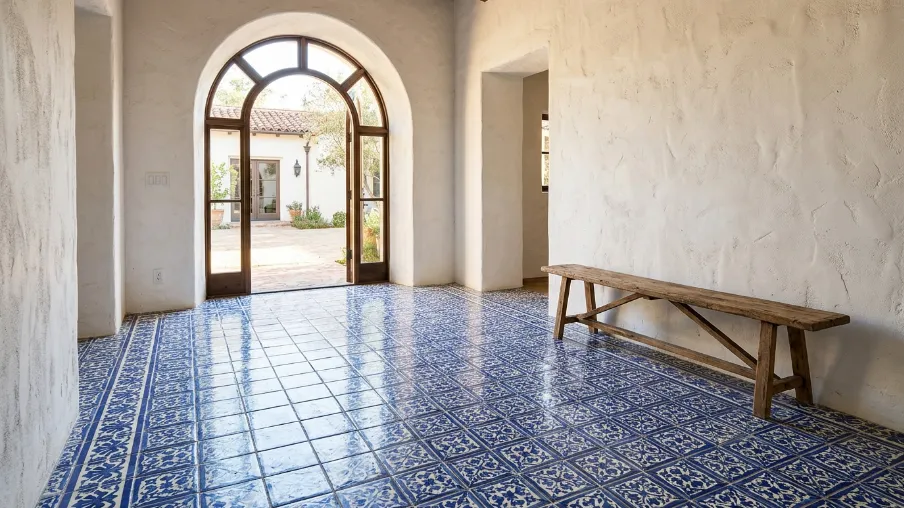
Direct answer: Spanish tile patterns follow a repeating module, where one tile or a small group of tiles creates a seamless design across a floor or wall. This repeating layout gives Spanish tile patterns their distinctive, continuous appearance and helps create a balanced, coordinated look throughout a space. For the best results, companies like Nusaiba Construction & Technology carefully plan the layout before installation.
Spanish patterned tiles are carefully designed rather than randomly decorative. Many collections use geometric, floral, or Mediterranean-inspired motifs that repeat across multiple tiles. This creates the rich visual effect that makes Spanish floor tile designs stand out in kitchens, living rooms, patios, and entryways.
The same principle applies to Spanish wall tile designs. Patterns must align correctly at corners, edges, and around fixtures to maintain a clean, uninterrupted appearance. Nusaiba Construction & Technology recommends planning the tile layout in advance to reduce waste, maintain pattern continuity, and achieve a professional finish.
Understanding how these repeating modules work makes it easier to choose Spanish tile patterns that suit your home's size, style, and layout, resulting in a finished space that feels intentional, cohesive, and professionally designed.
Common Placement Areas
Spanish kitchen backsplash tiles – small-format patterned tiles behind the stove or sink area
Spanish bathroom tile ideas – full or half-wall patterns paired with plain tiles to avoid overwhelming a small space
Spanish patio tiles – terracotta or textured tiles suited for outdoor durability
Spanish villa tile styles – used across entryways and living areas to create a cohesive, resort-like feel
I noticed that homeowners often make the mistake of tiling an entire room in a bold pattern. Instead, it usually works better as an accent, such as a backsplash, a border, a feature wall, or a single room like a powder bath, while the rest of the home stays neutral.
Why Spanish Tile Designs Matter for Bangladeshi Homes
Direct answer: Spanish tile designs suit Bangladeshi homes because glazed ceramic and terracotta tiles generally resist monsoon humidity, and their bold colours and patterns fit naturally with local design traditions.
Bangladesh's climate is humid, and many homes deal with monsoon dampness for several months a year. As a result, ceramic and terracotta based Spanish tiles generally handle moisture well, which is one reason they translate nicely into local building projects, not just as a design trend but as a practical material choice.
For example, Spanish terracotta tiles in particular are a popular starting point for anyone exploring Spanish style flooring ideas, since they combine an earthy, natural look with reasonable durability.
There is also a cultural fit. In addition, Bangladeshi interior design has long embraced bold colours and detailed patterns in textiles and craftwork, so Colorful Spanish tiles and Mediterranean Spanish tiles tend to feel familiar rather than foreign when introduced into a home.
Benefits and Challenges
Aspect | Details |
|---|---|
Durability | Ceramic tiles generally resist moisture and are easy to clean, suiting humid conditions |
Maintenance | Glazed tiles typically need only regular mopping; unglazed terracotta may need periodic sealing |
Cost | Handmade Spanish tiles can cost more than machine-printed alternatives; affordable Spanish tile designs exist in printed ceramic versions. A proper estimation and quantity take-off helps avoid budget surprises before ordering |
Design flexibility | Works for traditional, colonial, farmhouse, and modern interiors |
Installation | Pattern-matching requires an experienced tiler, since misalignment is visible immediately; installers in commercial projects often reference ANSI/TCNA installation standards for workmanship benchmarks |
Challenges to keep in mind:
Authentic handmade tiles often have slight variations in colour and shape, which is part of their charm but can surprise buyers expecting machine-perfect uniformity
Sourcing genuine Spanish ceramic tiles locally may be limited, so many suppliers offer Spanish inspired tile patterns manufactured regionally instead
Grout lines need attention, as patterned tiles show dirt in grout more visibly than plain tiles
Practical Steps Before You Choose Spanish Tiles
Define the space first. Decide if you want a full floor application, a feature wall, or a small accent area like a backsplash.
Check the finish. Glazed tiles suit kitchens and bathrooms; matte or unglazed terracotta suits patios and outdoor Spanish tile designs.
Order a sample batch. Because handmade tiles vary slightly, seeing a physical sample avoids surprises after installation. In fact, sourcing and coordinating sample batches is exactly the kind of task a materials supply and logistics team can help streamline, especially when tiles are coming from multiple suppliers.
Confirm slip resistance for wet areas. Bathroom and patio applications need a tile rated for slip resistance, not just decorative appeal. Specifically, in the tile industry, this is generally measured using a DCOF (Dynamic Coefficient of Friction) rating, with a wet DCOF of 0.42 or higher typically recommended for level interior wet areas under ANSI guidelines.
Plan the pattern layout with your tiler in advance. Spanish patterned tiles rely on correct alignment; a rushed layout plan is the most common cause of a disappointing result. Therefore, this is where a proper drawing and design service earns its keep, since a detailed layout drawing catches pattern and alignment issues before installation begins. For instance, one thing I learned on an earlier project is that it's worth doing a dry-lay of the tiles on the floor before any adhesive goes down, since it catches pattern mismatches while they're still easy to fix.
Common Mistakes to Avoid
From working on similar interior projects, these are the mistakes that come up most often:
Choosing a bold pattern for an entire large room. This can make the space feel busy rather than elegant
Ignoring grout colour, which affects how clean or rustic the final look appears
Skipping a physical sample and relying only on online photos, where colour often renders differently on screen
Mixing too many pattern styles in one home without a unifying colour palette
Expert Tips
From working on similar interior projects, a few practical tips stand out:
Pair a bold patterned tile with plain tiles of a matching accent colour to avoid visual overload
In small bathrooms, using the pattern on just the floor or one wall usually looks better. Covering every surface tends to feel crowded.
Terracotta tones pair well with wood and rattan furniture. This suits a Spanish farmhouse tile design feel particularly well. In fact, it's one of the more popular Spanish farmhouse tile designs we see requested for family homes
For budget-conscious projects, printed ceramic tiles can mimic hand-painted patterns closely. They achieve a similar visual effect at a lower cost than authentic handmade tiles
Overall, when clients ask us to shortlist the best Spanish tiles for interiors, the answer usually depends on the room: glazed ceramic for kitchens and bathrooms, textured terracotta for patios, and large-format printed patterns for anyone who wants the look with easier upkeep.
Future Trends in Spanish Tile Designs
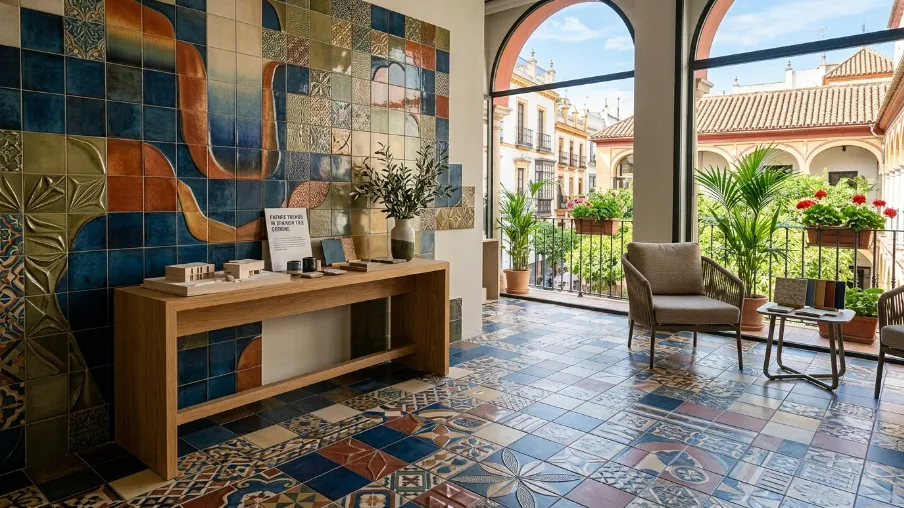
Interior design trends are currently leaning toward softer, muted colour palettes within the Spanish style, moving away from the very saturated blues and yellows of traditional designs.
Meanwhile, modern Spanish tile designs increasingly use terracotta, sage green, and off-white combinations, which suit both contemporary and traditional Bangladeshi homes. For anyone specifically looking for Spanish tile ideas for modern homes, this muted, large-format direction is generally the easiest starting point.
In addition, large-format tiles printed with smaller repeating Spanish motifs are also becoming more common, as they reduce the number of grout lines and simplify installation.
15 Spanish Tile Design Ideas to Inspire Your Home
If you searched for Spanish tile designs hoping to see the range of looks available before deciding on anything technical, this is the section for you. Specifically, here are the most popular directions homeowners in Bangladesh are choosing from right now:
Blue and white Talavera-style patterns – classic Spanish tile designs with cobalt blue motifs on a white base, popular for kitchen backsplashes; pieces from this tradition are held in museum collections including the Isabella Stewart Gardner Museum's Talavera tile gallery and the Victoria and Albert Museum's ceramics collection
Yellow and terracotta geometric tiles – warm, sun-baked tones that suit entryways and courtyards
Black and white Spanish mosaic tile designs – a graphic, high-contrast look for modern bathrooms
Green and cream floral patterns – softer traditional Spanish tiles suited to living rooms and dining areas
Encaustic-style concrete-look tiles – matte, vintage patterns for a farmhouse-inspired feel
Star and geometric Moorish patterns – intricate repeating shapes rooted in Andalusian design at the Alhambra, striking as a feature wall
Solid terracotta with painted borders – simple field tiles finished with a decorative Spanish-style edge, good for patios
Muted sage and off-white modern Spanish tiles – contemporary, understated versions of traditional motifs
Multi-colour Spanish patterned runners – a strip of patterned tile down a hallway or staircase, with plain tile on either side
Spanish colonial arabesque tiles – curved, symmetrical patterns often seen in colonial-style villas
Two-tone diamond patterns – simplified geometric layouts that work well in small bathrooms
Hand-painted floral border tiles – used as a decorative strip along the top or bottom of a plain-tiled wall
Textured terracotta patio tiles – slip-resistant, earthy tones for outdoor Spanish tile designs
Blue and yellow checkerboard-inspired layouts – a bold, playful take on traditional colour pairing
Large-format tiles with printed Spanish motifs – a lower-maintenance way to get the look with fewer grout lines
A practical way to use this list: pick one design as your "hero" pattern for a single wall or backsplash, then choose a plain or lightly textured tile in a complementary colour for the rest of the space. Overall, this is generally the easiest way to bring any of these fifteen looks into a home without it feeling overwhelming.
Conclusion
Spanish tile designs offer one of the most versatile ways to add colour, texture, and history to a home, whether you are working on a single kitchen backsplash or planning tile choices for an entire villa-style build. Specifically, the key is matching the specific Spanish tile design (traditional, encaustic, mosaic, or modern) to the room's actual use, moisture exposure, and the scale of the space.
Overall, used thoughtfully, Spanish tile designs can feel as fitting in a Dhaka home as they do in a Mediterranean courtyard, and a team that handles design, materials, and construction under one roof can make that transition far smoother.
FAQs About Spanish Tile Designs
What are the most popular Spanish tile designs right now?
Popular Spanish tile designs include blue-and-white Talavera-style patterns, yellow and terracotta geometric tiles, black-and-white mosaic layouts, and softer modern versions in sage green or off-white. Most homeowners choose one pattern as a feature and pair it with plain tiles elsewhere.
What are Spanish tile designs best used for?
Spanish tile designs work well as feature walls, kitchen backsplashes, bathroom floors, and outdoor patios. Overall, they are generally better as accents in a home rather than covering every surface, since the bold patterns are more striking in contrast to plain tiles.
Are Spanish tiles suitable for Bangladesh's humid climate?
Yes, glazed ceramic Spanish tiles typically resist moisture well and suit humid conditions. However, unglazed terracotta options may need occasional sealing to maintain water resistance over time.
What is the difference between Spanish encaustic tiles and regular ceramic tiles?
Encaustic tiles have colour inlaid into the clay itself, giving a matte, textured look, while regular glazed ceramic tiles have a printed or painted pattern under a glossy surface. As a result, encaustic tiles often need more maintenance.
Are handmade Spanish tiles expensive?
Handmade Spanish ceramic tiles generally cost more than machine-printed versions due to the labour involved. Affordable Spanish tile designs are available in printed ceramic formats that replicate the traditional look at a lower price point.
Can Spanish tile patterns be used in small bathrooms?
Yes, but it often works better to apply the pattern to one wall or the floor only, rather than the entire bathroom, to avoid making a small space feel visually crowded.
Do Spanish tiles work with modern interior design?
Yes. Modern Spanish tile designs use simplified geometric patterns and muted colour palettes, which blend well with contemporary interiors rather than only traditional or colonial-style homes.
How do I maintain Spanish patterned tiles?
Routine mopping with a mild cleaner is usually enough for glazed tiles. Grout lines may need periodic scrubbing, since patterns can make dirt in grout more noticeable than with plain tiles.
Sources and References
Heritage and historical background:
UNESCO World Heritage Centre – Alhambra, Generalife and Albayzín, Granada
Patronato de la Alhambra y Generalife – official tile panel documentation
Dosde – Tilework in the Alhambra, the perfection of Nasrid art
Moorish tile pattern history: Zellige, Azulejo, and their origins
Museum collections:
Industry associations and standards:
Slip resistance and technical guidance:
.webp&w=256&q=75)