
Tie Wire Guide: Best Types for Durable Construction Projects
.webp&w=96&q=75)
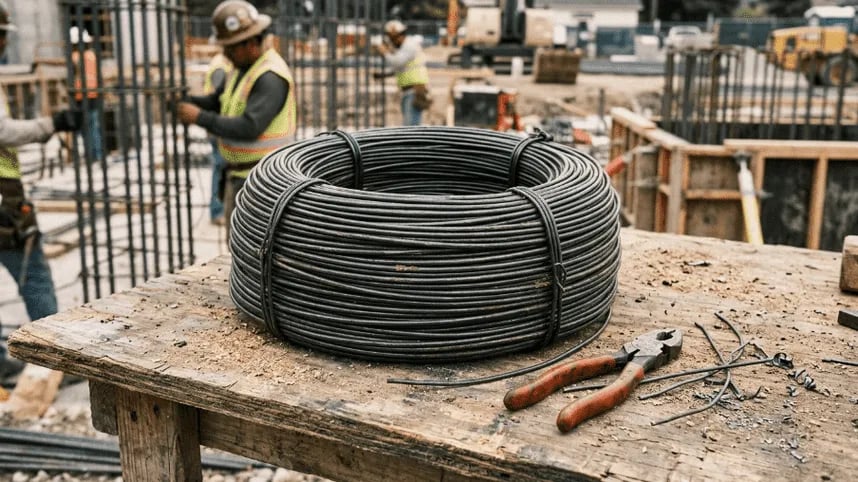
Tie wire, sometimes written as tie wires or simply tiewire, is a soft, annealed steel wire. Construction crews use tie wire in construction to bind rebar (reinforcement bars) together at intersecting points, which is why it's also called rebar tie wire or rebar tying wire.
We use tie wire in construction to keep rebar securely in place during concrete pouring and curing. The most common wire sizes range from 14 to 19 gauge (around 1.0 mm to 2.1 mm diameter), depending on the rebar size and project needs.
Tie wire is available as black annealed wire, galvanized wire, and coated wire. It is also known as binding wire, steel binding wire, or wire tie.
From our experience in Bangladesh construction projects, choosing the wrong tie wire type or gauge can weaken rebar joints and increase project risks. At Nusaiba Construction & Technology, we help clients source the right construction materials with proper quality and project requirements in mind.
Key Takeaways
Tie wire binds rebar joints together; it doesn't carry structural load itself, but poor tying leads to misaligned reinforcement and weaker concrete.
Gauge 16 tie wire (about 1.6 mm diameter) is the size most commonly specified for residential and light commercial construction in Bangladesh.
Black annealed wire is the cheapest and most common type; galvanized wire resists rust and generally suits humid or outdoor storage conditions better.
In our experience, uncoated wire can start showing surface rust in as little as 1–2 weeks when stored in humid or rainy conditions, though this varies with steel quality and exposure.
Tie wire is generally sold in rolls, commonly around 20–25 kg per coil, though this varies by supplier.
How We Put This Tie Wire Guide Together
This tie wire guide is based on our real construction site observations, project experience, and technical reference checks. We studied wire applications across residential and light-commercial construction projects in Dhaka, including work completed by Nusaiba Construction & Technology, to understand how different wire types, sizes, and finishes perform in practical construction conditions.
To improve accuracy, we compared our field observations with published wire gauge and diameter specifications from recognized standards, including the Bangladesh Standards and Testing Institution (BSTI) and ASTM International. You can learn more about these standards through the official resources from Bangladesh Standards and Testing Institution (BSTI) and ASTM International Standards.
Where we share insights from our own project experience, we clearly identify them as field observations using phrases like “in our experience” and “on the sites we observed.” These statements reflect real construction practices but should not be considered universal performance guarantees.
For example, the rust-onset timeframes discussed in this guide are based on site observations, not controlled laboratory corrosion testing. Tie wire durability can vary depending on steel composition, coating quality, humidity, rainfall exposure, and storage conditions.
If you need tie wire information for a technical specification, tender document, or large-scale construction project, we recommend requesting supplier test certificates, material reports, and compliance documents for verified performance data.
What Is Tie Wire?
Tie wire is a soft, pliable steel wire, and it's one of the most frequently asked construction questions: what is tie wire, and what is tie wire used for? Workers use wire to tie two or more crossing rebar sections together, holding them in a fixed position before and during concrete pouring, which is the core of what is tie wire used for on any job site.
Specifically, tie wire is made from low-carbon steel that has been annealed, heated and slowly cooled, to remove brittleness, which answers the common question of what is tie wire made of. As a result, this annealed steel wire becomes easy to twist by hand or with pliers.
Unlike rebar, tie wire carries no structural load. Instead, its only job is positional: keeping reinforcement bars aligned where the structural design calls for them. Therefore, the concrete's tensile strength is distributed as engineered. This is the main answer to what is tie wire used for in reinforced concrete work, and it's why tie wire uses extend across nearly every type of concrete structure.
How Is Tie Wire Used on Site?
First, a worker loops the tie wire around two crossing rebar bars. Next, the ends are twisted together with pliers or a rebar-tying tool until the joint is snug. Finally, the excess wire is bent inward, partly for a clean finish, and partly because protruding rebar and wire ends are a recognized site safety hazard that OSHA and similar bodies require to be guarded.
On a mid-size residential slab we've worked around, this meant several hundred to a few thousand individual tie wire joints across a few days. Consequently, wire quality differences, such as snapping or uneven twisting, become noticeable to the crew fairly quickly, usually within the first roll or two.
Why Tie Wire Quality Matters
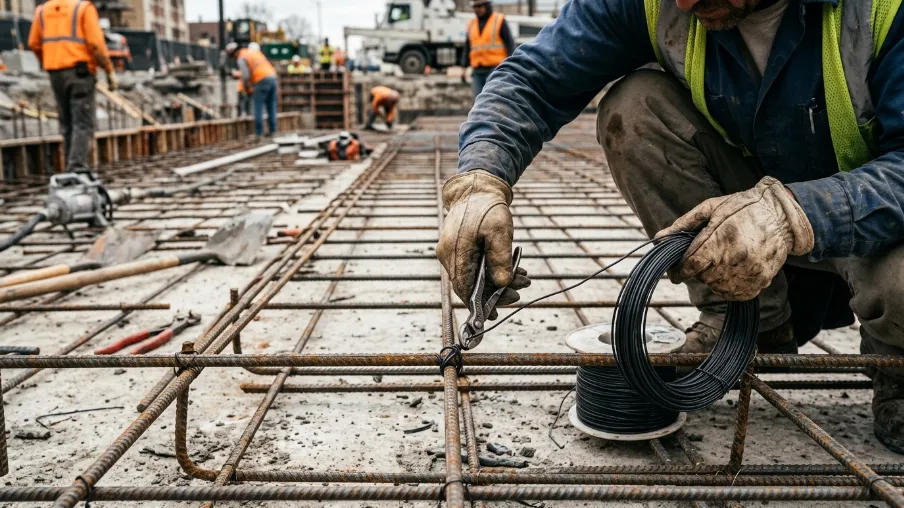
Tie wire is inexpensive relative to rebar or cement. However, its role in keeping reinforcement aligned has a direct effect on structural performance. If rebar shifts during pouring, because tie wire was too loose, too few ties were used, or the wire broke under tension, the concrete's reinforcement spacing changes.
In some cases, this can contribute to cracking or reduced load capacity in that section. Furthermore, evidence from general reinforced-concrete practice, including guidance referenced in the ACI 318 Building Code, suggests inspectors on larger commercial or government-funded projects routinely check tie wire quality and tying consistency.
This usually happens alongside rebar spacing and cover checks, though the exact inspection checklist varies by project and authority. On our own sites at Nusaiba Construction & Technology, this kind of quality control sits under our broader construction management service, which oversees material handling alongside site sequencing and safety.
Types of Tie Wire Used in Construction
Type | Key Feature | Best Suited For |
|---|---|---|
Black annealed wire | Soft, dark finish, low cost | General indoor construction, quick pours |
Galvanized wire | Zinc coating resists rust | Outdoor storage, monsoon-season projects |
PVC/epoxy-coated wire | Extra corrosion barrier | Marine structures, saline soil |
Stainless steel wire | High long-term corrosion resistance | Bridges, coastal infrastructure |
Black annealed tie wire is generally the default choice for most residential and commercial builds in Bangladesh. This is because it's affordable and easy to twist. Galvanized tie wire, on the other hand, costs more but typically resists rust better in humid conditions, since it goes through a zinc-coating process that forms a protective barrier over the steel.
For this reason, we tend to recommend galvanized tie wire for projects running through Bangladesh's monsoon season, when wire is often stored on-site for days or weeks before use.
Wire manufacturers generally reference standards such as ASTM A1064 for carbon-steel wire reinforcement and ASTM A641 for zinc-coated wire when specifying gauge, strength, and coating class. Meanwhile, coated and stainless steel tie wire are generally reserved for specialized environments, such as marine work, saline soil, or infrastructure meant to last decades.
Consequently, these types are less common in standard residential projects, mainly due to cost.
Tie Wire Gauge and Sizes
Gauge | Diameter (approx.) | Common Use |
|---|---|---|
14 gauge | 2.1 mm | Heavy-duty tying for large rebar or structural elements |
16 gauge | 1.6 mm | Standard residential and light commercial tying |
18 gauge | 1.2 mm | Lighter tying jobs, smaller rebar |
19 gauge | 1.0 mm | Fine tying, mesh work |
Gauge 16 tie wire, about 1.6 mm, is in most cases the size we see used most often in Bangladesh for foundations and columns. This is because it balances strength with flexibility.
Wire gauge numbering itself follows systems such as the Standard Wire Gauge (SWG), where a lower number generally means a thicker wire, the same logic used in most wire gauge charts worldwide. Thicker 14-gauge tie wire, meanwhile, is generally reserved for heavier structural elements.
By contrast, 18–19 gauge tie wire tends to suit lighter mesh or finishing work better. Overall, tie wire is typically sold in coils, commonly around 20–25 kg per roll, though roll size varies by supplier.
If you're budgeting a project and unsure how much tie wire or rebar you'll actually need, our estimation and quantity take-off service can work out material quantities before you order.
Common Mistakes to Avoid
Wrong gauge: thin wire on heavy rebar tends to loosen during pouring
Ignoring coating needs: black annealed wire left exposed to moisture can rust within 1–2 weeks in our observation, since annealed wire is generally more prone to rust than galvanized wire once exposed to the elements
Over-twisting: excess tension is a common cause of snapped thinner-gauge wire
Buying on price alone: lower-quality recycled steel wire appears, anecdotally, to break more easily under twisting
Poor storage: uncovered rolls generally lose corrosion resistance faster, even galvanized wire
Expert Tips for Selecting Tie Wire
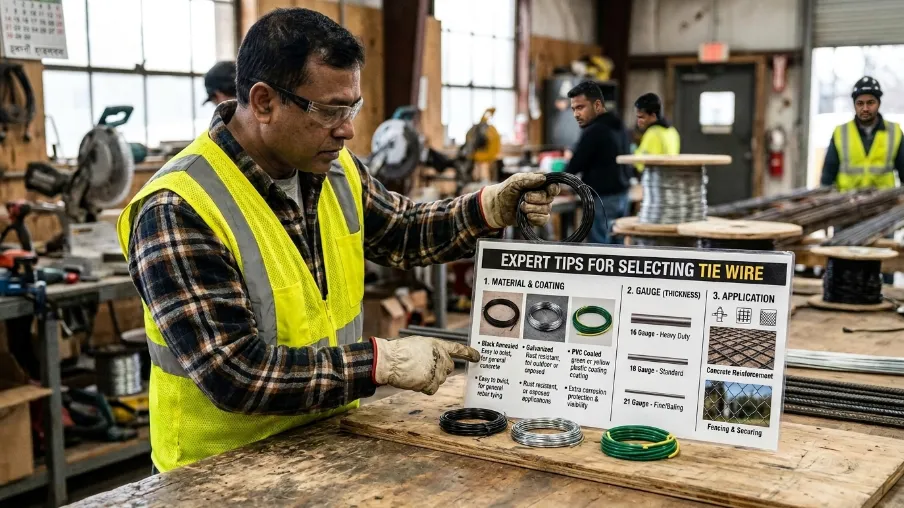
First, match the tie wire gauge to your rebar diameter. Heavier rebar generally needs 14–16 gauge tie wire for a secure hold, and your engineer's drawing and design specification should always take precedence over general guidance like this.
For projects running through Bangladesh's monsoon months, galvanized tie wire is usually worth the added cost over black annealed wire. This is based on what we've seen hold up better in covered versus exposed storage.
Also, confirm the steel grade with your tie wire supplier where possible, since lower-quality wire tends to snap under normal twisting pressure. In addition, store tie wire rolls covered and elevated off wet ground, even for short-term site storage.
Finally, for large-scale projects, a rebar-tying tool can noticeably cut labor time compared to manual twisting, though the time savings will depend on crew size and site layout, something a good project management plan accounts for upfront.
Case Study: Monsoon Storage Failure on a Dhaka Residential Project
Problem: On a mid-rise residential project in Dhaka, the kind of build our real-estate construction service handles regularly, the site team stored black annealed tie wire in an open shed during the rainy season, assuming it would be used quickly enough to avoid rust.
Approach: The wire sat in partially open storage for roughly two weeks while other site work (formwork, excavation) was completed ahead of the rebar-tying phase.
Result: By the time crews were ready to tie rebar, a visible portion of the coil had surface rust, and some sections were judged unusable for structural ties. The team switched to galvanized tie wire for the remaining floors and moved storage to covered, elevated racks for the rest of the project.
Lesson learned: In our experience, the tie wire type mattered less than the storage decision. However, choosing galvanized tie wire from the start, given the known monsoon timeline, would have avoided both the delay and the cost of the wasted coil. Therefore, we'd generally recommend planning your tie wire choice around storage conditions and pour schedule, not just around unit price.
Frequently Asked Questions
What is tie wire used for?
Tie wire is used to bind rebar together at intersection points, holding reinforcement bars in a fixed position before and during concrete pouring so they stay aligned as designed.
What is tie wire made of?
Tie wire is typically made from low-carbon mild steel that has been annealed for flexibility. Some types are additionally galvanized (zinc-coated) or plastic-coated for extra corrosion resistance.
What gauge tie wire should I use for standard construction?
Gauge 16 tie wire, about 1.6 mm in diameter, is generally the most common choice for residential and light commercial rebar work in Bangladesh, though your engineer's specification should take precedence.
Is galvanized tie wire better than black annealed wire?
Galvanized wire generally resists corrosion better and tends to suit humid or outdoor storage conditions. Black annealed wire is cheaper and typically works fine for quickly-poured indoor projects where long storage isn't a factor.
How long does tie wire last before rusting?
Based on our site observations, uncoated black annealed wire can show surface rust within about 1–2 weeks if exposed to humidity or rain. Galvanized wire typically resists rust for a noticeably longer period under similar conditions, though exact timelines vary.
Can tie wire replace welding for rebar joints?
Yes, in most cases. Tie wire is the standard method for securing rebar joints and is generally preferred over welding, since welding can weaken the rebar's structural properties at the joint.
How much does a roll of tie wire typically weigh?
Tie wire is commonly sold in coils, often around 20–25 kg per roll, though exact roll size and weight vary by supplier and gauge, so check with your supplier for their specific packaging.
Where can I buy quality tie wire in Bangladesh?
Tie wire is available through construction material suppliers and hardware stores across Bangladesh. We'd generally recommend buying from a supplier who can confirm the steel grade and gauge accuracy rather than choosing on price alone, or you can get in touch with our team at Nusaiba Construction & Technology directly for sourcing help.
Which Tie Wire Should You Choose?
To answer the question this tie wire guide set out to resolve: for most standard residential and light commercial projects in Bangladesh, gauge 16 black annealed tie wire is the practical default.
It's affordable, easy to twist, and sufficient when concrete is poured soon after tying. However, if your project runs through the monsoon season, involves outdoor storage, or sits in a humid or coastal area, galvanized tie wire is generally the better choice despite the higher cost, since it resists the rust that can compromise joint strength.
For specialized environments, such as marine structures, saline soil, or infrastructure meant to last decades, coated or stainless steel tie wire is the better call instead.
In short, match the tie wire gauge to your rebar size: 14–16 gauge for heavier bars, 18–19 gauge for lighter mesh work. Then, match the tie wire coating to your storage and climate conditions, and buy from a supplier who can confirm the steel grade.
Ultimately, that combination is what determines whether your tie wire does its job, keeping reinforcement exactly where it's engineered to be, for the life of the pour.
Sources and References
Bangladesh Standards and Testing Institution (BSTI): Bangladesh's national standards and testing body
BSTI ISO member profile: BSTI's role as Bangladesh's ISO member body
ASTM A1064/A1064M: Standard Specification for Carbon-Steel Wire and Welded Wire Reinforcement for Concrete
ASTM A641/A641M: Standard Specification for Zinc-Coated (Galvanized) Carbon Steel Wire
Wire Reinforcement Institute Technical Resources: industry technical guidance on wire reinforcement
ACI 318 Building Code Portal: American Concrete Institute's structural concrete code requirements
OSHA: Impalement Hazards from Rebar: U.S. federal safety standard interpretation for exposed rebar
Weekly Safety: Handling Impalement Hazards on Construction Sites: practical overview of rebar site safety requirements
Wikipedia: Rebar: general reference on reinforcing bar and reinforced concrete
Wikipedia: Annealing (materials science): heat-treatment process used to soften tie wire
Britannica: Galvanizing: overview of the zinc-coating process used for galvanized wire
Wikipedia: Wire gauge: general reference on wire gauge measurement systems
Wikipedia: Standard Wire Gauge (SWG): reference for the gauge numbering convention used for tie wire
Metal Supermarkets: What is Rebar?: general industry reference on rebar and reinforcement
Vulcan Wire: Annealed Wire vs. Galvanized Wire: comparison of corrosion behavior between wire types
Buyabeam: An Introduction to Steel Reinforcing Bar (Rebar): general reference on rebar types and applications
.webp&w=256&q=75)