
Tips for Efficient Process Planning and Cost Estimation
.webp&w=96&q=75)
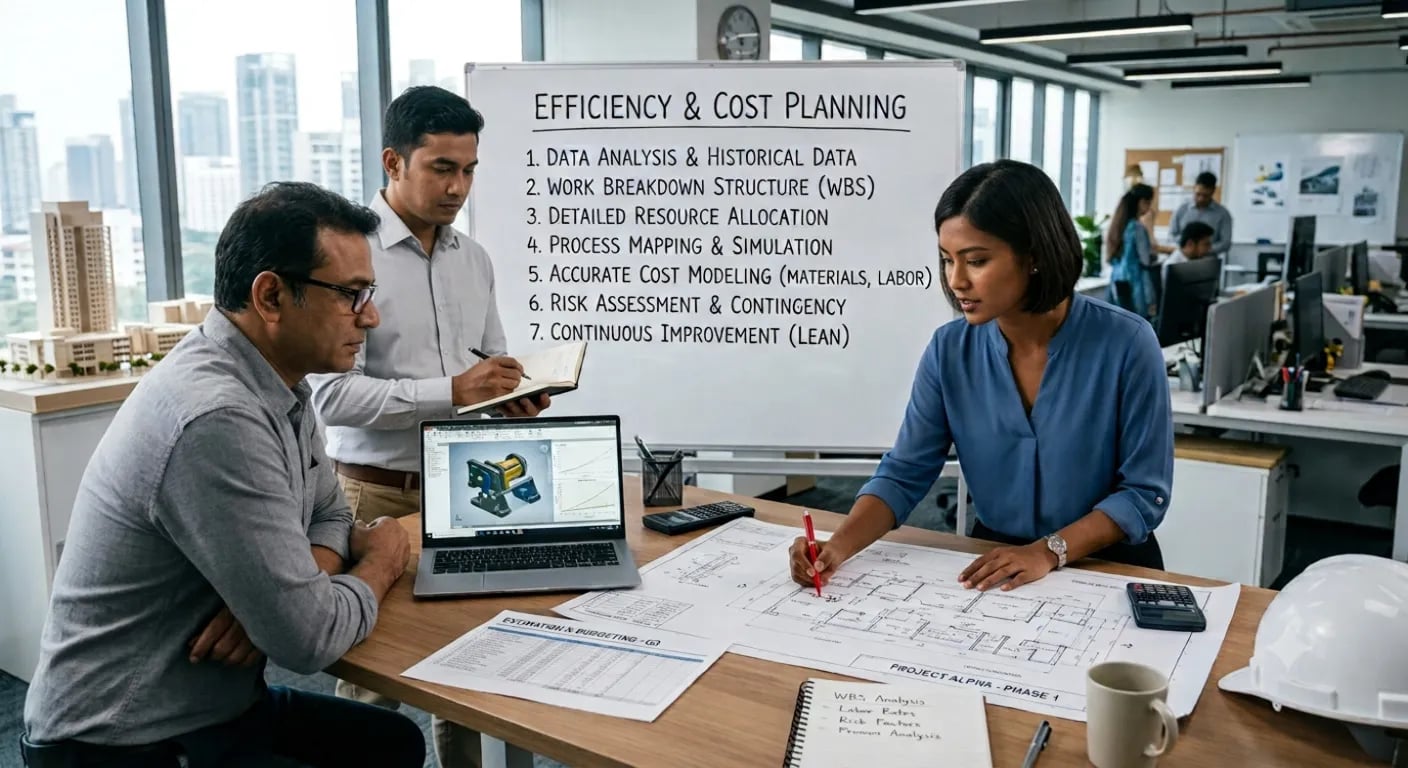
Quick answer: Efficient process planning and cost estimation means breaking a project into clear steps, pricing each one realistically, and adding a contingency buffer, usually 10–15%, before work begins. Done well, it keeps your final spend close to your original budget.
Efficient process planning and cost estimation means mapping every phase of a project, including labor, materials, equipment, and time, before work begins. It's the difference between the budget you set and the one you actually keep. In my experience at Nusaiba Construction & Technology, this one discipline separates projects that finish on schedule from ones that quietly bleed money for years.
That gap isn't theoretical. Public infrastructure projects in Bangladesh have a well-documented history of running over budget, even as World Bank investment keeps growing. The cause is almost always weak planning at the start, not bad luck later.
This guide covers what process planning and cost estimation involve, practical project planning tips, common cost estimation methods, why Bangladeshi projects often struggle here, and the steps that actually hold up on site.
Key takeaways:
Process planning defines what happens and when; cost estimation defines how much it costs.
Most cost overruns in Bangladesh trace back to weak preparation, not bad luck: design changes, delayed mobilization, and poor coordination are the top drivers.
A 10–15% contingency buffer is standard practice in project budgeting for absorbing price and schedule shocks, and it's a core part of ongoing cost control.
Estimates should be revisited at every major milestone, not just when something goes wrong.
What Is Process Planning and Cost Estimation?
Process planning is the set of decisions that turn a project idea into an executable plan, and it sits at the core of any project management process. It covers what tasks happen, in what order, with which resources, and over what timeframe. Efficient process planning and cost estimation help teams organize these decisions while keeping the project on schedule and within budget.
Cost estimation, whether called project cost estimation on a factory build or construction cost estimation on a building site, puts a realistic price tag on each of those tasks: labor, materials, equipment, permits, and contingency.
Think of process planning as the "how and when." Cost estimation is the "how much." They aren't separate exercises done one after another. Done well, efficient process planning and cost estimation inform each other constantly. A schedule that ignores material lead times will fall apart. So will a budget that ignores seasonal labor rates.
How Does It Work in Practice?
A working process plan usually moves through these stages:
Scope definition: decide exactly what is and isn't included.
Task breakdown: split the scope into a work breakdown structure (WBS), a concept formalized in globally recognized frameworks like the PMI's PMBOK Guide. It's just a list of the discrete activities needed to deliver the project.
Resource mapping: assign labor, machinery, and materials to each task. This is the heart of resource planning.
Sequencing and scheduling: order tasks based on dependencies, which is what project scheduling and project timeline planning really come down to. You can't pour a slab before the formwork is set.
Cost estimation: price each task using historical data, supplier quotes, or standard rate tables. These cost estimation methods are what you rely on when estimating project costs at any stage of development.
Contingency and risk buffer: add a margin for the things that will inevitably go wrong, which is the practical side of risk management in projects.
I found that skipping step 6 is one of the most common mistakes on projects here. It's also one of the most expensive. Without a buffer, even a small price swing forces a mid-project budget revision.
Why Does Efficient Process Planning and Cost Estimation Matter?
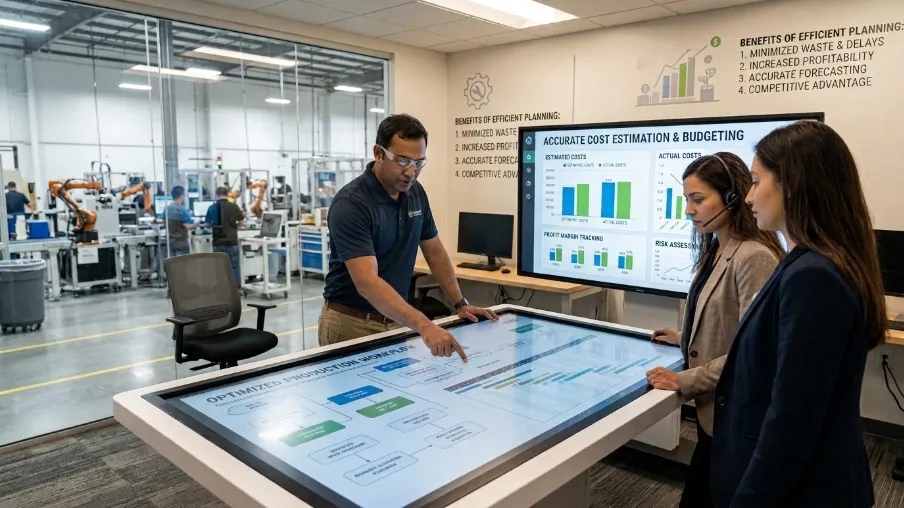
Poor planning shows up later as cost overrun. Bangladesh has real numbers that show the scale of the problem. One analysis of 92 completed public infrastructure projects found that, on average, projects experienced significant cost and time overruns, with time overrun far outpacing cost overrun in many cases, according to a study published by the Bangladesh Civil Service Administration Academy (BJAM)
Using data from the Implementation Monitoring and Evaluation Division (IMED). In more extreme cases, the gap can be dramatic. According to reporting by The Daily Star, one Bangladesh Railway station project saw costs escalate to more than double the original estimate after nearly a decade of delay, and a separate rail-line project ended up costing 260 percent more than planned.
Similar patterns show up outside road and rail projects too. Academic research from Abertay University on high-rise building construction in Bangladesh found that schedule delays, rather than cost, were often the more severe problem, though the two are closely linked in practice.
Academic research backs this up. A study of road transportation projects in Bangladesh, published in the Journal of Bangladesh Studies, identified frequent design changes, delays in site mobilization, poor stakeholder coordination, insufficient project preparation, and governance issues as the top drivers of cost overrun. Nearly all of these trace back to weak planning before the project even broke ground.
There's a broader cost story too. Reporting by The Business Standard on regional infrastructure spending found that building a four-lane urban arterial road in Bangladesh costs 4.4 times more than an equivalent road in India.
Analysts attribute part of that gap to planning and process inefficiencies, not just material costs. This pattern is also discussed in New Age's coverage of Bangladesh's abnormally high per-kilometre construction costs compared with neighboring countries.
Meanwhile, day-to-day cost pressure keeps building: the Bangladesh Bureau of Statistics recorded, as reported by The Daily Star, construction costs rising by 6.98 percent in a single month, driven by materials, transport, and labor charges. That's a reminder that estimates from even a few months ago can already be out of date.
Strong project cost management, paired with process optimization at each phase of construction planning, is usually what closes this gap between the original budget and the final bill.
Benefits and Challenges
When I work on a construction project, I have found that efficient process planning and cost estimation do much more than create a budget. They help me make better decisions, keep the project organized, and reduce costly surprises before construction even begins.
Benefit | What It Looks Like |
|---|---|
Predictable cash flow | You know what to pay, and when, weeks in advance |
Fewer disputes | Contractors and clients agree on scope before work starts |
Better resource use | Labor and equipment aren't idle or double-booked |
Early risk detection | Problems surface on paper, not on-site |
Common challenges include volatile material prices and seasonal labor availability, especially around monsoon season. Import dependency for equipment is another. So is a tendency to revise scope mid-project, as the research above shows.
Good budget planning and consistent project resource management help absorb these shocks, though cost control still requires ongoing attention rather than a one-time fix.
Practical Steps for Efficient Planning and Estimation
The planning and estimation techniques below focus on what actually holds up once a project is underway, not just what looks good on paper:
Start with a detailed work breakdown structure: Vague task lists lead to vague estimates.
Use historical cost data where you have it: Past project records, even rough ones, beat guesswork.
Get multiple supplier quotes for materials and equipment: Prices shift quickly, and one quote is a snapshot, not a benchmark. This is also where working with a dedicated estimation and quantity take-off service from a team like Nusaiba Construction & Technology can save time and reduce guesswork.
Build in a contingency of 10–15%: In my experience, projects without a buffer almost always need one anyway, just later and under pressure.
Separate labor, material, and equipment costs clearly: Keeping material cost estimation, labor cost estimation, and equipment cost estimation as distinct line items makes it far easier to spot where an overrun is actually coming from.
Review the schedule against resource availability, not just task logic, as part of ongoing project resource management. A perfect sequence on paper can stall if labor or machinery isn't actually free that week.
Revisit estimates at fixed checkpoints, not only when something goes wrong.
Efficient Process Planning and Cost Estimation: A Real-World Example
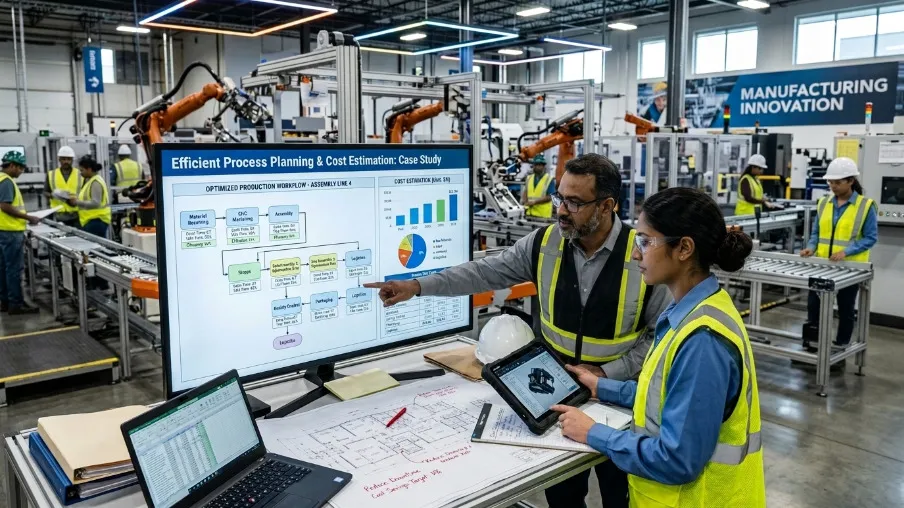
Here's a scenario I've seen play out on residential construction projects in Bangladesh. It's a composite example, not a single named project:
Situation: A mid-rise residential build in Dhaka had its budget locked six months before groundbreaking, based on material prices at the time.
Problem: By the time excavation started, rebar and cement prices had risen enough to eat into the margin on the structural phase. This matches the Bangladesh Bureau of Statistics' own tracking of month-to-month construction cost increases.
Solution: The project team split the remaining budget into two groups: locked-in items (already contracted) and float items (not yet purchased). They re-quoted the float items at current supplier rates instead of the original estimate.
Result: The revised estimate absorbed most of the increase within the existing contingency. No formal budget revision was needed.
Lesson: Locking an entire budget to prices from months earlier is risky when costs move this fast. Splitting estimates into "locked" and "floating" categories, then re-pricing the floating portion close to purchase time, is one practical way to keep accurate cost estimation intact and catch price movement before it becomes a crisis.
This is one illustrative pattern, not a universal fix. Projects with longer lead times or fixed-price contracts may need a different approach.
Common Mistakes I've Seen
Treating the initial estimate as final rather than a living document.
Underestimating site mobilization time, which the road-project research flagged as a top cost driver.
Skipping stakeholder sign-off before locking the budget, which invites scope changes later.
Ignoring seasonal effects on labor and transport costs.
Failing to separate design changes from the original scope, which hides where cost is actually escalating from.
Overlooking simple cost-saving strategies, like staged procurement, during project execution planning, which leaves money on the table even when the original estimate was accurate.
Expert Tips
From working around similar projects, a few habits consistently pay off. Estimate in ranges, not single numbers. This lines up with how bodies like AACE International classify estimate accuracy by project maturity rather than treating every estimate as equally precise. Document every assumption behind the estimate so it can be revisited later.
Treat the planning phase as a stakeholder alignment exercise, not just a spreadsheet exercise. Coordination gaps, not calculation errors, are usually what actually blow budgets, and closing those gaps does more for overall project efficiency than any single software tool.
Efficient Process Planning and Cost Estimation: Future Trends
Digital estimation tools and Building Information Modeling (BIM) are gaining traction in Bangladesh's construction sector, part of a broader shift toward modern construction methods that market research from Mordor Intelligence projects will keep growing through the rest of the decade.
These tools generally make it easier to link scheduling and costing in one model instead of two separate documents, borrowing workflow planning and production planning ideas that manufacturing has used for years. Adoption is still uneven, especially outside large firms.
For now, pairing digital tools with strong manual review, and grounding contingency decisions in established guidance such as AACE International's recommended practice on estimate accuracy, remains the sensible approach.
Limitations and Different Viewpoints
No efficient process planning and cost estimation method removes risk entirely. Here are a few honest caveats to keep in mind:
Contingency percentages and estimation methods that work for a mid-size residential build may not fit large public infrastructure projects. Those projects involve different governance, procurement, and approval processes.
Some practitioners believe heavy upfront planning can slow down small or fast-moving projects more than it helps. For a short renovation or minor construction job, a simpler approach to efficient process planning and cost estimation may be more practical.
Much of the Bangladesh-specific research focuses on public infrastructure and road projects. Private residential and commercial developments may face different challenges, even though poor planning remains a common reason for cost overruns and delays.
Digital tools such as BIM can improve the accuracy of efficient process planning and cost estimation, but they cannot replace practical site experience. Even the best model will produce unreliable estimates if it is built on incorrect assumptions.
In short, use these practices as a reliable starting framework rather than a guarantee of success. The most effective efficient process planning and cost estimation approach is the one that matches your project's size, complexity, and level of risk.
Frequently Asked Questions About Efficient Process Planning and Cost Estimation
What is the difference between process planning and cost estimation? Process planning defines what tasks happen and in what order. Cost estimation assigns a realistic price to each task. They work together: a schedule without cost data, or a budget without a sequence, is incomplete on its own.
How accurate should a construction cost estimate be?
Early-stage estimates are typically accurate within 15–25%. This tightens to 5–10% as designs finalize. Treat early figures as planning tools, not fixed promises.
Why do construction projects in Bangladesh often go over budget?
Research points to design changes, delayed site mobilization, weak stakeholder coordination, and insufficient upfront preparation as the most common causes, more so than raw material price increases alone.
How much contingency should I add to a project budget?
A common range is 10–15% of the total estimate, though higher-risk or longer-duration projects may warrant more.
What's the best method for estimating material costs?
The most reliable method combines current supplier quotes with historical price trends, rather than relying on either alone. This matters especially in Bangladesh, where material prices can shift by several percentage points within a single month.
Can process planning reduce project risk?
Yes. Mapping dependencies and resource needs in advance surfaces conflicts, like overlapping equipment needs or unrealistic timelines, while they're still cheap to fix on paper.
How does this fit into broader construction project management?
Process planning and cost estimation are two of the core building blocks of construction project management, alongside scheduling, quality control, and stakeholder communication. Strong project cost estimation at the start makes every later stage of construction project management easier to run.
What does efficient process planning and cost estimation actually involve?
It involves breaking a project into a clear sequence of tasks, assigning realistic labor, material, and equipment costs to each one, and adding a contingency buffer before work starts. Done consistently, it's what keeps a project's actual spend close to its original budget.
How often should cost estimates be updated?
At minimum, at every major milestone or whenever scope changes, rather than only when a problem has already appeared.
Conclusion
Getting efficient process planning and cost estimation right isn't about predicting the future perfectly. It's about building a plan detailed enough, and a budget honest enough, that surprises stay small instead of turning into a crisis six months in. The projects that consistently finish close to budget in Bangladesh aren't the ones that got lucky with prices.
They're the ones that broke the work down properly, priced it realistically, and left room for the inevitable. Whether you're planning a single building or a multi-phase infrastructure project, working with an experienced Estimation and Quantity Take-Off team from the planning stage is what actually protects your budget and your timeline.
Sources and References
A Study of Cost Overrun in Road Projects in Bangladesh, Journal of Bangladesh Studies
Analysis of Cost and Schedule Performance of Infrastructural Projects, BJAM
Time and Cost Overruns on High-Rise Building Construction in Bangladesh, Abertay University
Bangladesh Construction Market Overview, Mordor Intelligence
"13 Railway Projects: Cost Overrun up to 260pc", The Daily Star
"Construction Costs in Bangladesh 4 Times Higher Than India", The Business Standard
"Abnormal Construction Costs Continue to Bleed Economy", New Age
AACE International – Guide to Cost Estimate Classification Systems
.webp&w=256&q=75)