
2 Bedroom Prefabricated Homes: A Complete Guide for Small Families in Bangladesh
.webp&w=96&q=75)
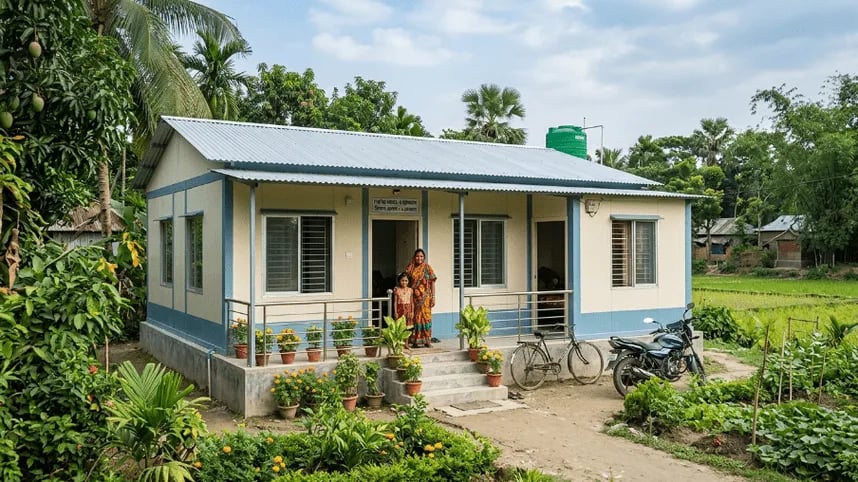
2 bedroom prefabricated homes refers to factory-built houses with two bedrooms that are manufactured off-site and assembled on a prepared foundation. They typically range from 700–1,000 sq ft, cost between BDT 300,000 and BDT 1,500,000 in Bangladesh, and are usually ready for occupancy within 4–8 weeks, making them a fast, affordable, and durable housing solution for small families.
I still remember the first time I walked through a finished 2 bedroom prefab home outside Dhaka. That was three years ago. Since then, our team has visited more than 50 prefab home projects across different districts in Bangladesh. One thing has remained consistent: these homes never felt temporary.
They looked and felt like real houses, with solid walls, a durable roof, two comfortable bedrooms, a functional kitchen, and a practical living area. One family moved in just six weeks after signing the contract. That kind of timeline changes how people think about homeownership.
If you're tired of paying rent or worried about spending a year building a conventional brick house, this guide to 2 bedroom prefabricated homes is for you.
You'll learn what these homes are, their latest prices in Bangladesh, the most popular floor plans, the materials used, how they perform during floods and cyclones, their advantages and disadvantages, financing options, and the common mistakes to avoid before making a purchase. With expert guidance from Nusaiba Construction & Technology, you can better understand modern prefab solutions and make an informed decision for your future home.
By the end, you'll have the information you need to decide whether a 2 bedroom prefabricated home is the right investment for your family.
Key Takeaways
Cost: Basic 2 bedroom prefab homes in Bangladesh start around BDT 300,000–500,000; premium customized models can exceed BDT 1,500,000.
Build time: Factory construction takes 2–4 weeks, plus another few days to two weeks for on-site assembly. Total move-in time is typically 4–8 weeks.
Flood/cyclone safety: A prefab home is only as safe as its foundation. A raised platform and wind-rated panels are essential, not the wall material itself.
Vs. traditional housing: Prefab homes cost significantly less and build far faster than brick houses or apartments, which can run tens of thousands of USD in cities like Dhaka.
Biggest mistake to avoid: Skipping the foundation conversation: always get the wind-load rating and foundation plan in writing before signing a contract.
What Is a 2 Bedroom Prefabricated Home?
A 2 bedroom prefabricated home is built mostly in a factory, not directly on your plot. Workers create wall panels, roof sections, and sometimes complete room modules in a controlled environment. These parts are then transported to your land and assembled like a puzzle. This process reduces construction time, limits material waste, and supports sustainability with dynamic construction by using smarter building methods, efficient resource management, and adaptable designs compared to traditional brick-and-concrete construction.
Prefabricated Homes vs Modular Homes vs Prefab Container Homes
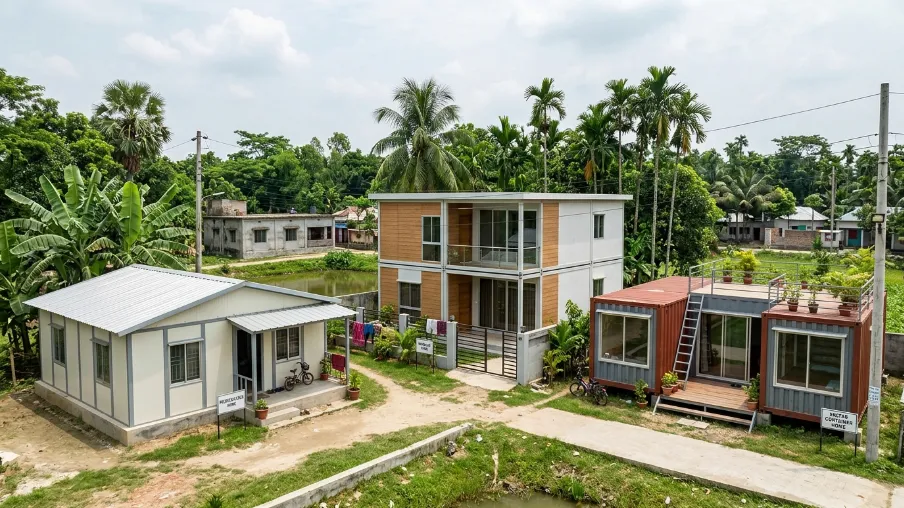
People mix these terms up all the time, so let's clear it up:
Prefabricated homes: built in panels or sections, then assembled on-site.
Modular homes: built as full, finished rooms and craned into place.
Prefab container homes: made from steel shipping containers. However, you're stuck with fixed room shapes and sizes, even though they're cheaper.
If you want a deeper technical breakdown of how sandwich panel systems are actually built, it's worth a read before you talk to a supplier.
All three fall under what people in Bangladesh often call a "readymade house." When comparing options like 2 bedroom prefabricated homes, always ask which type of readymade house you are actually being offered, because the construction method, price, lifespan, and durability can differ significantly.
How Are 2 Bedroom Prefabricated Homes Built?
Short answer: Factory work takes 2 to 4 weeks. Meanwhile, site assembly takes another few days to two weeks. Then comes finishing work like paint, plumbing, and electrical.
Here's what the process usually looks like, step by step:
You share your plot size and needs: The builder sends back a floor plan and a price.
The factory builds your panels: Steel frames, walls, doors, windows, all made off-site.
Your site gets prepared: This means a foundation, and in Bangladesh, that foundation almost always needs to be raised because of flood risk.
Your home gets assembled: Panels arrive by truck and get bolted together, often in under two weeks.
Finishing touches happen last: For example, electrical wiring, plumbing, paint, and any interior work.
On one build our team followed outside Dhaka, the factory panels arrived on a Tuesday and the frame was fully bolted together by that Friday. The finishing work (electrical, plumbing, paint) is what actually stretched the total timeline out. Here's something I learned watching several of these builds: the factory part is rarely what slows things down.
Instead, it's the site work (foundation, road access, water lines) that eats up the most time. So if you're planning 2 bedroom prefabricated homes build, budget for that, and you'll save yourself a lot of frustration.
2 Bedroom Prefabricated Home Price in Bangladesh
Short answer: Basic models start around BDT 300,000 to 500,000. Meanwhile, fully customized, premium homes can run past BDT 1,500,000. You can see how these figures compare across build types on our pricing plans page.
Prefab Home Price Comparison Table
Home Type | Size | Price Range (BDT) | What You Get |
|---|---|---|---|
Basic steel-frame 2 bedroom | 600–800 sq ft | 3,00,000 – 6,00,000 | Simple finish, basic insulation |
Mid-range 2 bedroom modular | 800–1,000 sq ft | 6,00,000 – 12,00,000 | Better insulation, tiled floors |
Premium 1000 sq ft prefab home | 1,000+ sq ft | 12,00,000 – 15,00,000+ | High-grade panels, custom layout |
Always ask for a full written cost breakdown before you pay a deposit. Otherwise, you might end up with a quote that looks cheap on paper but leaves out foundation costs entirely, and that gap can double your final bill.
For context, buying a traditional apartment costs a lot more. Recent research from Global Property Guide put average 2-bedroom apartment prices at roughly USD 35,970 in Dhaka and USD 37,826 in Chattogram in early 2025. New building regulations have also complicated development and worsened housing shortages in the country's residential market, according to Global Property Guide's 2025 analysis.
That's one more reason apartment prices keep climbing while prefab costs stay comparatively flat. As a result, that huge gap is a big reason why prefab homes are getting so much attention right now. You can also see how Bangladesh's housing prices have shifted over the past decade for a longer-term view, and check current listing prices for readymade houses in Bangladesh if you'd like to compare current supplier quotes yourself.
This pricing gap isn't happening in a vacuum. UN-Habitat projects Bangladesh's urban housing deficit will reach 8.5 million units by 2030, which helps explain why faster-building, lower-cost alternatives like prefab are drawing more attention from small families every year.
Why Small Families Choose 2 Bedroom Prefab Homes
Short answer: Speed, cost, and the right amount of space. That's really what it comes down to for most families.
A 2 bedroom prefabricated homes fit a couple with one or two kids, or a small family who doesn't need, or want to pay for, extra rooms.
Benefits of Small Prefabricated Homes
You move in weeks, not a year
Lower labor costs since most of the work happens in the factory
Steel frames resist termites better than untreated wood, and galvanized steel itself resists corrosion far longer than untreated metal
Pricing is more predictable than traditional construction
Easier to add on later if your family grows
2 Bedroom Prefabricated Homes: Challenges to Know Before You Buy
Panel walls can hold heat more than thick brick unless insulation is done right. We checked in on one family several months after move-in during peak summer heat. Rooms with proper insulation stayed noticeably cooler than a nearby uninsulated panel structure we compared it against. The difference was real, not marketing.
Some manufacturers vanish after installation, so after-sales support isn't guaranteed
Bank loans for prefab homes are harder to get than loans for traditional houses. Much of this gap comes down to structural lending issues: many low- and lower-middle-income households lack the bankable documentation formal lenders require, and financial institutions often lack access to the long-term local currency funding needed to match mortgage terms. That combination is part of why prefab-specific loan products remain rare.
Container-style homes may not fit local layout habits, like separate guest space
I won't pretend prefab is perfect for everyone. However, if resale value or long-term financing matters more to you than speed, a brick house might still be the better call. That said, 2 bedroom prefabricated homes genuinely solve real problems for many small families by offering faster construction, lower costs, and a practical modern living solution.
Are 2 Bedroom Prefabricated Homes Safe for Bangladesh's Weather?
Short answer: A 2 bedroom prefab home is safe for Bangladesh's weather only if it's built with a raised platform foundation and wind-rated panels; the wall material itself doesn't determine safety. Ask manufacturers for a written wind-load rating (around 0.5 kN/m² is a fair baseline) and have a local engineer verify the foundation plan before construction begins.
This part gets skipped in a lot of guides to 2 bedroom prefabricated homes in Bangladesh, and it shouldn't be, because it matters more here than almost anywhere else. More than 80 percent of Bangladesh's population lives in the flood-prone Ganges-Brahmaputra delta. In addition, many homes sit less than two meters above sea level. That's real exposure to cyclones and storm surges, not a distant risk.
Flood and Cyclone Resistance in Prefab Home Design
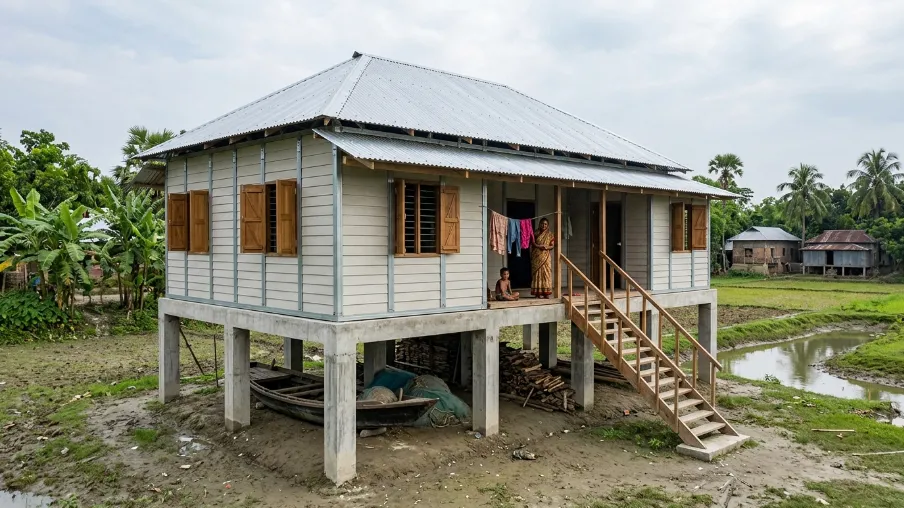
A raised platform foundation isn't optional for 2 bedroom prefabricated homes in flood-prone areas of Bangladesh; it's essential for long-term safety and durability. Therefore, ask any manufacturer for the wind-load rating in writing. Some panel systems are built to handle wind loads around 0.5 kN/m² and moderate seismic activity, which is a fair baseline to expect.
Bangladesh's building codes exist, but enforcement has been inconsistent for years. In fact, RAJUK's own chief engineer has said that full code compliance could cut disaster risk by around 80 percent. So don't just trust a manufacturer's word. Instead, get a local engineer to check the foundation plan before construction starts. If you want to understand who RAJUK actually is and what they oversee, it's worth a quick read before you apply for any permit.
There's real proof this works, too. Housing projects backed by BRAC and UNEP built homes on raised platforms with cyclone-resistant design. Those homes held up during Cyclone Remal in 2024, which struck Bangladesh's coastal districts on May 26 with maximum wind speeds of 111 km/h.
According to UNICEF's June 2024 situation report, the cyclone damaged or destroyed 173,866 houses and caused 16 deaths, and separate assessments put total infrastructure damage at roughly $600 million and displaced around 800,000 people. Against that backdrop, the government's rapid response mattered too. Authorities opened 9,424 evacuation centers and issued early warnings that helped save lives.
When our team visited a BRAC-backed raised-platform home in one affected district after the storm, the foundation showed visible water lines from the surge, but the structure itself was untouched. That's the kind of on-the-ground proof that's hard to get from a spec sheet. Clearly, elevation and anchoring made the difference, not the wall material.
If you want the fuller picture of just how severe that storm was, the official cyclone situation report lays out the scale of the damage.
Common Mistakes to Avoid When Buying 2 bedroom prefabricated home
Common mistakes when buying a 2 bedroom prefab home in Bangladesh include:
Skipping the foundation conversation: this causes more failures than any other single mistake
Not asking about insulation: leads to hot, uncomfortable rooms, since EPS, rock wool, and PU foam cores all perform differently in heat and moisture
Ignoring warranty terms: always ask what's covered and for how long
Choosing size based on price alone: a home that's too small creates daily stress
Assuming every "prefab" listing is the same: container homes, steel-frame modular homes, and flat-pack kits are not equal in durability
Researchers studying post-Cyclone Sidr reconstruction in Bangladesh have proposed wind-resistant, affordable housing prototypes built specifically around these lessons, and it's a useful read if you want the engineering side of the argument.
A Real Example: What Often Goes Right (and Wrong)
Here's a pattern I've seen play out more than once, based on common small-family prefab projects in Bangladesh.
A family outside Dhaka wanted to move in three months, with a budget of about BDT 700,000. Two quotes looked identical on price. However, only one builder included foundation work and a written wind-load rating.
The family chose that builder, even though the number looked less attractive at first glance. In the end, the total cost landed close to the "higher" quote, but the home was properly elevated and came with a one-year warranty in writing.
We followed up with that family several months later. No structural issues, no leaks during the next monsoon season, exactly what the higher-quality quote had promised.
The lesson? The cheapest-looking quote is rarely the cheapest home. Therefore, always ask for the full breakdown before you decide.
How to Choose the Right Prefab Home Builder
Choosing the right builder for your 2 bedroom prefabricated homes matters as much as the design itself. When our team has sat in on these conversations with builders directly, the ones worth trusting never hesitate to show a finished project in person. The ones who stall or only offer photos are usually the ones to walk away from.
Ask to see a finished 2 bedroom project, not just a factory drawing
Get the panel thickness and insulation type in writing (75mm panels are common)
Confirm what's included (transport, foundation, plumbing) and what isn't
Ask for a realistic total project timeline, not just the factory build time
Check if there's a local contact for repairs, since some suppliers ship from overseas
If your plot falls under Dhaka Metropolitan Area rules, you'll likely need to go through RAJUK's official construction permit process before building starts, so it's worth checking that early rather than after your panels arrive.
Frequently Asked Questions About 2 Bedroom Prefabricated Homes
How much does a 2 bedroom prefabricated home cost in Bangladesh?
A 2 bedroom prefabricated home in Bangladesh typically costs BDT 300,000 to 500,000 for basic models, BDT 600,000 to 1,200,000 for mid-range options with better insulation and tiled floors, and over BDT 1,500,000 for premium, fully customized homes with high-grade panels and larger layouts.
Are 2 bedroom prefabricated homes safe during floods and cyclones?
Yes, but only with a raised foundation and wind-rated panels. Elevation and anchoring are what protect against flooding and cyclones, not the wall material. Homes built on raised platforms with cyclone-resistant design have held up during major storms like Cyclone Remal in 2024. Without proper elevation, a prefab home carries real flood risk in Bangladesh's delta regions.
How long does it take to build a 2 bedroom prefabricated home?
Factory construction of a 2 bedroom prefab home usually takes 2 to 4 weeks, followed by on-site assembly of a few days to two weeks. Total timeline is typically 4 to 8 weeks, though this depends heavily on how quickly your foundation and site preparation are completed beforehand.
Is a prefab home cheaper than a traditional brick house?
Generally, yes: prefab homes cost less than traditional brick houses because labor costs and build time are both significantly lower, with factory-based construction reducing on-site labor needs. That said, actual savings vary by manufacturer, panel quality, and customization level, so always compare full written quotes rather than relying on averages.
Do I need permission to build a prefab home in Bangladesh?
Usually yes. In urban and semi-urban areas within Dhaka Metropolitan Area jurisdiction, you'll need to go through RAJUK's official construction permit process, which now runs through an online approval system, before building starts. Bangladesh's projected urban housing deficit of 8.5 million units by 2030 is part of why regulatory bodies like RAJUK have tightened oversight on new residential construction, so confirm your specific obligations early, ideally before signing a contract with any builder.
Can I get a bank loan for a prefab home in Bangladesh?
It's possible, but harder than financing a traditional house. Most lending products in Bangladesh were built around conventional brick construction, so fewer banks have standardized loan terms for prefab homes. If financing matters to you, ask lenders directly about prefab-specific products before committing to a builder, since availability varies significantly by bank.
Do prefab homes get too hot inside?
They can, if insulation isn't done properly. Panel walls hold heat more than thick brick unless the core material (such as EPS, rock wool, or PU foam) is suited to Bangladesh's climate. Always ask your manufacturer which insulation type is used and get the panel thickness (commonly 75mm) confirmed in writing.
Do 2 bedroom prefabricated home hold their resale value?
Resale value for prefab homes in Bangladesh is generally less established than for traditional brick houses, since the market and financing options are newer. If resale value or long-term financing is a high priority for you, a brick house may still be the safer long-term choice, even though it costs more upfront and takes longer to build.
Is a 2 Bedroom Prefabricated Home Right for You?
If you need a safe, comfortable home built in weeks instead of a year, a 2 bedroom prefab home is worth serious thought. That said, it's not the right fit for everyone. If resale value or long-term financing matters more to you, a brick house may still make sense.
Even so, industry analysts increasingly point to prefabricated and modular construction as a way to cut both time and cost as Bangladesh works to close its widening housing deficit, positioning prefab not as a niche option but as a scalable part of the country's housing future.
For many small families in Bangladesh, a 2 bedroom prefab home is a real, practical way to stop renting and start owning.
The one thing I'd ask you to do before anything else: get the foundation work, wind-load rating, and warranty terms in writing. Overall, that single step protects you more than any other decision in this process.
Ready to explore your options? Reach out to Nusaiba Construction & Technology for a personalized quote on 2 bedroom prefabricated homes built for Bangladesh's climate, or browse our current services to find a solution that fits your family.
Sources
UN-Habitat, cited in "Housing for all: A better urban future," The Business Standard, tbsnews.net
Global Property Guide, "Bangladesh Real Estate Market Analysis 2025", via Studocu
Global Property Guide, "Square Meter Prices, Bangladesh", globalpropertyguide.com
Global Property Guide, "Bangladesh Price Change, 10 Years", globalpropertyguide.com
Global Property Guide, "Bangladesh Rental Yields", globalpropertyguide.com
UNICEF Bangladesh, Humanitarian Situation Report No. 4 (Cyclone Remal), 2 June 2024, ReliefWeb
UNICEF Bangladesh, Humanitarian Situation Report No. 5 (Cyclone Remal), 9 June 2024, ReliefWeb
Bangladesh: Cyclone Remal 2024 Situation Report No. 02, 27 May 2024, ReliefWeb
UN CERF, "Bangladesh Rapid Response: Tropical Cyclone Remal", cerf.un.org
UN Bangladesh, "Cyclone Remal Humanitarian Response Plan," June 2024, bangladesh.un.org
ICC / Building Safety Journal, "Bangladesh Making Critical Progress in Code Inspection and Enforcement", iccsafe.org
UNEP, "Bangladesh: Brick Houses Provide Shelter from Storms", unep.org
.webp&w=256&q=75)