
Ready Mix Concrete Explained: A Complete Guide for Bangladesh Builders
.webp&w=96&q=75)
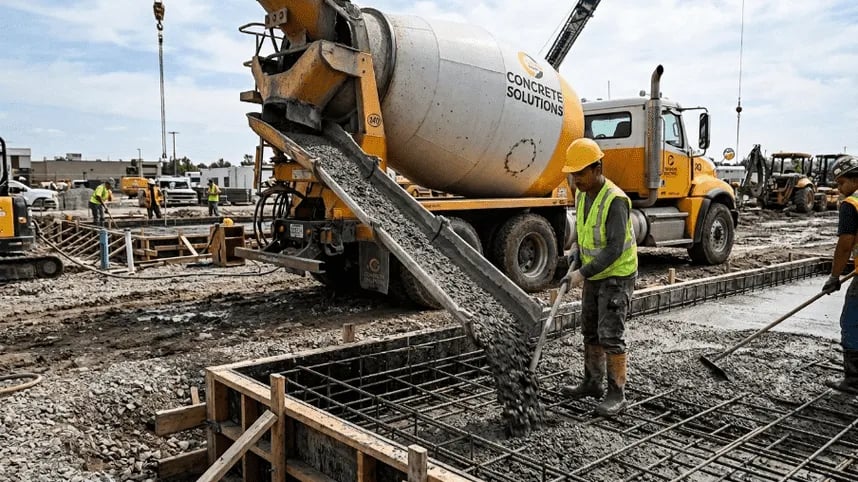
Ready Mix Concrete refers to concrete that is batched and precisely mixed at a factory plant to an exact target strength and slump, then delivered to the job site by mixer truck, ready to pour, rather than mixed by hand on-site.
Ready mix concrete is usually more consistent than site-mixed concrete. But that quality still depends on how the concrete is handled after it leaves the plant. Ready mix concrete quality is not just about the mix design. It's about everything that happens after the truck pulls away.
I have watched many pours in Dhaka over the past several years. I have talked to site engineers on-site, sometimes standing next to the truck as the drum turned. Most buyers never learn the small details that matter most. These details decide whether a slab lasts 30 years or cracks in three.
This article shares what suppliers rarely explain up front. It's based on what we see across Nusaiba Construction & Technology's real-estate construction projects in Bangladesh.
Key Takeaways
Ready mix concrete is pre-batched at a plant and delivered by truck. But its strength depends on what happens after it leaves the plant, not just the mix design.
Adding water at the site is a common habit on Bangladeshi sites. It is one of the biggest hidden causes of weak, cracked concrete.
Concrete has a discharge time limit. It is traditionally 90 minutes under ASTM C94. After that, quality can no longer be guaranteed.
Ready mix concrete cost in Bangladesh is rarely fixed. It changes with PSI/MPa grade, distance, and cement price. So "quotes only" is normal, not a red flag.
Bangladesh's hot, humid climate counts as hot-weather concreting territory. A supplier's plant certification, batching records, and slump-test habits matter more than their advertising.
What Is Ready Mix Concrete?
Ready mix concrete (RMC) is concrete made at a batching plant, where cement, sand, aggregate, water, and admixtures are all measured by weight instead of guessed on-site. A concrete mixer truck then carries the mix to your job site while the drum keeps turning, so it arrives ready to pour rather than needing to be mixed by hand. In my experience, this plant-level control is the main reason ready mix concrete beats hand-mixed concrete: the ratios stay consistent from the first truck to the hundredth, which matters far more over time than it seems on delivery day.
For a builder in Dhaka, that consistency matters more than it sounds. A foundation, column, or slab with uneven mix ratios can look fine on day one. It can still develop hairline cracks two years later.
Bangladesh sets its concrete and material rules in the Bangladesh National Building Code (BNBC). The BNBC was first introduced in 1993. It was last updated in 2020. It also places Dhaka in Seismic Zone 3. That is one of the country's more earthquake-active zones.
A 2022 UN-Habitat assessment cited in a Bangladesh construction-compliance review found something striking. Over 60% of buildings in Dhaka do not fully comply with BNBC standards. The World Bank has estimated that stricter enforcement could save the country over $1 billion a year, mostly from avoided disaster damage.
This compliance gap is exactly the kind of risk the ready mix concrete industry doesn't always spell out at the point of sale.
Ready Mix Concrete vs. Site-Mixed Concrete
Factor | Ready Mix Concrete | Site-Mixed Concrete |
|---|---|---|
Mix consistency | Computer-controlled batching keeps ratios steady load to load | Depends on the crew's measuring; ratios often vary |
Quality testing | Slump tested at the plant and again at delivery | Rarely tested unless specifically requested |
Material waste | Delivered close to the exact volume ordered | Leftover cement, sand, or aggregate is common |
Labor needed | Fewer concrete workers required for mixing | More labor-intensive on the mixing side |
Speed | Large volumes poured quickly once the truck arrives | Slower for large pours; limited by manual mixing |
Best suited for | Foundations, columns, slabs, roads, commercial pours | Small, non-structural jobs like garden paths |
Typical cost per unit | Slightly higher per cubic foot, but less waste | Lower per batch, but waste and rework add up |
Ready Mix Concrete Production Process: How It Actually Works
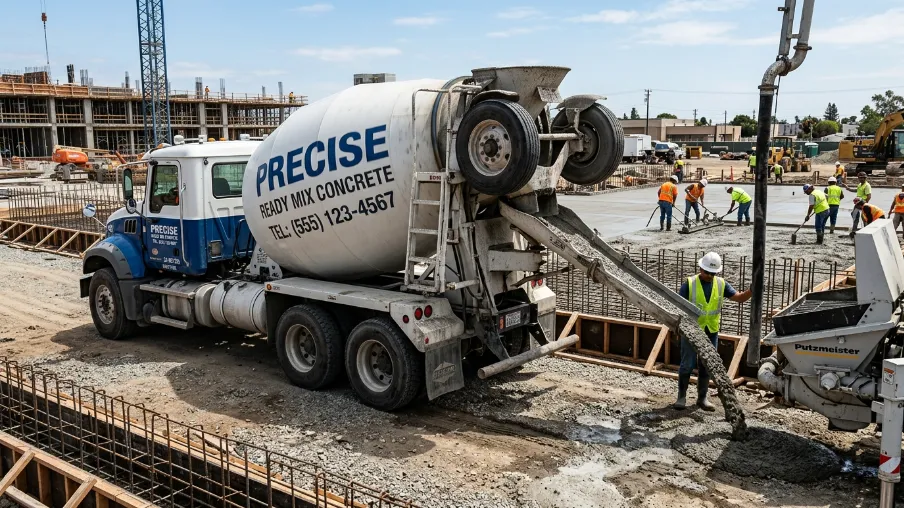
Design mix – An engineer sets the target strength, such as 3000 PSI or 4000 PSI. This comes from the structural drawing and design.
Batching at the concrete batching plant – The plant weighs cement, aggregate, sand, water, and admixtures. Computer-controlled batching replaces manual scoops.
Mixing and transit – The concrete mixing plant loads the mixer truck. The drum keeps turning during transport. This stops the concrete from segregating or setting early.
Slump test at delivery – A cone test checks workability before the concrete is accepted on site. This follows the ASTM C143 slump test method. It was first standardized for aggregate up to 1.5 inches (37.5mm). Most structural pours target a slump of 3 to 4 inches (75–100mm), and a reading above 9 inches is generally unreliable for quality checks.
Placement and curing – The concrete is poured and compacted. Then it's kept moist for several days. This follows guides like ACI 308.1 on curing concrete, which calls for a minimum of 7 days of moist curing at temperatures above 50°F (10°C). Full hydration typically needs a water-cement ratio of around 0.4 to 0.5. Concrete reaches roughly 65–70% of its 28-day design strength within the first 7 days, and about 90% by day 14, according to ACI strength-gain data. Most codes also check compressive strength at 28 days.
On one slab we followed closely, the crew covered it with wet burlap for a full week. When we checked the surface at the 28-day mark, it showed none of the fine dusting we've seen on slabs cured for only two or three days.
Each step in the ready mix concrete production process is a control point. Skip or rush one, and the final PSI strength on paper may never show up in the real structure. That's why proper construction management matters as much as the concrete grade itself.
Ready Mix Concrete Types and Uses (Common Grades)
Grade (PSI) | Approx. MPa | Typical Use |
|---|---|---|
2,500–3,000 PSI | 17–21 MPa | Non-structural work: sidewalks, patios, garden paths |
3,000–3,500 PSI | 21–24 MPa | Residential ready mix concrete slabs, driveways, boundary walls |
4,000 PSI | 28 MPa | Ready mix concrete for foundations, columns, beams |
5,000 PSI | 34 MPa | Commercial ready mix concrete foundations, multi-story columns |
6,000+ PSI | 41+ MPa | High-rise columns, heavy-load infrastructure, ready mix concrete for roads |
Exact grade selection should always come from the project's structural drawing, not from this table alone.
The Hidden Facts Suppliers Don't Always Volunteer
1. Adding water at the site quietly destroys strength
This is the single most common problem on residential sites in Bangladesh. Concrete workers see thick concrete. They add a bucket of water "to make it easier to pour." I've watched this happen more than once. The driver rarely objects unless someone stops to ask.
Water added beyond the design mix reduces strength. It also raises the risk of cracking.
Industry guidance is clear on this point. Adding water to speed up discharge is not allowed, even when the concrete looks thick. If workability is genuinely a problem, the fix is different. Use a water-reducing admixture, not a bucket from the site tank. An admixture or superplasticizer raises the slump without changing the water-cement ratio. That ratio is what controls strength.
2. There's a clock running the moment mixing starts
Ready mix concrete is not "good forever" once it's on the truck. ASTM C94 was first published in 1935. It required discharge within 90 minutes of batching, or 300 drum revolutions, whichever came first. The 2021 revision changed this default rule. Now the buyer and producer agree on a discharge time limit together.
In heavy Dhaka traffic, a delivery truck can get stuck for over an hour. It may arrive with concrete that's already losing workability. Ask your ready mix concrete supplier what discharge time they commit to. Do this before delivery day, not after the truck is stuck at a signal.
3. Price lists rarely exist, and that's normal
Many buyers assume there's a hidden markup when a company quotes a custom price instead of a printed rate card. In reality, most ready mix concrete manufacturers don't publish fixed national price lists.
Ready mix concrete cost depends on strength grade, distance from the plant, and current cement or admixture costs. A fair supplier should still explain the cost line by line. They should say why a 4000 PSI mix costs more than a 3000 PSI mix. That's a normal part of pricing across the industry, not a sign of a bad deal.
If you want affordable ready mix concrete, the real lever isn't haggling on price. It's matching the grade to the job so you're not overpaying for strength you don't need.
4. Not every truck gets tested the same way
Some suppliers run a slump test on every load. Others test occasionally and hope the batch matches the design. That design was worked out during estimation and quantity take-off.
The difference in ready mix concrete quality often shows up months later, not on delivery day. On one project, we didn't spot a problem until about six months after the pour. A patch of the slab started dusting under foot traffic. It can also appear as honeycombing or uneven color. That's exactly why it's easy for a supplier to under-invest in testing. Buyers often don't notice right away.
5. Dhaka's heat works against the concrete before it even sets
Bangladesh's hot, humid climate counts as hot weather concreting conditions under international guidance. High ambient temperature speeds up water loss and cement hydration in fresh concrete.
ACI standards generally cap the maximum concrete temperature at discharge. The limit is 95°F (35°C) for typical structures like pavements, bridges, and buildings. Practical guidance exists for managing high concrete temperatures. It recommends early morning pours, shaded storage of materials, and covering fresh concrete quickly.
Rapid moisture loss raises the risk of plastic shrinkage cracking. A supplier who doesn't adjust for local heat is quietly gambling with your slab's surface quality.
Ready Mix Concrete Advantages and Challenges
Advantages
Consistent water-cement ratio across the entire project
Faster pouring than manual mixing, which shortens labor time on site
Less material waste compared with on-site batching
Suited for ready mix concrete for building construction: foundations, columns, slabs, roads, and commercial pours, supported by reliable logistics and materials supply
Fewer concrete workers needed for mixing
Challenges
Concrete must be used within its agreed discharge window
Site access must allow a concrete mixer truck and, often, a pump
Custom mix concrete generally costs more than basic grades
Quality still depends on curing after the concrete is poured. The concrete delivery service's job ends at delivery.
Common Mistakes Buyers Make
Letting concrete workers add water on site without asking the driver to record it
Not confirming the PSI/MPa grade in writing before the pour
Skipping the slump test because the crew is in a hurry
Requesting the exact volume with no allowance for spillage or formwork leakage
Assuming "ready mix" alone guarantees quality, and skipping curing afterward
Expert Tips for a Better Pour
Ask for the delivery ticket. Check the batching time, not just the arrival time. Good project management keeps this on schedule.
Request the mix design (cement content, water-cement ratio) for anything structural: foundations, columns, beams.
Keep the concrete moist for at least 7 days after pouring. Strength development doesn't stop when the truck leaves.
For residential builds in Dhaka, compare at least two ready mix concrete services near you. Look at the PSI grade, not just the price per cubic foot.
If the crew wants to add water on site, insist it's measured and recorded. Don't let them eyeball it.
How to Choose a Reliable Ready Mix Concrete Supplier in Bangladesh?
Finding the right ready mix concrete supplier near me isn't only about price. Here's a simple checklist:
Confirm the PSI/MPa grade in writing before delivery, matched to your structural drawing.
Ask about discharge time policy so you know how long the concrete stays usable after batching.
Request slump test records for the specific grade you need, not just a general quality claim.
Check plant certification and batching method at their concrete batching plant (computer-controlled vs. manual).
Get a clear cost explanation tied to grade, distance, and admixtures, rather than a vague flat rate.
Confirm curing guidance the supplier provides after delivery, since their concrete pouring service doesn't end when the truck leaves.
This applies whether you need bulk ready mix concrete for a large commercial job or a small residential ready mix concrete order for a boundary wall.
Future Trends in Ready Mix Concrete
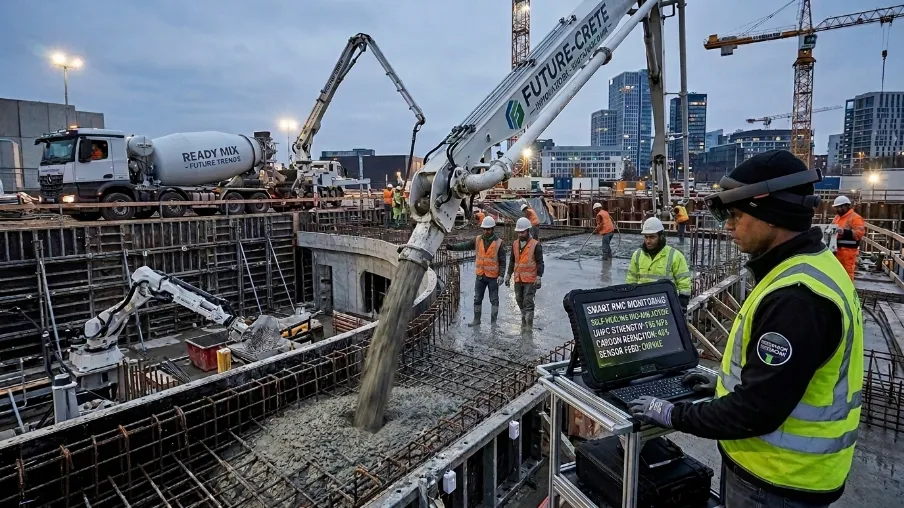
Bangladesh's construction sector is expanding quickly. Demand for ready mix cement concrete is following it. Globally, the ready-mix concrete market was valued at roughly $1.03 trillion in 2025 and is projected to nearly double by 2033, growing at an annual rate of about 8.4%. Asia Pacific already accounts for over 70% of that global revenue, driven largely by urbanization and infrastructure spending.
The Bangladesh Ready Mix Concrete Association (BRMCA) represents the country's leading RMC producers. It works to make quality ready concrete solutions the preferred building material over traditional hand-mixed concrete. Industry estimates citing BRMCA data put the domestic market's growth at 5% to 10% a year, with monthly demand in the range of 2 to 2.5 crore cubic feet of concrete nationwide.
Expect more concrete mixing plants offering self-compacting concrete. This is a highly flowable mix first developed in Japan in 1988. It fills congested formwork and reinforcement without vibration.
Also expect more eco-friendly ready mix concrete blended with fly ash or slag. This typically replaces 20% to 40% of the cement by weight. That matters for a simple reason. Cement production alone accounts for roughly 8% of global CO2 emissions, according to research on supplementary cementitious materials. So every percentage point of fly ash replacement cuts both cost and carbon footprint per cubic meter poured.
Digital delivery tracking is also becoming more common. It lets buyers see batching and transit times in real time, instead of taking a driver's word for it.
"Fly ash mixes used to be a hard sell here. Now clients ask for the eco-friendly option themselves, mostly because it's often cheaper too."
Self-Compacting Concrete vs. Conventional Ready Mix Concrete
Factor | Self-Compacting Concrete (SCC) | Conventional Ready Mix Concrete |
|---|---|---|
Placement method | Flows and fills formwork under its own weight | Requires mechanical vibration to compact |
Best for | Congested reinforcement, complex formwork, underwater pours | Standard slabs, foundations, columns, roads |
Labor requirement | Lower; no vibration crew needed | Higher; skilled vibration operators required |
Mix cost | Generally higher due to admixture content | Lower base cost |
Noise and site disruption | Minimal, since no vibration equipment is used | Higher, due to vibrator operation |
Availability in Bangladesh | Offered by a growing number of RMC plants | Widely available from nearly all suppliers |
FAQs About Ready Mix Concrete
What is ready mix concrete?
Ready mix concrete is concrete that is batched and mixed at a factory plant, with cement, sand, aggregate, water, and admixtures measured precisely by weight rather than guessed on-site. A concrete mixer truck then delivers it to your site, keeping the drum turning during transit so the mix stays workable and doesn't segregate or set early. It arrives ready to pour, which is why it's the standard choice for foundations, columns, slabs, and roads across most residential and commercial builds in Bangladesh today.
Is ready mix concrete better than site-mixed concrete?
In most cases, yes, because plant batching controls the cement-water-aggregate ratio far more precisely than a crew mixing by hand. That consistency reduces the risk of uneven strength across a slab or foundation. But "better" isn't automatic: ready mix concrete still depends on proper delivery timing, an accurate slump test at drop-off, and correct curing after it's poured. A rushed or poorly cured pour of ready mix concrete can still underperform a carefully hand-mixed small batch, so the advantage comes from good handling, not the label alone.
Why does ready mix concrete price vary so much?
Ready mix concrete price changes with three main factors: the strength grade you order (PSI or MPa), the distance from the batching plant to your site, and current cement and admixture costs, which shift with the market. A 4000 PSI mix for a foundation costs more than a 3000 PSI mix for a garden path, and a site further from the plant adds transport cost. That's why most ready mix concrete manufacturers in Bangladesh give custom quotes rather than a single published price list, and it's a normal part of how the industry prices jobs.
Can water be added to ready mix concrete on site?
Only in a small, measured amount that's already accounted for in the original mix design, and it should be recorded on the delivery ticket. Adding extra water beyond that design amount lowers the concrete's strength and raises the risk of cracking later, even though it makes the mix easier to pour in the moment. If the crew genuinely needs better workability, the correct fix is a water-reducing admixture or superplasticizer, not a bucket from the site tank, since that keeps the water-cement ratio intact while still loosening the mix.
How long does ready mix concrete stay usable after mixing?
Many producers in Bangladesh still work to the traditional 90-minute guideline, measured from the start of mixing to full discharge at the site, which comes from the original ASTM C94 standard. The 2021 revision of that standard changed the default rule, so the buyer and producer can now agree on a different time limit based on distance, traffic, and weather conditions. In heavy Dhaka traffic, it's worth confirming this discharge time commitment with your supplier before delivery day, not after the truck is already stuck at a signal.
How do I choose a reliable ready mix concrete supplier in Bangladesh?
Look for a ready mix concrete supplier that will confirm the PSI/MPa grade in writing, run consistent slump tests at delivery, and explain their discharge time policy before the pour. Check whether their plant uses computer-controlled batching rather than manual scoops, since that's what keeps mix ratios steady load to load. Pricing should be explained clearly by grade, distance, and admixture cost, not offered as a vague flat rate. Finally, ask what curing guidance they provide after delivery, since a supplier's responsibility for concrete quality doesn't fully end when the truck drives away.
Does ready mix concrete need curing after it's poured?
Yes, curing is essential and it's a step suppliers often don't take responsibility for once the truck leaves. Curing means keeping the concrete moist, typically by covering it or watering it, for at least several days after pouring so the cement can fully hydrate. Skipping this step, or cutting it short, undermines even a perfectly batched, correctly tested load of ready mix concrete. Most codes check compressive strength at 28 days, and poor curing is one of the most common reasons a slab fails to reach the strength it was designed for.
In Short: Ready Mix Concrete, Explained
Here is the resolution to what this guide set out to explain: ready mix concrete is concrete that's batched and mixed at a factory plant, to a precise, computer-controlled strength and slump, then delivered to your site by mixer truck, ready to pour. That is the complete definition.
Nothing about handling, discharge time, or curing changes what the material is; those factors only affect whether it performs as designed once it arrives on site. When produced and used correctly, ready mix concrete also supports sustainability with dynamic construction by reducing material waste, improving quality control, and helping modern construction projects achieve greater efficiency and consistency.
Its real-world quality comes down to three things beyond the plant gate: the mix design, the discharge and curing after delivery, and how closely a supplier tests each load. None of this means ready mix concrete is unreliable. For most residential and commercial builds in Bangladesh, it remains a stronger, more consistent choice than site mixing, provided it's handled correctly after it leaves the plant.
You now have the full picture: what ready mix concrete is, how it's made, and why water addition, discharge time, pricing, testing, and Dhaka's heat all affect the final result. That's ready mix concrete explained end to end, from the batching plant to the cured slab, with nothing left unanswered.
Sources and References
Forming America, "Can You Add Water to Concrete On-Site?": https://formingamerica.com/can-you-add-water-to-concrete-on-site/
Concrete International / ACI, "Concrete Q&A: 90-Minute Rule for Ready Mixed Concrete" (ASTM C94/C94M): https://www.concrete.org/publications/internationalconcreteabstractsportal.aspx?
ConcreteToolkit.com, "Concrete Delivery Time Calculator (USA)": https://concretetoolkit.com/calculators/concrete-delivery-time-calculator-usa/
Bangladesh Ready Mix Concrete Association (BRMCA): https://bdrmca.org/
Grand Rapids Concrete Leveling & Repair, "ACI 308.1 Guide to Curing Concrete": https://grandrapidsconcreterepair.com/ensuring-proper-concrete-curing-for-lasting-durability-aci-308-1-guide-to-curing-concrete/
Global Gilson, "Concrete Slump Testing: Test Methods, Equipment, and Testing Techniques" (ASTM C143): https://www.globalgilson.com/blog/concrete-slump-guide
Certified Materials Testing Products, "ASTM C143 Slump Test": https://blog.certifiedmtp.com/astm-c-143-slump-test-mastering-concrete-consistency/
American Concrete Institute, "Maximum temperature limits for hot-weather concreting" (ACI 305): https://www.concrete.org/frequentlyaskedquestions.aspx?faqid=15
National Ready Mixed Concrete Association (NRMCA), "Hot Weather Concreting": https://www.nrmca.org/wp-content/uploads/2021/01/12pr.pdf
MDPI Sustainability, "Enhancing Concrete Performance through Sustainable Utilization of Class-C and Class-F Fly Ash": https://www.mdpi.com/2071-1050/16/12/4905
Springer, Journal of Building Pathology and Rehabilitation, "Sustainable concrete development towards eco-friendly construction": https://link.springer.com/article/10.1007/s41024-024-00407-5
ScienceDirect Topics, "Self Compacting Concrete": https://www.sciencedirect.com/topics/materials-science/self-compacting-concrete
Starpath Holdings, "Construction Compliance Bangladesh: Standards & Regulations": https://starpathholdings.com/construction-compliance-bangladesh/
Concrete Pour Checker, "How Long to Cure Concrete: ACI Curing Times & Methods": https://concretepourchecker.com/guides/how-long-to-cure-concrete
Grand View Research, "Ready-Mix Concrete Market Size, Share & Growth Report": https://www.grandviewresearch.com/industry-analysis/ready-mix-concrete-market
.webp&w=256&q=75)