
Nine Reasons RAJUK Rejects Building Plans Explained: Why Plans Fail and How to Avoid It (2026 Guide)

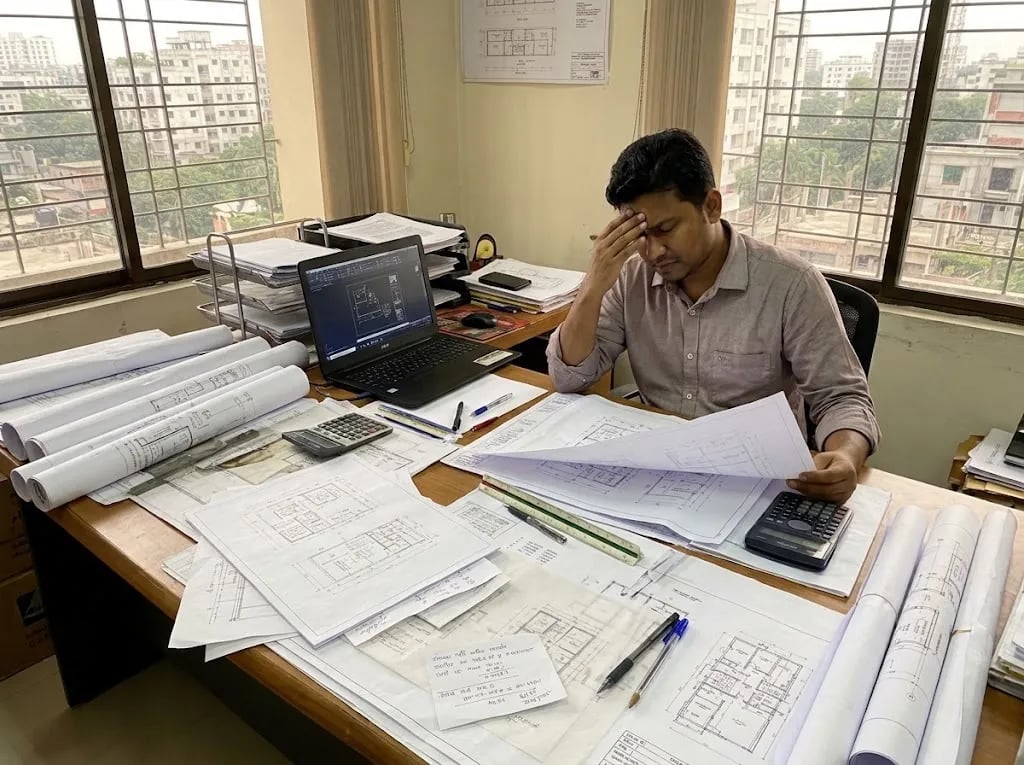
Nine Reasons RAJUK Rejects Building Plans refers to the nine common issues that can cause RAJUK to reject a building design. These include land-use violations, flood zone restrictions, setback violations, FAR limits, height restrictions, missing NOCs, incomplete land documents, drawing errors, and structural design deficiencies.
I wrote this guide for plot owners, architects and engineers in Bangladesh. Most rejections come from a few errors. You can fix them. This step-by-step guide explains why RAJUK rejects building plans and how to fix each fault. It also explains the RAJUK plan approval process in Bangladesh in simple words. Read the Nine Reasons RAJUK Rejects Building Plans first, then check your own file. A little checking before you file can prevent long delays.
How I checked the facts. I searched for RAJUK rules, news and guidance in October 2026. I studied more than a dozen sources. I cross-checked every number that appeared twice. I dropped any claim I could not trace to a named source. Last updated: 25 October 2026. Rules change often, and some sources are old. Treat this as a guide, not legal advice. Confirm details with RAJUK before you file.
One limit matters most. RAJUK does not publish a ranked list of rejection reasons. So my list of the Nine Reasons RAJUK Rejects Building Plans is my own summary of rules, reports and design guides. It is not an official count of the reasons for building permit rejection in Bangladesh.
Key Takeaways
The Nine Reasons RAJUK Rejects Building Plans start with land use and site checks, before drawings.
Setback, FAR and height errors are three of the Nine Reasons RAJUK Rejects Building Plans.
Missing clearances, such as fire or aviation NOCs, can stall your file.
Your drawings must match your land papers and the Bangladesh National Building Code.
A rejection is rarely final. Fix the Nine Reasons RAJUK Rejects Building Plans and resubmit.
Table of contents
What Are the Nine Reasons RAJUK Rejects Building Plans?
Why Do Land Use and DAP Problems Cause Rejection?
How Do Setback, FAR and Height Errors Fit the Nine Reasons?
Which Documents and Drawing Mistakes Trigger Rejection?
What Should You Do After a Rejection?
Conclusion
FAQs
What Are the Nine Reasons RAJUK Rejects Building Plans?
The nine reasons are land use clash, flood-zone or wetland sites, setback breaches, FAR and coverage excess, height breaches, missing clearances, weak land papers, drawing errors and structural gaps. Each one breaks a rule in the Building Construction Act, the Dhaka building rules or the DAP.
Here are the RAJUK building plan rejection reasons, in the order I explain them:
Land use does not match the DAP zone.
The plot sits in a flood flow zone, wetland or water-flow overlay.
The design breaks setback rules.
FAR or ground coverage goes over the limit.
The building is taller than the zone allows.
Required clearances (NOCs) are missing.
Land papers and plot size do not match.
Architectural drawings are incomplete or wrong.
The structural design fails the building code.
Why do these checks exist? According to The Daily Star, RAJUK approval is required under the Town Improvement Act, 1953. RAJUK’s chief urban planner said code breaks can bring legal action under the Building Construction Act, 1952. So each reason ties to a written rule. Know the RAJUK building plan approval requirements and the RAJUK building construction rules, and you can avoid the Nine Reasons RAJUK Rejects Building Plans.
How big is the problem? The Financial Express reported that about 66% of buildings in RAJUK areas are unplanned. It cited a survey the housing minister mentioned. Some have no approval. Others ignore approved designs. UNB also links to a report that RAJUK plans to demolish 3,382 Dhaka buildings for design violations. These RAJUK building code violations also explain many rejections. They sit behind the Nine Reasons RAJUK Rejects Building Plans.
Expert numbers differ. Dhaka Tribune reported a survey result of 66.1% of buildings breaking codes. RAJUK reportedly found about 95% were built without following its codes. A BUET civil engineering professor told The Financial Express that more than 35% of buildings in and around Dhaka lack RAJUK approval. That report is old. Use it as background, not a current count.
Why Do Land Use and DAP Problems Cause Rejection?
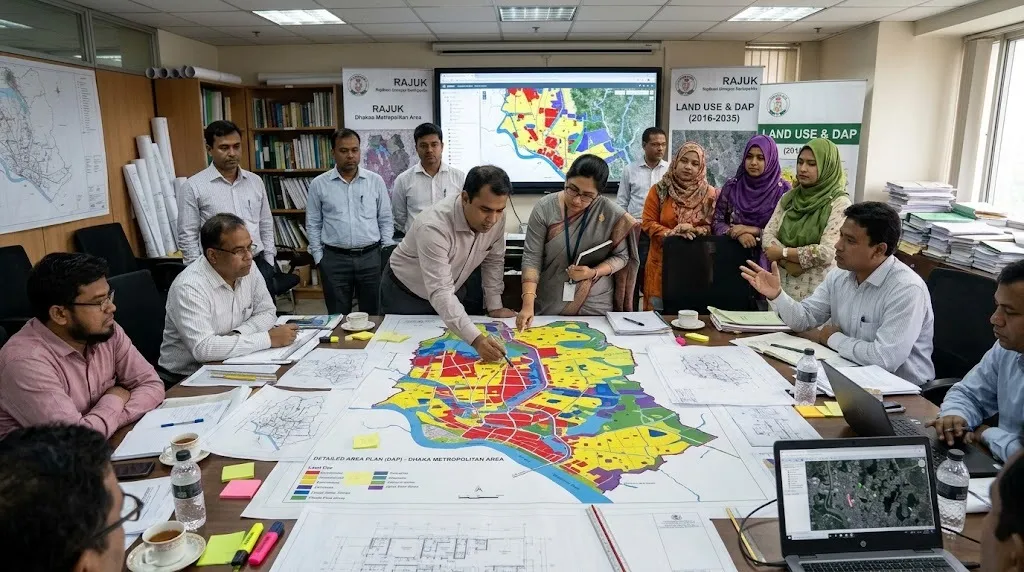
Land use and DAP problems can lead to rejection because RAJUK checks your plot against the zoning map first. If the plot falls within a flood flow zone, wetland or an incompatible land-use zone, the application may be rejected before the drawings are reviewed. Understanding these restrictions is an essential part of meeting RAJUK construction permit requirements. Nusaiba Construction & Technology helps property owners understand land-use restrictions and planning requirements before proceeding with building design. These issues cover Reasons 1 and 2 of the Nine Reasons RAJUK Rejects Building Plans.
Reason 1 of the Nine Reasons RAJUK Rejects Building Plans: land use mismatch.
For example, you cannot build flats on land the plan keeps for another use. Prothom Alo reports that land use clearance and construction approval are both required in RAJUK areas. RAJUK launched its online system, ECPS, in 2023. Prothom Alo says it took Tk 480 million. Often, a RAJUK ECPS application rejection starts with a clearance problem. So study the RAJUK land use clearance requirements first.
The law backs this check. Section 3A of the Building Construction Act, 1952 says an owner cannot change a building’s use without permission. The Ministry of Law publishes the Act. The same section lets the Authorised Officer end a use that does not fit the Master Plan. The owner gets six months to stop the use and twelve months to remove the building.
Reason 2 of the Nine Reasons RAJUK Rejects Building Plans: the site itself.
The Daily Star reported that housing in a flood flow zone is not allowed. The Supreme Court also ruled against the 550-acre Modhumoti Model Town project. That project filled a flood flow zone. Prothom Alo also notes that a 15-storey design in Mirpur’s Baunia badh was denied earlier. That area is a wetland and height-restricted zone.
The rules also move. On 15 October 2026, the government published a revised gazette of the DAP 2022-35. bdnews24 says it changes land use classes and water-flow overlay rules. It gives residential plots of at least 334.45 square metres in Purbachal and Jhilmil an extra 0.5 FAR. Owners must apply within six months. So always check the latest RAJUK DAP 2022-2035 regulations before you design. As of 25 October 2026, the gazette is only ten days old. I expect more clarification soon.
Timing facts help here. According to Prothom Alo, RAJUK began online land use clearance and construction approval in May 2019. Officials said more than 500 land use clearance applications were pending. An incomplete file can wait a long time.
How Do Setback, FAR and Height Errors Fit the Nine Reasons RAJUK Rejects Building Plans?
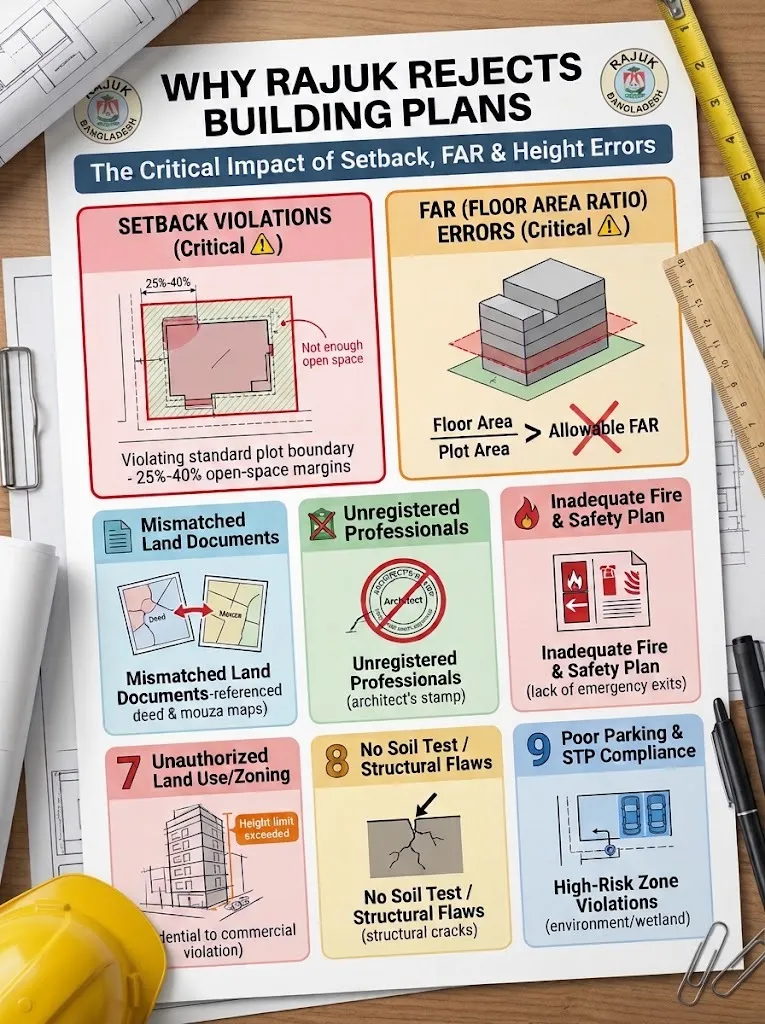
Setback, FAR and height errors cause rejection because the building is too big, too tall or too close to the boundary. RAJUK links FAR to road width and plot size. One wrong number in your FAR sheet can sink the whole drawing. Learn the RAJUK setback rules and RAJUK FAR regulations before you draw.
Reasons 3, 4 and 5 of the Nine Reasons RAJUK Rejects Building Plans are the classic design errors.
The Daily Star explains that the Dhaka building rules of 2008 set ground coverage at 50% to 67.5%, based on plot size. Check the RAJUK plot size and setback requirements together. They also base FAR on road width and plot area. Architects say the DAP cut allowed height on many plots. The Business Standard quoted an architect. He said a plot that allowed eight storeys under the 2008 rules now allows four to six.
Research suggests the rules keep changing. A policy committee later approved changes. They raise maximum heights in almost all areas. This changes the RAJUK building height restrictions. They also align the 2020 building code with the DAP. They target extra void space, setbacks and land coverage. They add an appeals committee. So check which version of the RAJUK residential building regulations fits your plot.
The numbers show how much has changed. UNB reports that the proposed DAP revision cuts Dhaka’s administrative blocks from 275 to 68. It limits the area to 1,094 square kilometres. It raises a density limit from 250 to 300. The Financial Express quoted a REHAB president. He claimed one bigha could carry about 80,000 square feet under the 2008 rules, but only about 50,000 under the DAP. That is an industry claim, not an official figure.
Rule | What RAJUK checks | Common mistake |
|---|---|---|
Setback | Open space on every side | Missing or too-small dimensions |
FAR | Floor area divided by plot area | Wrong road width or wrong area count |
Ground coverage | Share of the plot you build on | Going above the 50% to 67.5% range |
Height | Zone limit and NOC thresholds | Ignoring restricted zones |
Which Documents and Drawing Mistakes Trigger Rejection?
Missing clearances, mismatched land papers, incomplete drawings and weak structural design cause most document-based rejections. RAJUK expects every NOC, every dimension and every professional’s details. One gap gives the reviewer a reason to send the file back. These are the common RAJUK building plan approval mistakes. They cover Reasons 6 to 9 of the Nine Reasons RAJUK Rejects Building Plans.
Reason 6 of the Nine Reasons RAJUK Rejects Building Plans: missing clearances.
A minister told The Financial Express that approval needs four bodies. They are land use clearance, a civil aviation NOC where aircraft fly, a law enforcement NOC near key point installations, and a fire service NOC for buildings above 10 storeys. That statement is several years old. Confirm today’s list of RAJUK building plan approval documents.
Taller towers need more. One developer’s guide from Assure Group says a building above 33 metres needs clearance from 10 more authorities. It also says town planning clearance stays valid for 24 months. Check that yours has not expired.
Reason 7 of the Nine Reasons RAJUK Rejects Building Plans: land paper problems.
In my reading, one design guide on Arch Bangla stood out. It says the plot size in your drawing must not be larger than the size in your land paper. This holds even if the real plot looks larger. It also asks for the CS plot number, mouza, thana and holding number.
Fake papers also get caught. Prothom Alo reported that RAJUK checked seven suspicious land use clearance certificates and found forgery. A mismatch in your papers can end your file.
Reason 8 of the Nine Reasons RAJUK Rejects Building Plans: architectural drawing errors.
The same guide lists RAJUK architectural drawing requirements. It asks for a FAR sheet, marked setback distances, ground floor level and total building height. Common RAJUK building plan design errors include:
missing setback dimensions
a FAR sheet that does not match the floor plans
no total height shown on elevations
unclear plot identification details
Reason 9 of the Nine Reasons RAJUK Rejects Building Plans: structural gaps.
In 2011, the High Court told RAJUK to help enforce the Bangladesh National Building Code for the time being. A policy committee wants both structural and architectural design approvals before construction. RAJUK also requires the names of the owner, architect and engineer in the application. These details are part of the RAJUK structural drawing requirements.
The law gives this check a base. Section 18A of the Building Construction Act, added in 2006, lets the government issue the Bangladesh National Building Code. The code covers fire protection, structural design and building services. Bonik Barta quoted RAJUK sources. They said designs must go through an authorised engineer after clearance. A design filed directly online is rejected.
What Should You Do After a Rejection?
After a rejection, read the objection notes. Fix each point. Then resubmit through ECPS with updated documents. Do not guess. Fix each of the Nine Reasons RAJUK Rejects Building Plans in your file. Ask your architect to match each comment to a drawing change. Check the DAP and building code again before you upload.
This is how the RAJUK building plan correction process works, step by step:
Read every objection line by line.
Match each comment to a drawing, document or clearance.
Correct the drawings and the FAR sheet together.
Collect any missing NOC or land paper.
Resubmit the complete file in one go.
Timing matters. Prothom Alo reports that RAJUK sources expect approval within about 45 days of a complete online file. However, officials said nearly 4,500 design applications were pending at that time. So a complete first file is the smartest way to avoid delays.
When I traced the 45-day figure, I found it in Prothom Alo’s report of RAJUK sources. I did not find it in a rule I could open. So treat it as typical, not promised.
Independent research adds context. A Transparency International Bangladesh study covered November 2018 to December 2019. It put the government-set top fee for developers at Tk 3.65 lakh, before 15% VAT. It also found that RAJUK issued 6,011 land use clearances and approved 6,698 designs in 2017-18. Deadlines are not always kept.
Building without approval is risky. The RAJUK unauthorized construction rules are strict, and the draft ordinance would make them tougher. A draft RAJUK Ordinance 2025 proposes up to two years in jail or a Tk 10 crore fine for master plan violations. It also proposes a fee of three to five times the approval fee to make a building legal. These are drafts. Check the final law. Architects also cited RAJUK’s own claim that 87% of Dhaka’s buildings are illegal or unauthorised. This shows how common building plan approval problems in Dhaka are.
The same UNB report lists more fines in the draft. A structure that goes beyond 10 feet into open space would draw a Tk 50 lakh fine. Road encroachment would bring a Tk 75 lakh fine or six months in jail. Continued master plan offences would cost Tk 10,000 per day. The Financial Express also noted that REHAB held 37 meetings with RAJUK on the latest building code and DAP. Expect more changes.
Court records show the risk. A Supreme Court of Bangladesh writ, W.P. 15971 of 2022 describes RAJUK show-cause notices. A builder had a five-storey approved plan but built seven storeys. I read only the petition text. Check the final ruling before you cite it.
How to get RAJUK building plan approval, step by step
Check your plot’s land use and zone in the latest DAP.
Confirm the plot is not in a flood flow zone, wetland or water-flow overlay.
Match plot size, CS plot number, mouza, thana and holding number to your land papers.
Prepare architectural drawings with setbacks, a FAR sheet and total height.
Prepare structural drawings that follow the Bangladesh National Building Code.
Collect the required NOCs, such as aviation, law enforcement or fire service.
Submit the complete file through ECPS with the owner, architect and engineer names.
Track the file and answer every objection in one complete reply.
Quick fixes for the Nine Reasons RAJUK Rejects Building Plans
Rejection reason | Quick fix |
|---|---|
Land use mismatch | Check the DAP zone and get land use clearance before you design |
Flood flow zone or wetland | Verify the site status with RAJUK; choose another plot if restricted |
Setback breach | Mark every setback dimension on the plans |
FAR or coverage excess | Recalculate FAR from road width and plot area |
Height over the limit | Check the zone limit and any height-linked NOCs |
Missing NOCs | Collect aviation, security and fire clearances early |
Land paper mismatch | Never show a plot size larger than your land paper |
Drawing errors | Add a FAR sheet, total height and plot details |
Structural gaps | Follow the building code and name your engineer |
Pre-submission document checklist for the Nine Reasons RAJUK Rejects Building Plans
Land papers and mouza details
Land use clearance
Architectural drawings with a FAR calculation sheet
Structural drawings and engineer details
Required NOCs
Owner, architect and engineer names
Key terms in the Nine Reasons RAJUK Rejects Building Plans, explained
FAR (floor area ratio) is the total floor area divided by the plot area.
Ground coverage refers to the share of your plot that the building covers.
Setback means the open space you must leave between the building and the plot boundary.
NOC (no-objection certificate) is a written clearance from a body such as civil aviation or the fire service.
ECPS is RAJUK’s Electronic Construction Permitting System, the online software that handles applications.
DAP (Detailed Area Plan) is the zoning plan that sets land use, height and density for the RAJUK area.
Flood flow zone is land the master plan keeps free for water flow.
Conclusion
The answer to why RAJUK rejects building plans is simple: the file violates a written rule or contains missing information. The Nine Reasons RAJUK Rejects Building Plans are land use mismatch, flood-zone sites, setback breaches, excessive FAR, height limit violations, missing NOCs, incomplete land documents, drawing errors and structural gaps. Addressing these issues before applying can help reduce delays in obtaining RAJUK approval.
Here is how to prepare your application in four steps. First, check your plot against the latest DAP. Second, confirm the required setbacks, FAR and building height. Third, collect all necessary NOCs and land documents. Finally, submit a complete application through the ECPS portal. If RAJUK rejects your application, review the stated objections and correct them before resubmitting. Use the Nine Reasons RAJUK Rejects Building Plans as your checklist to prepare a stronger application for RAJUK approval.
FAQs About Nine Reasons RAJUK Rejects Building Plans
What is the most common reason RAJUK rejects building plans?
Among the Nine Reasons RAJUK Rejects Building Plans, rule breaches in design or land use come up often. Setback, FAR, height and zoning errors appear most in public reports. However, no official ranking exists. Treat this as a general pattern. Check your own rejection notes for the exact reason.
How long does RAJUK take to approve a building plan?
RAJUK sources told Prothom Alo that approval usually takes about 45 days after a complete online file. However, delays happen when files are incomplete or many applications wait. So submit every document at once. Track your ECPS application often.
Can I fix a rejected plan and apply again?
Yes, in most cases you can fix the Nine Reasons RAJUK Rejects Building Plans and reapply. Read the objection notes. Correct the drawings and documents. Then resubmit through ECPS. Fix every comment together, not one at a time. Ask your architect or engineer to confirm that each fix meets the current rules.
Can I get approval for a plot in a flood flow zone?
Evidence suggests the answer is usually no. Flood sites are one of the Nine Reasons RAJUK Rejects Building Plans. The Daily Star reported that housing in flood flow zones is not allowed. The Supreme Court ruled against Modhumoti Model Town. However, the DAP overlay rules changed in October 2026. Ask RAJUK to confirm your plot’s status.
Which documents does RAJUK need for plan approval?
Expect land papers, mouza map details, land use clearance, architectural and structural drawings, a FAR sheet and any needed NOCs. You also need the owner, architect and engineer names. Lists change. Learn the current checklist from RAJUK before you file.
