
RAJUK Plan Pass Rules: Stress-Free Approval Guide 2026
.webp&w=96&q=75)
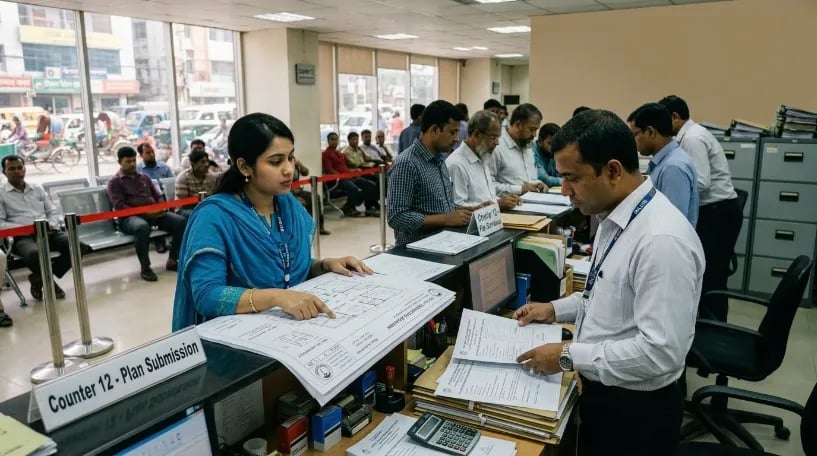
RAJUK plan pass rules are the planning, design, construction, safety, land-use, setback, FAR, and documentation requirements that a proposed building must meet to obtain approval from the Rajdhani Unnayan Kartripakkha (RAJUK). These rules help ensure that building plans comply with applicable regulations, DAP requirements, road access, site conditions, and technical standards before construction begins.
This guide explains what changed in 2026, how to apply, and where owners usually slip up.
About the Author
Written by: Mitu Das, SEO Specialist & Member of the Leadership Team at Nusaiba Construction & Technology
Reviewed by: Nusaiba Construction & Technology Team
Published: 19 September 2026
Editorial policy: This guide explains the RAJUK plan pass rules, including planning permits, construction permits, required documents, setbacks, FAR, occupancy certificates, fees, and common reasons for delays or rejection. It combines information reviewed from the RAJUK ECPS portal, government and published regulatory sources, DAP-related reports, and research on building-plan compliance in Dhaka.
Because some 2025–2026 regulatory figures in this guide come from published reports rather than the complete gazette text, those figures are identified as indicative where appropriate. Readers should verify current requirements, fees, and approval procedures with RAJUK or ECPS before submitting a building plan or starting construction. See our editorial policy for how we review construction and building approval content.
Table of Contents
What Are the RAJUK Plan Pass Rules and Regulations?
How Does the RAJUK Building Plan Approval Process Work?
What Documents Do the RAJUK Plan Pass Rules Require?
How Do RAJUK Building Setback and FAR Regulations Work?
Why Do Plans Get Delayed or Rejected?
Conclusion: Your Next Steps With the RAJUK Plan Pass Rules
FAQs About RAJUK Plan Pass Rules
Key Takeaways
The RAJUK plan pass rules require two approvals: a planning permit, then a construction permit.
Reports say the 2025 Dhaka rules replaced the 2008 rulebook, so old advice may mislead you.
Setbacks and FAR under the RAJUK plan pass rules decide how many floors you can build.
You apply online through ECPS, and you pay fees electronically.
Rules shift often, so confirm details on the live portal before you spend money.
What Are the RAJUK Plan Pass Rules and Regulations?
The RAJUK plan pass rules and regulations are the building controls that sit under the Town Improvement Act 1953, the Dhaka building construction rules, and the Detailed Area Plan (DAP) 2022–2035. Together, they set land use, height, density and safety limits. Therefore, no owner can legally start work without RAJUK's written permission.
Here is the part many guides miss. The RAJUK building construction rules in Bangladesh, at least for Dhaka, changed recently. The 2008 rulebook introduced FAR and maximum ground coverage limits. However, reports say RAJUK gazetted the Dhaka Building Construction Rules 2025 on 14 December 2025, replacing the 2008 rulebook (Studio16 Architects).
Before that, an advisory committee gave in-principle approval to the draft rules and DAP amendments on 19 October 2025 (BSS). Meanwhile, the DAP covers about 1,528 square kilometres (Prothom Alo).
I reviewed the ECPS portal, BSS, The Business Standard and Prothom Alo reports, and two published setback studies. However, I could not read the gazette text itself, so verify the RAJUK plan pass rules figures below with RAJUK. Sources also disagree slightly: early reporting mentioned 65 density blocks, while a later firm summary lists 68.
How Does the RAJUK Building Plan Approval Process Work?
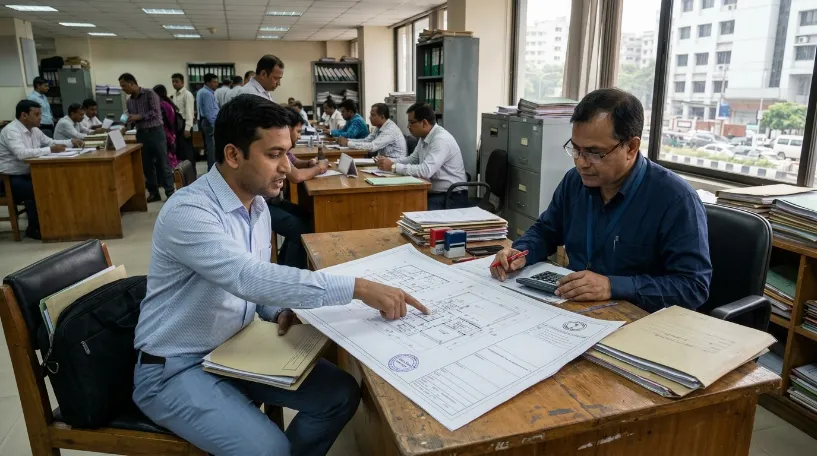
The RAJUK building plan approval process runs in stages: a planning permit (land-use clearance), a construction permit, and finally an occupancy certificate. In most cases, you apply online through RAJUK's Electronic Construction Permitting System (ECPS). Officials review your land papers and drawings before they issue each approval.
Here is the order the RAJUK plan pass rules follow:
Register on the ECPS portal with your NID and date of birth.
File the planning permit application (Form 101) with your land papers.
Have a registered architect and structural engineer prepare the drawings.
Submit the construction permit application and pay online, since the portal accepts no offline payment.
Answer RAJUK's queries, then wait for written approval before building.
Apply for the occupancy certificate once construction ends.
Reviewers then check land documents, planning compliance, setbacks, structural design and fire safety, according to one 2026 guide.
What Documents Does the RAJUK Plan Pass Rules Require?
RAJUK building plan approval requirements usually include the land deed, mutation record, updated land tax receipt, NID or passport, a digital survey map, and a signed application. For the construction permit, you also need architectural, structural, electrical and plumbing drawings plus an FAR calculation sheet. Requirements vary by project, so verify the current checklist.
Bring these items to satisfy the RAJUK plan pass rules:
Ownership deed and mutation record
Updated land tax receipt
NID or passport copy, plus a photograph
Signed architectural and structural drawings
FAR calculation sheet showing ground coverage, setbacks and storeys
Indemnity bond, where required
Older guides add a twist. Buildings above 10 storeys or 33 metres needed separate clearances from about ten agencies, including power, water, gas, and fire services. Evidence indicates that special projects may still face extra scrutiny, so if you need RAJUK approval service, it is better to confirm the required clearances early.
How Do RAJUK Building Setback and FAR Regulations Work?
RAJUK building setback and FAR regulations sit at the core of the RAJUK plan pass rules. They control how much of your plot you can cover and how tall you can build. Floor Area Ratio (FAR) divides total floor area by plot area. Setbacks are the open spaces you must leave around the building.
For example, a 1,000 sq ft plot with an FAR of 1.5 allows 1,500 sq ft of total construction. Moreover, the amended DAP keeps the open-space requirement at 25% to 40% of a plot (The Business Standard). Therefore, plot size alone never tells you the floor count.
Item | Reported figure | Why it matters |
|---|---|---|
Open space (setback) | 25%–40% of plot | Light, air, fire access |
Residential FAR | About 1.6 to 2.3 by area | Sets total floor area |
Area-based FAR | 2.0 to 5.5 (Gulshan and Banani highest) | Shapes block projects |
Sewage plant (draft) | Compulsory from five kathas | Adds cost |
Approval fee (draft) | Proposed rise from Tk1,000 to Tk5,000 | Affects budget |
These figures come from pre-gazette press reports (TBS, TBS on fees), so treat them as indicative.
Why Do Plans Get Delayed or Rejected?
Delays often trace back to mismatched land documents, designs that ignore FAR or setback limits, and missing technical drawings. Owners also lose time following outdated 2008-era advice on the RAJUK plan pass rules. In practice, a feasibility check before drawing starts prevents most of these problems.
The field evidence is sobering. A study of Uttara found about 20% of surveyed buildings broke setback rules, mainly because of high land prices and weak enforcement. Meanwhile, RAJUK sources told researchers that nearly 90% of buildings on the capital's outskirts, including Savar, lacked authorization.
Therefore, never start construction before you hold the construction permit under the RAJUK plan pass rules. Also, never stray from the approved drawing.
Conclusion: Your Next Steps With the RAJUK Plan Pass Rules
So, what is the simplest way to follow the RAJUK plan pass rules? Treat them as a sequence. First, confirm your land papers and jurisdiction. Second, ask your architect for an FAR and setback feasibility check under the 2025 rules. Third, register on ECPS and apply for the planning permit. Fourth, submit drawings for the construction permit.
Finally, wait for approval before you build, then apply for occupancy. If you need help coordinating these steps, Nusaiba Construction & Technology can assist with planning, drawing, estimation, and construction-related requirements.
Because final numbers may differ from press reports, call the ECPS helpline (working days, 9:00 AM to 4:30 PM) or email [email protected] before you commit money.
FAQs About RAJUK Plan Pass Rules
Is online submission mandatory for RAJUK plan approval?
In most cases, yes. Under the RAJUK plan pass rules, ECPS handles planning permits, construction permits and related services, and it accepts fee payments only online. Architecture firms also describe ECPS as mandatory for new approvals in RAJUK areas. Even so, check the portal for exceptions before visiting an office, because procedures can change.
Do the 2008 rules still apply to new applications?
Reports say RAJUK gazetted the Dhaka Building Construction Rules 2025 on 14 December 2025, replacing the 2008 rulebook. The RAJUK plan pass rules for new applications and therefore generally follow the 2025 rules and the amended DAP. However, older approvals may carry earlier terms. Confirm which version governs your file with RAJUK or a registered architect.
How much does RAJUK plan approval cost?
Under the RAJUK plan pass rules, fees depend on plot size and building use. A draft of the 2025 rules proposed raising several fees from Tk1,000 to Tk5,000, plus Tk5,000 per katha for multi-unit residential blocks. Because finance ministry sign-off was pending at the time of reporting, check the final fee schedule on ECPS before setting your budget.
What happens if you build without RAJUK approval?
Building without approval breaks the RAJUK plan pass rules and can bring penalties, extra fees and enforcement action. Under the 2008 rules, owners who built amended portions before re-approval paid ten times the original fee plus penalties (2008 rules). Research suggests enforcement is uneven, but relying on that gap is risky.
Do you need an occupancy certificate after construction?
Yes. Under the RAJUK plan pass rules, the occupancy certificate confirms that the finished building matches the approved plan and meets safety standards. Under the draft 2026 rules, it no longer needs renewal every five years once issued. Apply after completion, and keep the certificate safe, since buyers, lenders and utility providers may ask for it.
.webp&w=256&q=75)