
Steel Building Cost Per Square Foot in Bangladesh: A Practical Guide (2026)

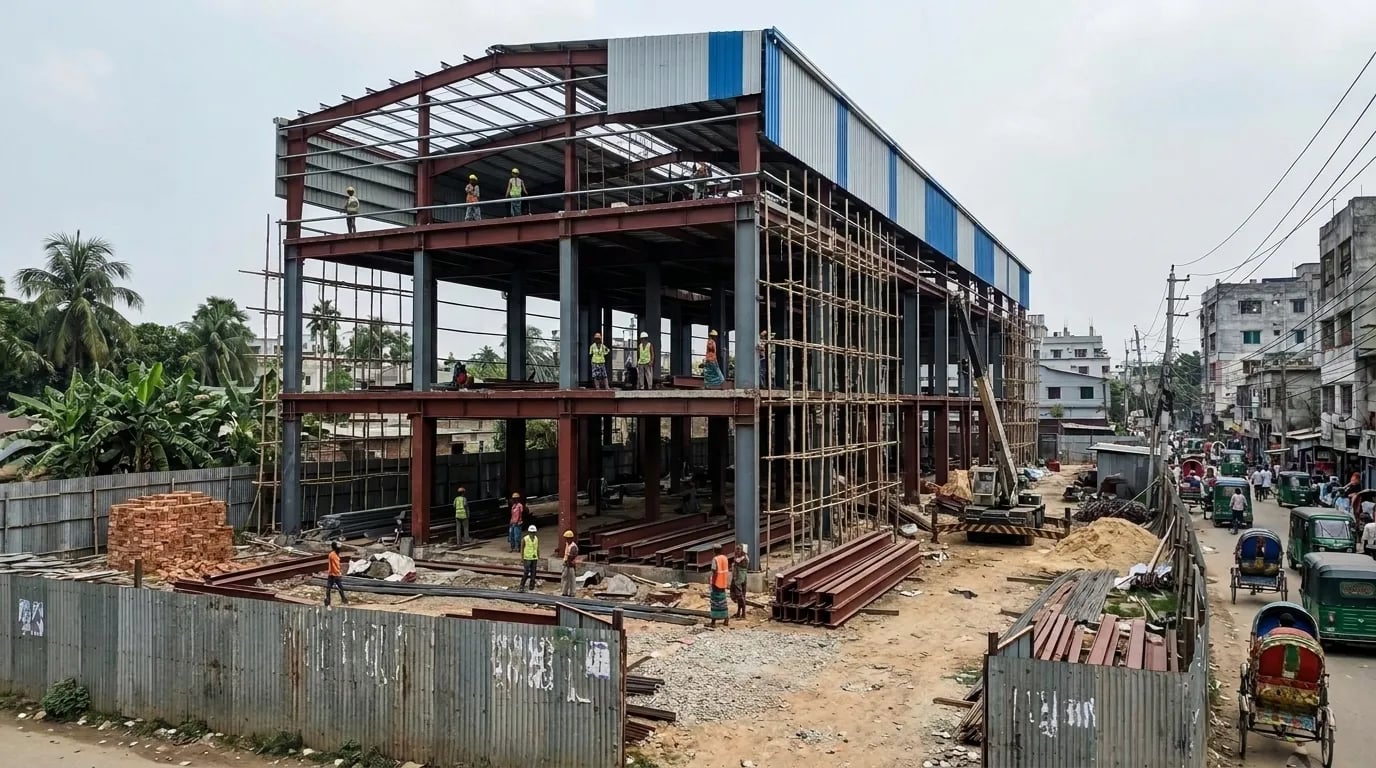
Steel building cost per square foot refers to the total construction cost of a steel building divided by its covered floor area. In Bangladesh, this cost depends on structural steel prices, building size, design complexity, foundation requirements, labour, and finishing materials. Understanding these factors helps you estimate your construction budget and compare steel buildings with conventional RCC structures.
This guide shows you how to work out that number. It also shows how to read an estimate line by line. And it explains why steel often costs less than concrete.
I wrote it from Bangladeshi and US sources. I checked each figure's date and scope. I also redid the math by hand. Public data on steel building cost in Bangladesh is thin. So treat every figure here as a guide, not a final price.
How I researched this guide
Method: On 16 November 2026, I searched Bangladeshi and US sources separately. This kept US dollar prices out of the Bangladesh numbers. Then I compared the figures and redid the math.
Tools: I used a web search, a page reader, and hand math. I did not use a cost model or a paid database.
My five tests for a source:
It shows a date.
It names who made the claim.
It is about Bangladesh, or I can label it as a US reference.
It says what the rate covers.
It comes from news, government, a rating agency, or a named supplier.
What I left out: Pages with no author or date. Indian rupee listings. Price pages that copied each other.
How deep I checked: I read the Daily Star June 2026 article in full. For other sources, I used the excerpts from my search.
Scope: Pre-engineered and conventional steel buildings in Bangladesh. US guides are only for reference. I did not cover high-rises, bridges, or land costs.
Assumptions: The examples, the steel weights, and the 10 percent buffer are mine. They are not published standards. "By my arithmetic" means I did the math myself. I did not convert dollars to taka. Exchange rates move, and a conversion would look too exact.
Original analysis method: I gathered dated price points. I used the middle of each range. I worked out the changes by hand. This is desk research, not a survey.
Limits: I know of no current, verified public price list for steel buildings in Bangladesh. The Tk 250–350 figures are from 2016 or earlier. BSMA is an industry group with its own interests. Rod is not structural steel. I did not visit sites or collect supplier estimates.
Table of Contents
What does steel building cost per square foot include?
How much is steel building cost per square foot in Bangladesh?
What factors affect steel building cost per square foot?
How to calculate your steel building cost per square foot
Steel building cost per square foot vs concrete: which is cheaper?
What hidden costs should you budget for?
Conclusion: the short answer on steel building cost per square foot
FAQs and references
Key Takeaways
This steel building cost per square foot guide treats the rate as a planning number, not a final price.
Older Bangladeshi reports show steel costing 20–50 percent less than concrete for factories and sheds.
Steel building cost factors drive most of the total. These are material price, size, design, soil, and labor.
Foundation, transport, insulation, and approval fees are often missing from the first estimate.
For your steel building cost estimate, read three written estimates line by line. Then add a 10 percent buffer.
What Does Steel Building Cost Per Square Foot Include?
Steel building cost per square foot usually covers the frame, roof sheets, wall sheets, and bolts. It often leaves out land, foundation, insulation, permits, and interior work. Always check what the rate covers. Two estimates with the same number can cover very different work.
Sellers use many names for the same idea. Metal building cost per square foot, pre-engineered steel building cost, and steel structure construction cost mean much the same thing. That is why published numbers often differ.
Scope matters more than the number. Toro Steel Buildings says a basic steel kit costs about $30 to $68 per square foot. Fully installed buildings cost $55 to $114 in the US (Read more: Toro price guide).
US Patriot Steel says a full build adds 80 to 150 percent to the kit price (Learn more: US Patriot Steel guide). So one building can look cheap or costly. It depends on what the rate includes.
A steel building price breakdown shows the same thing. Titan Steel Structures lists $25–$35 per square foot for a basic shell, $35–$55 for rigid-frame commercial buildings, and $60–$100+ for fully finished ones (Discover the Titan guide).
Toro also lists a 50×100 foot building. That is 5,000 square feet. The price is $144,000–$176,000. By my arithmetic, that is about $29–$35 per square foot. See case study 3 below.
To see how designs differ, compare steel building types.
How Much Is Steel Building Cost Per Square Foot in Bangladesh?
Older Bangladeshi reports put pre-engineered steel at Tk 250–350 per square foot. Concrete was about Tk 500. These numbers are old, so they are probably too low today. Rates depend on span, height, and finish. Study at least three written estimates before you set a budget.
Here is what I found on the average steel building cost per square foot. The Business Standard reported that insiders put steel buildings at Tk 250–300 per square foot, and RCC at Tk 500 (Read more: Business Standard).
A Daily Star article quoted a maker at Tk 250–350 per square foot. That is 20–30 percent below a conventional building (Learn more: Daily Star).
A March 2016 rating study repeats the Tk 250–300 range. It also notes that Bangladesh used about 4 million tons of steel per year (Discover the study (PDF)).
Steel prices have moved since then. The Daily Star reported in 2025 that retail 60-grade MS rod fell 12 percent in a year, to Tk 85,000–89,000 per tonne. Then prices rose about 2 percent, from roughly Tk 84,000 in October to Tk 85,500 by the second week of January.
By June 2026, retail rod sold at Tk 91,000–92,000 per tonne. It could reach at least Tk 97,000 (Read more: Daily Star report). By my arithmetic, that is a 5–7 percent jump.
Rod is not structural steel. But it shows where steel building material cost is heading.
Supply is not the main problem. About 40 modern mills and over 150 re-rolling mills can make about 1.22 crore tonnes a year. Demand is about 50 lakh tonnes. Also, monthly rod demand has swung from about 6.5 lakh tonnes to about 4 lakh tonnes in slow periods. This suggests costs and demand, not shortages, drive prices.
Source | Reported figure | Notes |
|---|---|---|
Business Standard / Emerging Credit Rating (2016) | Tk 250–300 steel vs Tk 500 RCC | Older Bangladeshi estimate |
Daily Star | Tk 250–350 | Older; a maker's claim |
Engineering blog (2024) | Tk 1,500–2,300 | Large 60,000 sq ft factory shed; scope not verified |
Titan Steel Structures (US, 2026) | $25–$35 shell; $35–$55 rigid-frame | Basic and commercial |
Toro Steel Buildings (US, March 2026) | $55–$114 | Fully installed |
What I noticed when comparing these sources. The Tk 250–300 range shows up in three places. Repeated numbers often come from one origin. So I count them as one data point, not three.
Then I checked the 2024 blog. Its Tk 1,500–2,300 is four to nine times higher. I could not explain the gap from the text. It likely covers a full factory shed, not a bare frame. So I mark it as unverified and leave it out of my math.
Original analysis: what the data shows
Method. On 16 November 2026, I gathered every dated price point I could verify. Where a source gave a range, I used the middle. Then I worked out the changes by hand. I did not survey suppliers or builders.
Result 1: rod prices rose about 9 percent in eight months
Date | 60-grade MS rod, retail (Tk per tonne) | Middle used | Source type |
|---|---|---|---|
Mid-2024 peak | nearly Tk 1 lakh | about 100,000 (rough) | Daily Star |
Oct 2025 | around Tk 84,000 | 84,000 | TCB data via Daily Star |
Dec 2025 | Tk 81,000–86,000 | 83,500 | TCB data via Financial Express |
Jan 2026 | Tk 85,500 | 85,500 | TCB data via Daily Star |
Jun 2026 | Tk 91,000–92,000 | 91,500 | BSMA via Daily Star |
[Figure 1: paste the SVG chart here. Caption: Retail price of 60-grade MS rod, put together by the author from Daily Star and Financial Express reports. The y-axis starts at Tk 75,000. The mid-2024 point is rough.]
My math from the middle values:
Oct 2025 to Jun 2026: +7,500, or +8.9 percent.
Jan 2026 to Jun 2026: +6,000, or +7.0 percent.
Mid-2024 peak to Jun 2026: −8,500, or −8.5 percent. Prices are still below the peak.
BSMA's warning of Tk 97,000 would be 5.4 to 6.6 percent above the June range.
The June figure is a retail price from an industry group. The earlier ones come from TCB data. So 8.9 percent shows a direction, not an exact index.
Result 2: installation and foundation add about 70–90 percent to a frame price
I compared three US guides. I looked at what the add-ons cost compared with the basic building.
Source | Base price | Add-on | Add-on as share of base |
|---|---|---|---|
Titan Steel Structures | $25–$35 shell | $8–$12 foundation + $10–$20 erection = $18–$32 | 72–91% (my math) |
Toro Steel Buildings | $30–$68 kit | $55–$114 installed, so $25–$46 extra | 68–83% (my math) |
US Patriot Steel | kit price | 80 to 150 percent added for a full build | 80–150% (as published) |
The three ranges overlap at about 80–83 percent. I matched low with low and high with high. So these shares show typical cases, not extremes. A frame-only price likely understates the finished building by more than half.
A "what if" case, not a price. Say the old Tk 250–350 range covered the frame only. Apply Toro's multiplier of 1.68–1.83. You get about Tk 420–640 per square foot (250 × 1.68 = 420; 350 × 1.83 = 640.5). This ignores inflation and the rod price rise. It also ignores Bangladeshi labor and foundation costs. It only shows how big the scope effect can be. Do not use it as a quote.
Result 3: a power tariff rise reaches your rate through steel weight
BSMA said the June 2026 tariff change adds around Tk 1,785 per tonne alone, and up to Tk 3,560 with other costs. That is Tk 1.785 to Tk 3.56 per kilogram.
Multiply that by the steel weight per square foot. The weights below are my assumptions. Swap in your engineer's real number.
Assumed steel weight (kg per sq ft) | Added cost at Tk 1,785/tonne (Tk per sq ft) | Added cost at Tk 3,560/tonne (Tk per sq ft) |
|---|---|---|
5 | 8.9 | 17.8 |
10 | 17.9 | 35.6 |
15 | 26.8 | 53.4 |
At 10 kg per square foot, the high case of Tk 35.6 equals about 10–14 percent of the old Tk 250–350 range. Rod is not structural steel, so real effects may differ.
Limits. I have five data points from mixed sources. Retail and mill prices differ. I did not convert US dollars. The steel weights are assumed. Treat all results as a direction.
The gaps between rows show why one number cannot fit all. Scope, date, and country all differ. Use the US rows to learn the pattern, not to price your project.
What Factors Affect Steel Building Cost Per Square Foot?
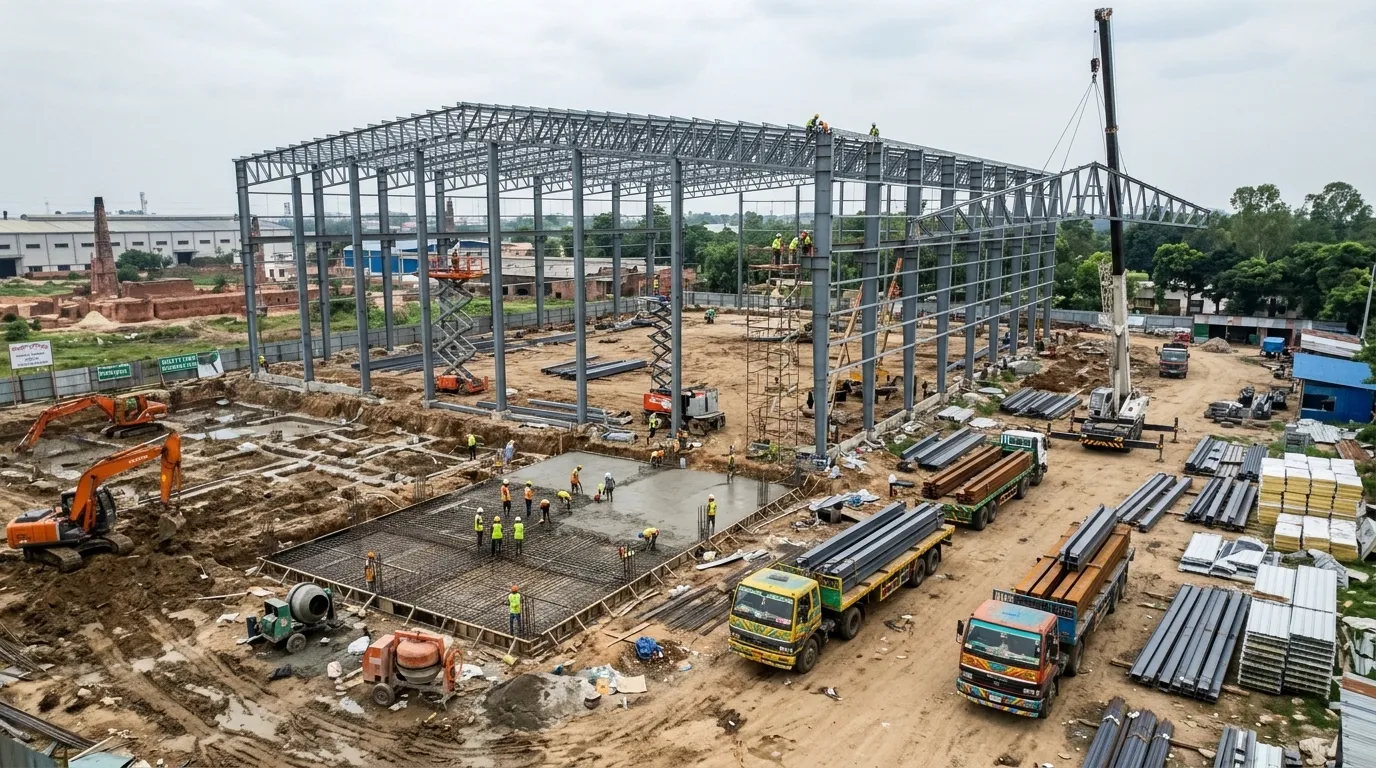
Five things drive steel building cost per square foot most. They are steel price, building size, design, foundation and soil, and labor with transport. Insulation, doors, and code rules add more. In most cases, steel price and size move the total the fastest.
These steel building cost factors explain why the factors affecting steel building costs differ by site. A Dhaka warehouse and a Sylhet workshop will not cost the same. Here they are in order of impact:
Steel building material cost: The cost of steel building materials follows the steel market. BSMA says the 2026 power tariff rise of about 17 percent for industry adds around Tk 1,785 per tonne alone, and up to Tk 3,560 with other costs. Meanwhile, the Building Materials Price Index fell to 1.9% in May 2026, from 6.23% in January 2024 (Discover the TBS report). Also, government projects use about 60 percent of steel, so public spending moves prices.
Steel building cost by size: Small buildings may average $28–$30 per square foot. Larger ones approach $25 (Read more: Titan price guide).
Design and use: Clear spans, tall walls, and heavy loads raise the rate. Viking Steel Structures lists $300–$600 for each extra foot of wall height. Also, industrial buildings carry the highest cost per square foot.
Steel building foundation cost: Soil and loads set the slab or pile design. US guides budget $8–$12 per square foot for a standard slab. One Bangladeshi blog says BDT 100–150 per square foot for a large shed. I could not verify it.
Steel building labor cost: Crew skill and site access matter. US guides say expert assembly usually adds $10–$20 per square foot.
Steel building installation cost and the cost of erecting a steel building: Crane use, bolting, and sheeting all count. US guides list erection apart from the kit price.
Codes and fees: The Housing and Building Research Institute (HBRI) is the custodian authority of the Bangladesh National Building Code. BNBC-2020 added a new energy-efficiency chapter (HBRI, government site).
BNBC 2020 splits Bangladesh into four seismic zones. It took effect in February 2021 (Learn more: IISEE Japan study). A peer-reviewed study found its seismic base shear is 1.33 to 1.82 times higher than under the 1993 code for mid-rise concrete buildings (BAIUST journal).
On enforcement, the minister said the BBRA Act passed on 10 April 2026 to help apply and monitor the code nationwide (Read more: BSS).
Draft Dhaka rules also propose raising the fee for a 3,000 square meter building from Tk 26,000 to Tk 150,000, and for a 10,000 square meter building from Tk 83,000 to Tk 500,000 (Prothom Alo). A second report says industrial or commercial buildings may pay up to Tk 150 per square meter (Learn more: Dhaka Tribune).
Expert voices on steel and construction costs
“…will fall directly on the construction and infrastructure sectors.”
Mohammad Jahangir Alam, president, Bangladesh Steel Manufacturers Association, The Daily Star, 8 June 2026
Alam was talking about higher steel prices. For you, this means mill costs reach your building's rate.
“…raise the cost of rebar by around Tk 2,000 per tonne.”
Tapan Sengupta, deputy managing director, BSRM, Prothom Alo
Sengupta was describing a power price rise. Energy costs flow into steel.
“…lack of an enforcement mechanism…”
Mohammad Abu Sadeque, director, Housing and Building Research Institute, The Daily Star
Abu Sadeque is HBRI director and a BNBC steering committee member. He said this about why the code was barely used after 1993. That report is old. It shows a code-enforcement worry, not the 2026 position. Ask your engineer to confirm code compliance in writing.
How to Calculate Your Steel Building Cost Per Square Foot
You do not need special software. A simple steel building cost calculator is a spreadsheet. Follow these steps to build your steel building cost estimate:
Measure your covered floor area in square feet.
Get a written breakdown of the frame, roof, and walls.
Add foundation, transport, crane use, and erection.
Add insulation, doors, windows, and fees.
Divide the total by your floor area. Then add a 10 percent buffer. That buffer is my rule of thumb, not a published standard.
Example 1: a 4,000 square foot warehouse. These numbers are made up. They show the math only.
Line item | Illustrative cost |
|---|---|
Frame, roof, and wall sheets | Tk 12,00,000 |
Foundation | Tk 3,00,000 |
Transport and erection | Tk 2,50,000 |
Insulation, doors, and fees | Tk 2,50,000 |
Total | Tk 20,00,000 |
Divide Tk 20,00,000 by 4,000 square feet. The rate is Tk 500 per square foot. With a 10 percent buffer, the total is Tk 22,00,000. That is Tk 550 per square foot.
Example 2: why scope matters: Estimate A says Tk 400 per square foot for the frame and sheets only. Estimate B says Tk 520 and includes foundation and erection.
Add Tk 75 for foundation and Tk 50 for erection to Estimate A. It reaches Tk 525. So the "cheaper" estimate was not cheaper. Both add-ons are made up.
How I checked the examples: I did both by hand before publishing. In Example 1, Tk 20,00,000 plus 10 percent is Tk 22,00,000. Divided by 4,000, that is Tk 550. In Example 2, Tk 400 plus Tk 75 plus Tk 50 is Tk 525. That beats Estimate B's Tk 520 only on paper.
This showed me why a rate without scope misleads. In practice, the gap between two estimates is often a missing line, not a better price.
Real-world case studies: three named examples
Case study 1: Bangladesh's June 2026 steel tariff shock
Problem: In June 2026, the government raised industrial power tariffs by around 17 percent. Steel makers warned that builders would pay more.
Approach: BSMA held a press conference and gave numbers. It said the tariff alone adds around Tk 1,785 per tonne. It can reach Tk 3,560 once VAT, port charges, fuel, and ferro-alloys are added (Read more: Daily Star).
Result: BSMA said retail 60-grade rod, then at Tk 91,000–92,000 per tonne, could rise to at least Tk 97,000. By my arithmetic, that is about 5–7 percent.
Lesson: Turn a tonne price into a square foot price. Say a shed uses 20 tonnes of steel. At Tk 3,560 per tonne, it costs Tk 71,200 more. Over 4,000 square feet, that is about Tk 17.80 per square foot. The 20 tonnes is my guess. Rod is not structural steel. But the method works.
Case study 2: the 21-storey Secretariat building cost dispute
Problem: A newspaper said a planned 21-storey Secretariat building would cost Taka 53,000 per square metre. The number alarmed readers.
Approach: On 5 April 2026, the Ministry of Housing and Public Works called the report misleading. It gave the cost without basements, VAT, income tax, and profit margins, at Taka 3,500.86 per square foot. The basement alone was Taka 759.65 per square foot (Learn more: BSS).
Result: One project gave two very different numbers. By my arithmetic, Tk 53,000 per square metre is about Tk 4,924 per square foot. So the unit change does not explain the gap. A scope difference likely does.
Lesson: This is not a steel building. I use it only as a scope lesson. Always check the unit and what the rate includes.
Case study 3: Toro's 50×100 foot building
Problem: A buyer wants a 5,000 square foot building and needs a budget range.
Approach: Toro Steel Buildings lists a 50×100 metal building at $144,000–$176,000, or $30–$37 per square foot (Discover the Toro guide).
Result: I rechecked. $144,000 ÷ 5,000 is $28.80. $176,000 ÷ 5,000 is $35.20. The listed range is a bit higher than its own totals.
Lesson: Redo every rate yourself. A small mismatch is a reminder that a listed rate is a guide, not a promise.
What these cases teach: Turn big numbers into per-square-foot numbers. Check the unit and scope. Check the math before you trust a figure.
Steel Building Cost Per Square Foot vs Concrete: Which Is Cheaper in Bangladesh?
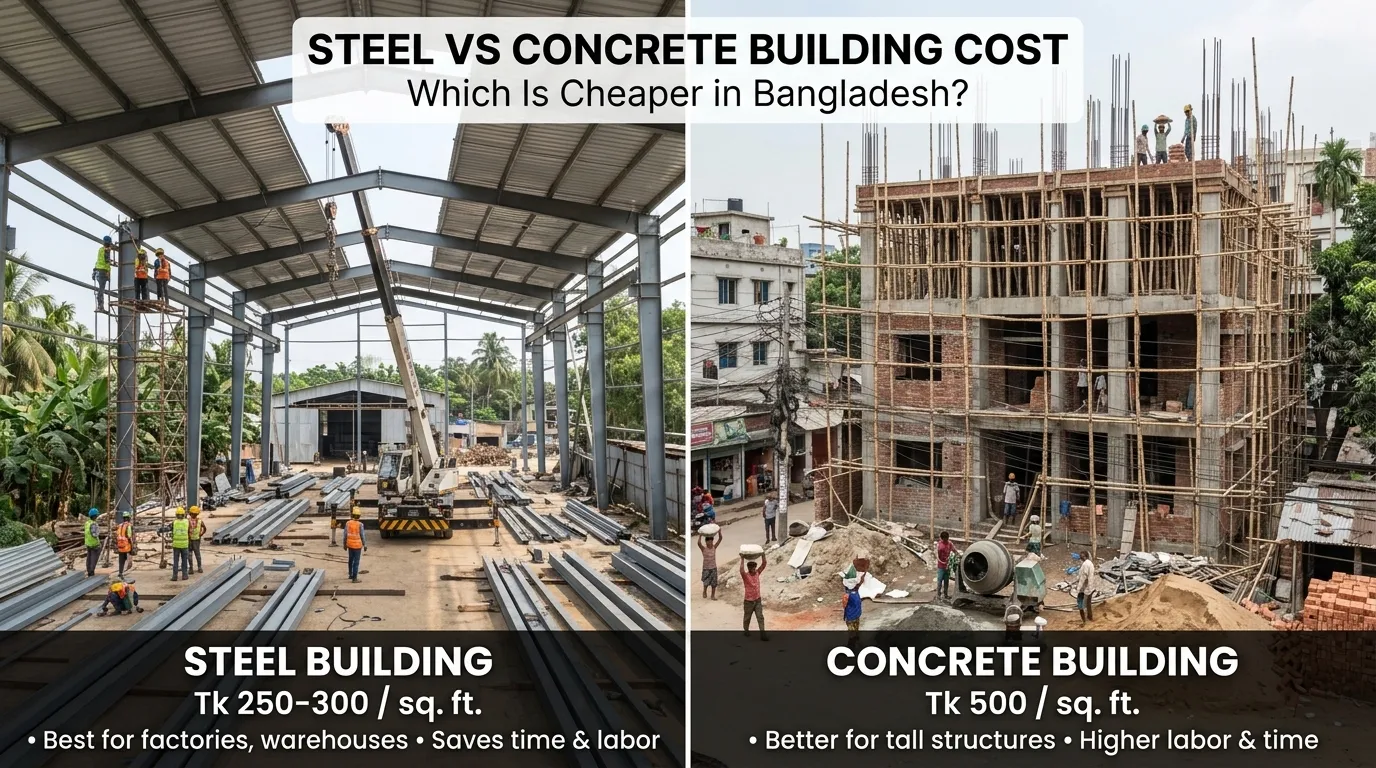
In most cases, yes. This is true mostly for factories, warehouses, and sheds. Industry insiders put steel at Tk 250–300 per square foot. They put concrete at Tk 500. However, tall buildings cost more in steel. So study estimates for your own design.
Why does steel often cost less? When you weigh steel building vs concrete building cost, look past the price tag. The two reports above imply savings of 20–30 percent. By my arithmetic, the other implies 40–50 percent. Consider these points:
Makers send all parts to the site and join them with nuts, bolts, and anchor bolts, which saves time.
Parts are made in a factory, so there is less site work. Steel building construction expenses for labor often fall.
Steel building maintenance cost stays low if you check bolts, coatings, and roof drains each year.
Steel building lifespan and maintenance go together. Research suggests well-coated steel lasts for decades with regular care. However, coastal areas like Chattogram need more rust checks.
Steel also has room to grow here. The Daily Star, citing the World Steel Association (2013), reported that Bangladesh used about 12 kg of steel per person, against 459 kg in Germany, 506 kg in Japan, and 477 kg in China. That data is old. I use it only as context.
Not sure which suits your site? See which one fits your project.
What Hidden Costs Should You Budget For?
Hidden costs include site work, foundation, transport, crane use, insulation, fire safety items, approval fees, and VAT. Many first estimates leave these out. Ask for a written list of what is in and what is out. That way, you avoid surprises later.
Some extras have clear prices in US guides. Viking Steel Structures lists standard insulation at $1–$3 per square foot, windows at $150–$250 each, and lean-to add-ons at $1,500–$5,000 or more. These extras can swing your steel building construction expenses by a lot.
Building type matters too. Residential steel building cost climbs fast once you add interiors. Commercial steel building cost sits in the middle. Industrial steel building cost is usually the highest. It needs heavier steel and stronger floors.
Also, steel building vs concrete building cost can flip. This can happen if the soil needs deep piling.
For layouts that keep extras low, review steel building designs.
Conclusion: The Short Answer on Steel Building Cost Per Square Foot
Here is the answer. Steel building cost per square foot is the total project price divided by covered floor area. It tells you what each square foot costs. But it only helps when you know what the rate includes.
In Bangladesh, older reports put pre-engineered steel at Tk 250–300 per square foot, against Tk 500 for RCC. That range is old.
Retail rod went from about Tk 84,000 in October to Tk 91,000–92,000 per tonne by June 2026. That is roughly 9 percent by my arithmetic. So today's rate is probably higher.
I could not find a verified, current public price list. That is the main limit of this guide. See "How I researched this guide" above for my scope and assumptions.
You now know the four things that matter. You know what the rate covers. You know what drives it. You know how to calculate it. And you know why steel often costs less than concrete for sheds and factories.
Next steps: Follow these four steps.
Define your building's size, height, and use.
Collect three written estimates with clear inclusions.
Check each estimate for foundation, erection, and coating warranty.
Divide each total by your floor area. Then add a 10 percent buffer.
After step 4, you have your own steel building cost per square foot. You can then judge any estimate with confidence.
A limit of my experience: I wrote this from published sources and math. I have not built a steel structure myself. Prices change each month. Recheck the figures before you commit money.
Where to go next:
Compare steel building types: see how pre-engineered, conventional, and hybrid designs differ.
Review steel building designs for warehouses, factories, and sheds.
See options for steel building sizes and how size changes the rate.
Which one fits your project: steel or concrete? Learn more before you decide.
Best steel building uses in Bangladesh: read more about where steel works best.
FAQs About steel building cost per square foot
What is the average steel building cost per square foot in Bangladesh?
No single public average exists. Older reports say Tk 250–350 for pre-engineered steel. Today's rates are probably higher. They also change with scope. In my review, US installed prices ran from $55 to $114 per square foot. Study three local estimates to find your own average.
Does a bigger building cost less per square foot?
Usually, yes. Suppliers spread design and setup costs over more floor area. So steel building cost by size tends to fall as buildings grow. Titan Steel Structures says small buildings may average $28–30 per square foot. Larger ones approach $25. However, tall walls and heavy loads can reverse this.
How long does a steel building last, and what does maintenance cost?
Research suggests a well-coated steel building can last for decades. Maintenance cost is usually low. Check bolts, clear gutters, and touch up paint where rust shows. Coastal sites like Chattogram need more checks. Ask your supplier for the coating warranty in writing.
Is there a steel building cost calculator I can use?
Yes, you can build a simple one in a spreadsheet. Add the frame and sheets, foundation, transport, erection, insulation, doors, and fees. Divide the total by your floor area. Then add a 10 percent buffer. For a firm figure, read your supplier's written estimate line by line.
What costs more: residential, commercial, or industrial steel buildings?
Industrial buildings usually cost more per square foot. They need heavier steel, taller walls, and stronger floors. Commercial rigid-frame buildings run about $35–$55 per square foot in US guides. Basic shells start near $25–$35. However, full finishes can reach $60–$100 or more.
References
Housing and Building Research Institute (HBRI), Government of Bangladesh: BNBC custodian publication
BSS (state news agency): Ministry of Housing and Public Works statement, 5 April 2026
Building Research Institute, Japan (IISEE): Regulations for Seismic Design, Bangladesh entry
Patwary, Ahmed, Zarir, Mia and Sakib, BAIUST journal: Comparing BNBC 1993 and BNBC 2020 seismic rules
IISEE graduate synopsis (HBRI research engineer): Seismic evaluation of an RC building
Emerging Credit Rating Ltd., March 2016: Pre-Engineered Building System of Bangladesh
International Code Council Building Safety Journal, June 2020: Bangladesh code enforcement progress
The Daily Star: Steel makers seek withdrawal of power tariff hike, June 2026; Steel buildings to redraw industrial landscape; HBRI talk on the updated code
The Business Standard: Steel structure makers boom with mega projects; Building Materials Price Index, May 2026
Prothom Alo: Dhaka building construction fees; Steel and power prices
Dhaka Tribune: Fee hike for building approvals
