
Girder Bridges: Types, Design, Components, Cost and Uses in Bangladesh

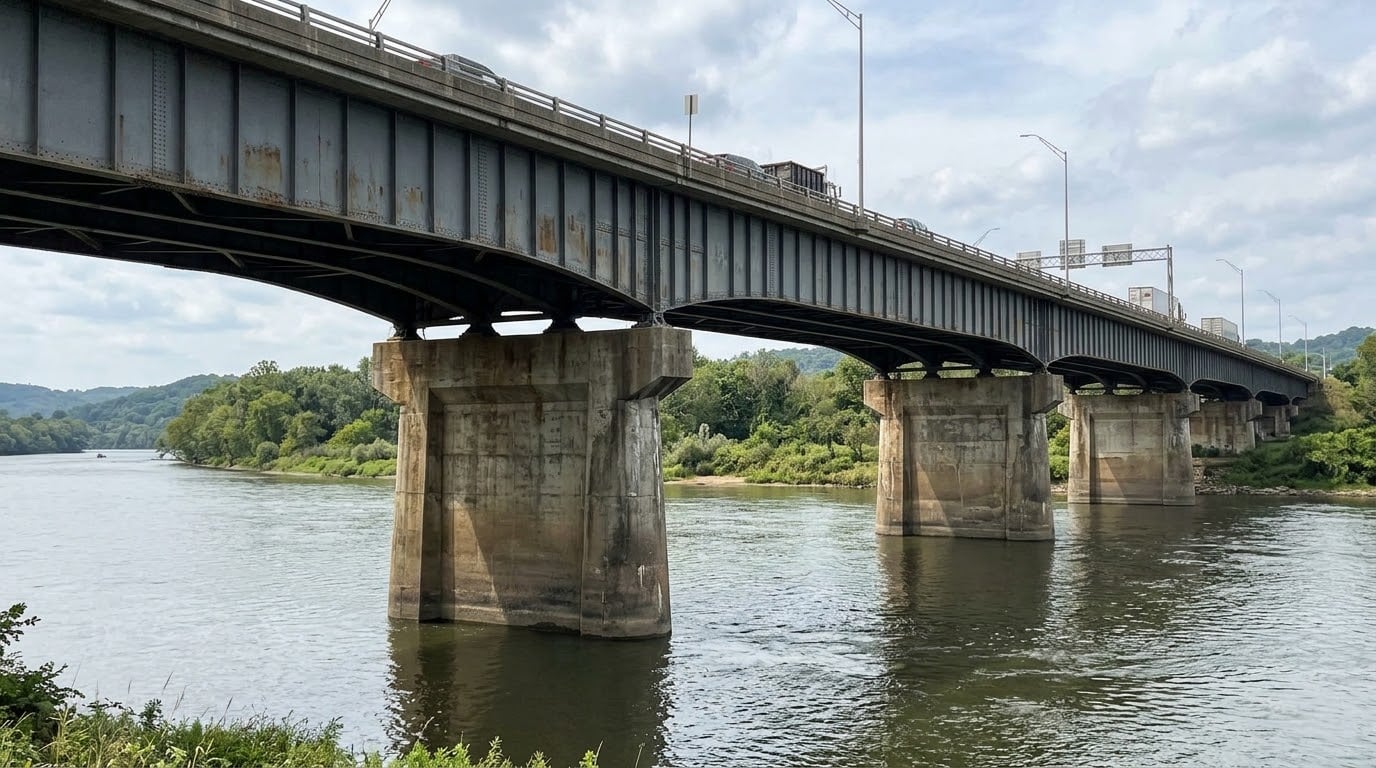
Girder bridges are bridges that use strong horizontal beams, called girders, to carry the deck and traffic across a gap. The girders pass the load to piers, abutments and foundations. They suit short, medium and some long spans, and are among the most common bridges in Bangladesh and worldwide.
This girder bridges guide covers girder bridge engineering in simple words. You will learn the girder bridge structure, components, materials, design, construction cost and maintenance. It also studies three real bridges in Bangladesh, from a 4.8 km concrete crossing to a 6.15 km steel bridge, and states its method and limits openly.
Key Takeaways
A girder bridge sends loads from the bridge deck to girders, then to bridge piers, bridge abutments and foundations.
The main types of girder bridges are I-girder, plate girder and box girder bridges. Each can use steel or concrete.
According to PCI, prestressed concrete I-girders generally suit about 20 to 45 meters. A box girder bridge can often pass 100 meters.
AASHTO LRFD sets a 75-year design life for new bridges.
FHWA requires routine inspection at least every 24 months. This is the core of girder bridge maintenance.
In most cases, soil and river conditions shape the design as much as span does.
Span ranges here are typical values from published guidance, not design limits.
Girder Bridge Facts at a Glance
Fact | Typical value | Source or note |
|---|---|---|
Design life of new bridges | 75 years | AASHTO LRFD |
Routine inspection interval | At least every 24 months | FHWA |
Prestressing strand strength | About 1,860 MPa | Common 270 ksi strand |
Steel density | About 7,850 kg/m³ | Standard value |
Concrete density | About 2,400 kg/m³ | Standard value |
Structural steel yield strength (Grade 50) | About 345 MPa | ASTM A709 |
Concrete design strength age | 28 days | Standard practice |
Design truck weight (HL-93) | About 325 kN | AASHTO LRFD |
Prestressed I-girder span | About 20 to 45 m | PCI guidance |
Padma Bridge main spans | 41 spans of 150 m | Public project data |
Jamuna Bridge length | 4.8 km | Public project data |
Dhaka Metro Line 6 viaduct | 20.1 km | Public project data |
What Is a Girder Bridge? A Simple Definition
A girder bridge is a bridge where horizontal girders carry the deck and pass the load to supports at each end. The girders resist bending from vehicles or trains. It is one of the most common bridge types in the world, and it suits short, medium and some long spans.
The Britannica guide to girder bridges explains the basic idea. In Bangladesh, the Roads and Highways Department and LGED use girder bridges on highways, rural roads and flyovers. Learn more about bridge engineering basics.
How Do Girder Bridges Work? The Load Path Explained
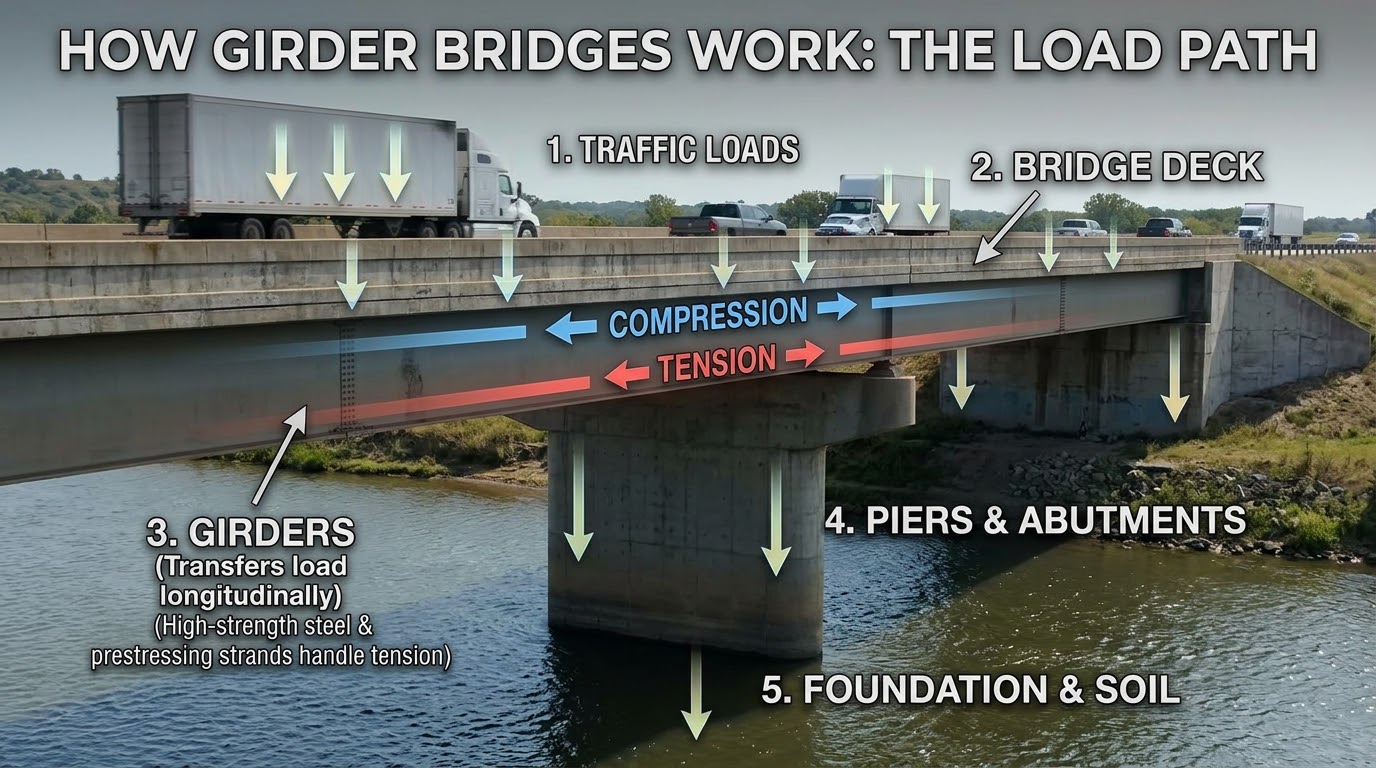
Girder bridges work by moving load in steps. Traffic loads the bridge deck, the deck passes the load to the girders, and the girders send it to piers and abutments. These carry it down to the foundation and soil. The girders bend slightly, with compression on top and tension below.
This is how girder bridges work in every girder bridge structure. Steel or prestressing strands handle the tension. Prestressing strands commonly have a tensile strength near 1,860 MPa, which is about 270 ksi.
Why Are Girder Bridges Important in Bangladesh?
Girder bridges are important in Bangladesh because the country has around 700 rivers and tributaries, plus many canals and wetlands. People need safe crossings for roads and rail. Girder bridges are generally simple to build with local materials and skills, and they suit both short village spans and long highway spans.
The scale of benefit can be large. The Padma Bridge was expected to add 1.2 to 1.7 percent to Bangladesh's GDP every year. It also improves road links for 21 south and southwestern districts.
Key Terms Explained: Girder, Flange, Web and Span
Girder: the main beam that carries the deck.
Flange: the top or bottom plate of a girder.
Web: the thin vertical part that joins the flanges.
Span: the distance between two supports.
Deck: the surface that carries traffic.
What Are the Components and Structure of a Girder Bridge?
Girder bridge components fall into two groups: the bridge superstructure above the supports and the substructure below. Together they form the girder bridge structure. The superstructure carries traffic, and the substructure carries the superstructure and passes loads to the ground. These are the main structural components of girder bridges.
What Does the Bridge Superstructure Include?
The bridge superstructure includes everything above the supports: the bridge deck, the girders, the bearings, and the diaphragms and cross girders. The deck carries traffic, the girders carry the deck, the bearings allow small movement, and the diaphragms keep the girders stable and share load between them.
Bridge deck: the driving surface
Girders: the main load-carrying beams
Bearings: pads that allow small movement
Diaphragms and cross girders: stability and load sharing
What Does the Substructure Include?
The substructure includes the bridge piers, the bridge abutments and the foundations. Piers are middle supports. Abutments are end supports that also hold back soil. Foundations, such as piles or wells, reach strong soil and pass the whole bridge load to the ground. Bangladesh often needs deep piles because of soft river soil.
The Padma Bridge shows the scale. A total of 294 piles support its superstructure. Read more about foundation design to see why.
What Are the Types of Girder Bridges? I-Girder, Plate Girder and Box Girder
The main types of girder bridges are the I-girder bridge, the plate girder bridge and the box girder bridge. Engineers also group them by material, such as a steel girder bridge or a concrete girder bridge. These groups are also called the types of bridge girders, and each suits different spans and loads.
What Is an I-Girder Bridge?
An I-girder bridge uses girders shaped like the letter I, with a top flange, a bottom flange and a thin web joining them. It is simple and widely used. An I-girder bridge usually suits short and medium spans, and it is often built with precast concrete or rolled steel.
What Is a Plate Girder Bridge?
A plate girder bridge uses steel plates welded into a custom I-shaped girder. Engineers can change the plate size to match the load. A plate girder bridge tends to suit heavy loads and railways, and it can reach long spans when the web is deep and stiffened.
The American Institute of Steel Construction shares design resources.
What Is a Box Girder Bridge?
A box girder bridge uses a hollow, box-shaped girder that resists twisting very well. This makes it a good fit for long spans, curved roads and elevated expressways. A box girder bridge can be built in prestressed concrete or steel. The Jamuna Bridge is a well-known example in Bangladesh.
What Are Precast Concrete Girders?
Precast concrete girders are girders cast in a yard or factory, then lifted into place on site. Controlled casting generally improves quality and saves time on site. Precast concrete girders are common on highway bridges and elevated lines, and they are often prestressed to carry heavier loads over longer spans.
Read the Precast/Prestressed Concrete Institute overview to learn more.
What Materials Are Used in Girder Bridges? Steel, Concrete and Composite
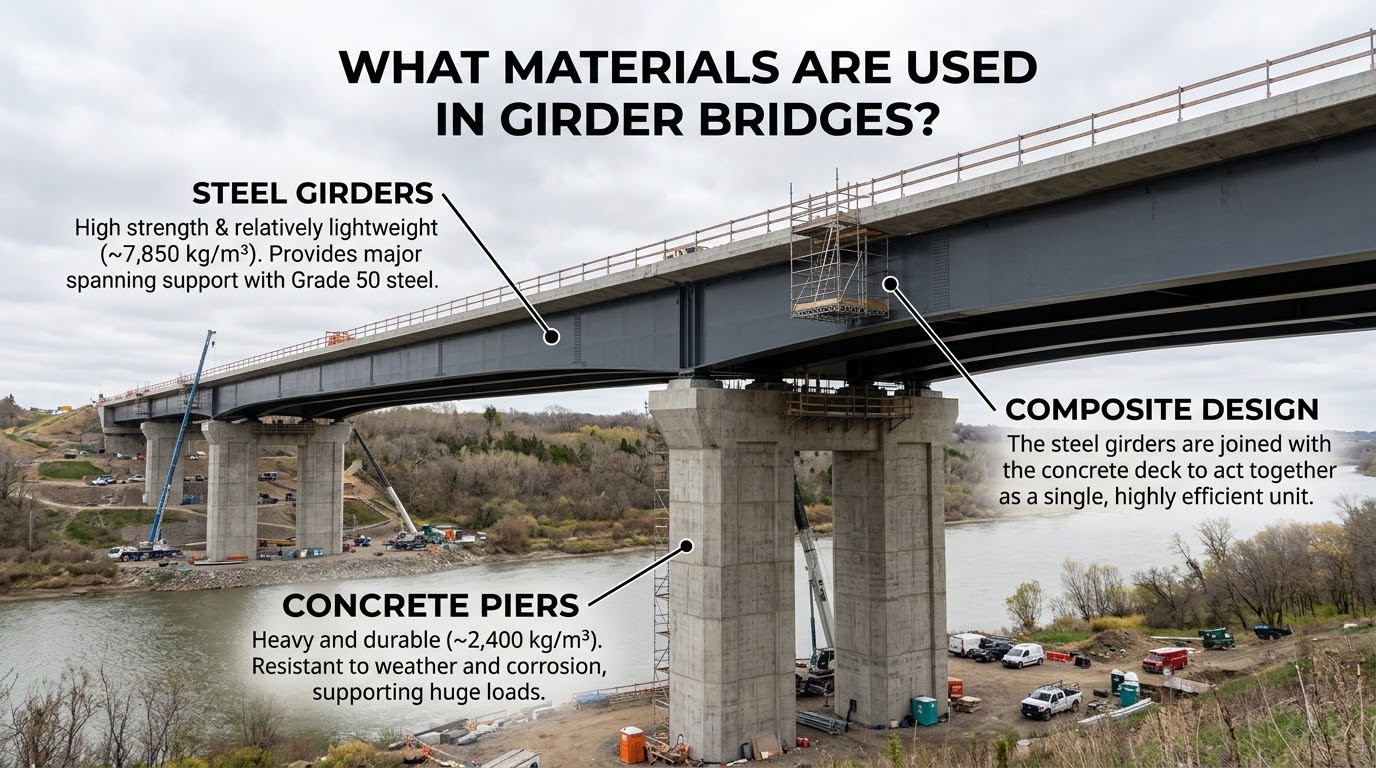
Girder bridge materials mainly include structural steel, reinforced concrete, prestressed concrete and steel and concrete composite. Steel is strong and light. Concrete generally resists corrosion and often needs less upkeep. Composite designs join a steel girder with a concrete deck so both materials work together efficiently.
Steel weighs about 7,850 kg per cubic meter, and concrete about 2,400 kg per cubic meter. Common Grade 50 bridge steel has a yield strength of about 345 MPa. Concrete reaches its design strength at 28 days, and girder concrete is often specified between about 35 and 55 MPa. The Steel Construction Institute offers free steel bridge guidance.
Steel vs Concrete Girder Bridges: How Do They Differ?
In the steel vs concrete girder bridges comparison, a steel girder bridge tends to suit long spans and heavy loads, while a concrete girder bridge tends to suit short and medium spans and often needs less upkeep. Neither wins in every case. The right choice depends on span, site and climate.
Factor | Steel Girder Bridge | Concrete Girder Bridge |
|---|---|---|
Weight | Light (about 7,850 kg/m³) | Heavy (about 2,400 kg/m³ concrete, plus steel) |
Span | Long | Short to medium |
Corrosion risk | Higher | Lower |
Maintenance | More frequent | Less frequent |
The advantages of steel girder bridges include high strength, fewer piers, fast assembly and easy repair. In humid coastal areas, steel usually needs extra coating care.
Girder Bridge vs Beam Bridge: What Is the Difference?
A beam bridge uses simple beams over a short gap, while a girder bridge uses larger, often built-up beams for heavier loads and longer spans. In a girder bridge vs beam bridge comparison, all girders are beams, but not all beams are girders. Girders also collect load from smaller beams above them.
How Do You Choose the Right Girder Bridge Type? A Step-by-Step Guide
To choose the right girder bridge type, match the girder to the span, load, soil and climate. Start with site data, then compare two or three options on build time and upkeep. A licensed bridge engineer should confirm the final choice. The five steps below show the usual order.
Measure the span: Under 20 meters, reinforced concrete often works. From 20 to 45 meters, prestressed I-girders are common. Above that, steel or box girders typically appear.
Check the load: Heavy rail or truck traffic may need plate girders.
Test the soil: Soft soil generally favors lighter girders and deep piles.
Check the climate: Coastal salt air usually favors concrete or well-coated steel.
Review build time: Precast girders can save time on short and medium spans.
Case Studies: Girder Bridges in Bangladesh
Each case study follows the same pattern: problem, approach, results and lessons. Figures come from public sources and should be read as reported values.
Case Study 1: Jamuna Bridge (Prestressed Concrete Box Girders)
The Jamuna Bridge was formerly named the Bangabandhu Bridge. It was renamed in February 2025.
Problem: The Jamuna is a very wide, shifting river. The river is 10 to 20 km wide, and river training works guide it through a bridge opening of only 4.8 km.
Approach: The bridge is a prestressed concrete box girder bridge with 49 main spans of about 99 meters. The box is 6.5 meters deep at the piers and 3.25 meters deep at mid-span. The structure has 1,263 deck segments, 121 piles and 50 piers. Tubular steel piles driven into the river bed support it.
Results: The bridge opened on 23 June 1998, and it was the 11th largest bridge in the world at that time. It is 4.8 km long and 18.5 meters wide. Read the Banglapedia entry for more detail. After a crack first developed in a box girder in 2006, the Bangladesh Bridge Authority lowered the train speed limit to 20 kph. After the Jamuna Railway Bridge opened in 2025, the rail tracks were removed to add road space.
Lessons: Evidence from this case indicates that prestressed concrete box girders can serve long river crossings for decades. It also shows that long-span girders need close monitoring. Published repair and monitoring reports exist for this bridge. Cracks and repairs are a reminder that inspection is not optional.
Case Study 2: Padma Bridge (Steel Truss Girders Over a Major River)
Problem: The Padma is a wide, fast river with deep, shifting channels. Reports indicate the soil is soft and scour risk is high. Bangladesh also sits in an active seismic region.
Approach: According to the Bangladesh Bridge Authority, the bridge is a major public project. The main bridge has 41 spans of 150 meters on 42 piers. It is a double-layer steel truss bridge, with a four-lane highway on the upper level and a single-track railway below. The spans are composite trusses, and a post-tensioned segmental concrete deck carries the highway.
Results: The bridge is 6.15 km long. Construction started on 26 November 2014, and the bridge was inaugurated on 25 June 2022. The final construction cost was about Tk 30,193 crore. In its first year, tolls brought in roughly Tk 800 crore.
Lessons: This case suggests that in deep, scour-prone rivers, foundations drive the design. A repeating span length also appears to help, since 41 near-identical spans can speed up fabrication and launching. The build took more than seven years, which shows how long large river crossings can take.
Case Study 3: Dhaka Metro Rail Line 6 (Elevated Girders in a Dense City)
Problem: Dhaka is extremely crowded. There is little ground space, and traffic is heavy. A ground-level line would likely have disrupted the city for years.
Approach: According to DMTCL, Line 6 runs on an elevated viaduct. Builders completed the entire 20.1 km viaduct when the last girder segment was installed. The line has 16 elevated stations, each 180 meters long.
Results: The first section opened for service on 29 December 2022, and the second section on 5 November 2023. The line was expected to carry 60,000 people per hour and cut the Uttara to Motijheel trip from about two hours to 40 minutes. The project was approved in December 2012 at a cost of Tk 21,985 crore. Japan provided about 60 percent of the cost as a soft loan.
Lessons: In dense cities, elevated girders appear to save ground space and reduce road disruption. Careful lifting plans and night work are likely to matter as much as the girder design. The long timeline, from approval in 2012 to full opening in 2023, also shows that planning and funding matter as much as engineering.
What Do Engineers Check First on Bangladesh Sites?
Engineers usually check the riverbank, soil, flood level, drainage and seismic risk first. They walk the bank for erosion and scour, take soil samples early, set the deck above the design flood level, and plan coating and drainage for humid air. These notes are general good practice, not records of one project.
Riverbank: look for erosion, flood marks and scour near old piers.
Soil: soft alluvial soil can change foundation depth a lot.
Flood level: keep the bridge deck above the design flood level.
Coating and drainage: humid air and monsoon rain speed up rust and water damage.
Seismic risk: Bangladesh lies in an active seismic zone.
Worked Examples: How Girder Bridges Fit Different Sites
These examples are illustrative. They are not real project records.
Example 1: A 15-meter village road bridge. The span is short and the load is light. A reinforced concrete girder bridge on pile foundations is a common fit.
Example 2: A 40-meter highway bridge over a river. The span is medium and trucks are heavy. Prestressed concrete I-girders can be cast in a yard and lifted into place. This may cut time on site.
Example 3: An 80-meter rail crossing. The span is long and the load is heavy. A steel plate girder is a typical choice. Good coating helps protect it from humid air.
Example 4: A curved elevated road in a city. Space is tight and the road bends. A box girder resists twisting well, so it usually suits this case.
What Are the Span Length and Load Capacity of a Girder Bridge?
Girder bridge span length ranges from about 10 meters for reinforced concrete to over 100 meters for steel or box girders. Girder bridge load capacity depends on girder size, material and design code. Engineers check dead load, traffic, wind, water flow and earthquakes. The ranges below are typical, not strict limits.
Reinforced concrete: about 10 to 20 meters
Prestressed concrete I-girder: about 20 to 45 meters
Steel plate girder: about 30 to 100 meters
Box girder: about 40 to 200 meters
According to AASHTO, the HL-93 design truck weighs about 325 kN, and the design lane load is about 9.3 kN per meter. Real bridges are checked against both. For scale, the Padma Bridge lists a load limit of 10,000 tonnes in public project data.
How Does Girder Bridge Load Distribution Work?
Girder bridge load distribution describes how a vehicle's weight spreads across several girders. Cross girders and diaphragms share the load, so one girder does not carry too much. Good load distribution usually lets engineers use lighter girders and keeps stress levels even across the whole bridge deck.
How Is a Girder Bridge Designed? Standards, Analysis and Modern Methods
Girder bridge design starts with site data: soil tests, river flow, flood level and traffic counts. Engineers then size the girders, deck, piers and foundations. They check bending, shear, deflection and fatigue using structural analysis of girder bridges, and they follow a design code such as AASHTO LRFD.
A simple sizing check shows the idea. According to AASHTO LRFD guidance, the suggested minimum depth of a simple-span prestressed concrete I-girder is about 0.045 times the span. For a 40-meter span, that gives about 1.8 meters. Final depth still comes from full analysis.
Which Girder Bridge Design Standards Apply?
Girder bridge design standards set the loads, safety factors and detailing rules for a bridge. Common ones include AASHTO LRFD, the Eurocodes, and RHD and LGED guidelines in Bangladesh. The right standard depends on the owner, the road class and the contract. A licensed engineer confirms which code governs each project.
AASHTO LRFD Bridge Design Specifications, which set a 75-year design life
RHD and LGED design guidelines
What Is Modern Girder Bridge Design?
Modern girder bridge design uses 3D models, digital load checks and seismic checks to test a bridge before it is built. Many teams also review scour and climate risks early. These tools help engineers find problems sooner and choose lighter, safer girders for each site.
Discover how structural analysis works in practice.
What Is Concrete Girder Bridge Design?
Concrete girder bridge design focuses on cracking, prestress force, concrete strength and cover over the steel. In most cases, prestressing keeps the girder in compression, which limits cracks. Designers also check creep and shrinkage over time, because concrete changes shape slowly under long-term load.
How Is a Girder Bridge Built? The Construction Process
Girder bridge construction happens in stages: foundation, piers and abutments, girders, deck and finishing. Crews build the supports first, then lift in the girders and cast the deck. Load testing comes last. The girder bridge construction process can take months or years, depending on span, river conditions and season.
Survey and soil test
Foundation piles or wells
Bridge piers and bridge abutments
Bridge girder fabrication in a yard or factory
Girder launching by crane or launching truss
Bridge deck casting (concrete reaches design strength at 28 days)
Bearings, joints and railings
Load testing
Real timelines vary widely. The Jamuna Bridge works began in 1994 and finished in 1998. The Padma Bridge took more than seven years from the 2014 start.
What Is Bridge Girder Fabrication?
Bridge girder fabrication is the making of girders before they reach the site. Steel girders are cut, welded and coated in a workshop. Concrete girders are cast in molds, often with prestressing strands. Factory-style control usually improves quality, shortens site work and makes girder sizes more consistent.
What Affects Girder Bridge Cost?
Girder bridge cost depends on span, width, material, foundation depth, site access and local steel and cement prices. Two bridges of equal length can differ widely in cost. Precast concrete girders often suit short and medium spans, while steel often suits long spans. This guide gives no unit prices because market rates change often.
Public project totals show the range. The Padma Bridge cost about Tk 30,193 crore. The Dhaka Metro Line 6 was approved at Tk 21,985 crore. These include far more than girders, such as river training, stations and approach roads.
Learn what affects bridge costs in more detail.
What Are the Advantages and Disadvantages of Girder Bridges?
The main girder bridge advantages and disadvantages come down to simplicity versus weight. Girder bridges are simple, flexible and easy to inspect, but they get heavy over long spans and need strong foundations. Very long crossings may use cable-stayed or other bridge types instead.
Advantages: simple design, many span options (about 10 to 200 meters), quick precast construction, easy inspection.
Disadvantages: heavy for long spans, need strong foundations, steel needs regular coating.
Where Are Girder Bridges Used? Girder Bridge Applications in Bangladesh
Girder bridge applications include highways, railways, urban flyovers, rural roads and footbridges. In Bangladesh, they link villages across canals, carry trucks on national highways, support elevated city roads and carry trains over rivers. The same basic girder idea scales from a short village span to a very long river crossing.
Highway girder bridges: national roads and interchanges. Discover highway bridge examples.
Railway girder bridges: plate girders generally carry heavy trains. Discover railway bridge examples.
Urban elevated roads: box and precast girders suit tight city spaces.
Rural roads: short concrete girder spans link villages and markets.
How Do You Maintain a Girder Bridge? Inspection Basics
Girder bridge maintenance means regular inspection, clean drains, timely repainting of steel and scour checks after each monsoon. According to FHWA, routine inspections are required at least every 24 months. Early detection matters, as the crack history of the Jamuna Bridge shows. Small repairs are usually cheaper and safer than late repairs.
A bridge designed for 75 years under AASHTO LRFD only reaches that life with steady care. The Jamuna Bridge first showed box girder cracks in 2006, 8 years after it opened.
Read the FHWA bridge program for guidance. Read more about bridge maintenance to understand each step.
How Did We Evaluate the Information?
We collected sources from standards bodies, government agencies and professional institutes first, then checked each figure against several public sources. We tested each claim for local fit with Bangladesh conditions. In November 2026 we compared each case study figure with at least two public sources.
What Criteria Did We Use?
We judged every claim on five criteria: source quality, recency, local fit, clarity and consistency. Official and standards-based sources were preferred, and numbers had to agree across sections. A non-engineer should be able to follow each explanation. The table below shows what we checked for each criterion.
Criterion | What we checked |
|---|---|
Source quality | Official, standards-based or professional sources preferred |
Recency | Latest public update where available |
Local fit | Applies to Bangladesh soil, climate and practice |
Clarity | A non-engineer can follow the explanation |
Consistency | Numbers agree across sections |
What Tools and Sources Did We Use?
We used web research across AASHTO, FHWA, PCI, AISC, the Steel Construction Institute, the Bangladesh Bridge Authority, DMTCL, Banglapedia and news and engineering reports. We did not run lab tests, site measurements or software simulations for this article. The guide is a research summary, so it should be read as education, not design advice.
What Assumptions Did We Make?
We assumed normal ground, ordinary traffic loads and typical span ranges from published guidance. Standards values such as the HL-93 truck and strand strength are common design values, not project-specific numbers. We give no unit prices, because steel, cement and labor rates change often. The worked examples are illustrative.
What Are the Limits of This Guide?
This guide is not design advice. Every bridge needs site soil data, hydrology, load analysis and a licensed engineer's sign-off. Figures and standards can change, and public sources sometimes differ slightly, so check the linked sources for the latest values. Case study lessons are our reading of public information and show patterns, not proven cause and effect.
Scope: common girder bridges for roads and rail. Cable-stayed, arch and movable bridges are not covered in depth.
Publisher note: Nusaiba publishes this guide for education, and we link to independent sources so you can verify each point.
How Do We Keep It Current?
We plan to review this guide every six months and after major changes to standards or projects. Updated figures, new case studies and corrections will be added with a new date at the top of the page. If you spot an error, please report it through the Nusaiba website.
Frequently Asked Questions About Girder Bridges Explained
What is a girder bridge in simple words?
A girder bridge is a bridge with strong horizontal beams that hold the road or rail. The girders pass the load to bridge piers and bridge abutments at each end. It is a simple, common bridge type used for short, medium and some long spans, from about 10 meters to over 100 meters.
What are the main types of bridge girders?
The main types are I-girder, plate girder and box girder. I-girders usually suit short spans of about 20 to 45 meters. Plate girders often suit heavy loads. Box girders tend to suit long spans and curved roads. Each type can be built in steel, concrete or composite material.
How do steel and concrete girder bridges differ?
Steel is light and strong, so it generally suits long spans and heavy loads. Concrete tends to suit short and medium spans and often needs less upkeep. Steel weighs about 7,850 kg per cubic meter and concrete about 2,400. In humid coastal areas, steel usually needs extra coating care.
How long can a girder bridge span?
A girder bridge can span from about 10 meters up to over 100 meters. Reinforced concrete spans are shortest, about 10 to 20 meters. Prestressed concrete typically reaches about 45 meters. Steel plate and box girders can reach much longer spans. Site conditions and design choices can move these values.
How long does a girder bridge last?
AASHTO sets a 75-year design life for new bridges. With good inspection and repair, many girder bridges may last longer. Poor drainage, rust and scour can shorten that life, so regular care matters. FHWA requires routine inspection at least every 24 months to catch problems early.
What is the difference between a girder bridge and a beam bridge?
A beam bridge uses simple beams for short gaps. A girder bridge uses larger, built-up beams for heavier loads and longer spans. Girders also collect load from smaller beams above them. In short, all girders are beams, but not all beams are girders. The difference is mainly size, build-up and load role.
What to Remember About Girder Bridges
In summary, girder bridges use horizontal beams to carry the bridge deck and send loads to piers, abutments and foundations. The bottom line is simple: span, load, soil and climate decide the right girder type. Concrete generally suits short and medium spans. Steel and box girders often suit long spans and heavy loads.
To sum up the key takeaway, learn the parts, know the types, and match the girder to the site. The Jamuna, Padma and Dhaka Metro cases suggest that foundations, river behavior, build method and inspection matter as much as the girder itself. This guide is educational, and real projects need a licensed engineer.
Next Steps: Compare Options and Explore Further
Compare steel and concrete girder options side by side.
Which one fits your site? See the best girder type by span and load.
See options and project examples from different bridge types.