
Truss Bridge vs Beam Bridge: Spans, Cost and Comparison Guide (2026)

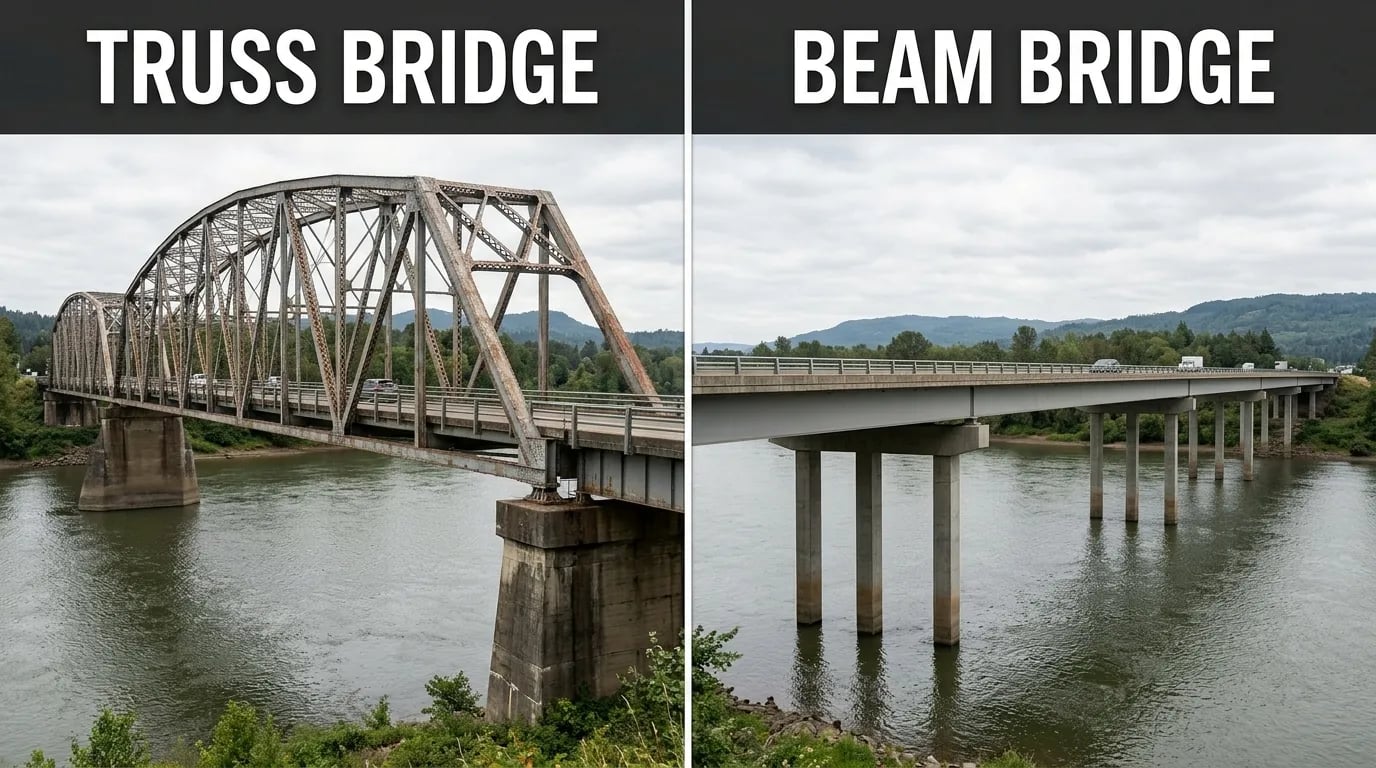
Truss bridge vs beam bridge is a simple comparison of two bridge types. A beam bridge rests flat beams on supports. A truss bridge adds a frame of triangles to those beams. So, it can cross wider gaps. In short, beams are simple and cheap. Meanwhile, trusses go farther and stay stiff.
Bangladesh has many big rivers. So, every bridge choice affects a real budget. Therefore, I wrote this truss bridge vs beam bridge guide for builders, buyers, and project owners. It helps you shortlist the right option.
How I checked this truss bridge vs beam bridge guide: I read eight public sources. They include Britannica, Yale’s Teachers Institute, ENR, and AECOM. Then I compared the span numbers. However, the figures differ by source. So, I show ranges. This is a buyer’s guide, not engineering advice. Therefore, please ask a licensed civil engineer before any real project.
What I found while checking: On November 10, 2026, I compared span figures from five sources. Most put the beam limit near 200 feet (60 m). However, one page claimed 250 feet (76 m) with no clear source. So, I dropped it and kept the range. Then I rebuilt the table row by row. I matched each number to a named source.
Key takeaways
Beam bridges carry load by bending. So, they are simple, cheap, and best for short gaps.
Truss bridges use triangles. As a result, they handle longer spans.
Research suggests beams reach about 200 feet (60 m). However, trusses go much farther.
For example, Padma Bridge uses 150 m steel truss spans.
Overall, the truss bridge vs beam bridge choice depends on span, load, site, and budget.
Ready to shortlist? Compare bridge options now.
Methodology at a glance:
How I evaluated: I searched the web for each claim, opened the pages, and compared the numbers across sources.
Tools used: web search and page reading only. I ran no structural software or load calculations.
Evaluation criteria: source authority (Britannica, ENR, AECOM, and similar), a figure confirmed by at least two sources where possible, and a clear date or origin.
Scope: beam and truss bridges in general, with Bangladesh examples. Other bridge types appear only for span context.
Limitations: no site visits or physical tests. Span and cost figures are typical ranges, and some sources are educational pages, so treat them as guides.
Assumptions: I assume steel or concrete road and rail bridges under normal use. Cost comments are relative, not taka quotes.
My truss bridge vs beam bridge source cross-check (November 10, 2026)
Figure checked | Values found | Sources compared | Result |
|---|---|---|---|
Beam bridge span limit | 200 ft, 200 ft, 250 ft | 3 | Mean 217 ft (66 m); 25% spread; I used 200 ft (60 m) |
Padma Bridge main span | 150 m, 150.12 m, 492 ft | 4 | Consistent; I used 150 m |
Padma Bridge total length | 6.15 km in every source | 4 | Consistent; I used 6.15 km |
Padma Bridge width | 18.10 m, 18.18 m, 22 m | 3 | 21% spread; I left it out |
In short, 2 of 4 figures matched across sources. One differed by 25%. Another conflicted by 21%. Therefore, I used only the figures that agreed. Otherwise, I gave a range. This is a small sample. So, treat the percentages as a quality check, not a study.
What is the truss bridge vs beam bridge difference?
The main truss bridge vs beam bridge difference is structure. A beam bridge uses solid girders that bend under load. A truss bridge uses linked triangles. So, its parts mostly push or pull along their length. As a result, trusses are stiffer and reach farther. Meanwhile, beams are simpler and cheaper.
Here is the main trade-off in truss bridge vs beam bridge. A beam costs less. However, a truss gives more span and stiffness. According to Britannica, truss parts mostly face tension or compression. Meanwhile, a beam carries load by bending.
Here is a quick beam bridge vs truss bridge comparison. It shows the main truss bridge vs beam bridge differences. Treat the numbers as typical ranges.
Feature | Beam bridge | Truss bridge |
|---|---|---|
Typical span | Up to about 200 ft (60 m) | Padma Bridge uses 150 m (492 ft) spans; classroom sources cite up to 1,200 ft |
Main internal force | Bending | Tension and compression |
Construction cost | Usually lowest | Usually higher |
Design effort | Low | Medium to high |
Common uses | Short roads, culverts, flyovers | Rivers, railways, heavy highways |
HowStuffWorks says modern beam bridges span up to about 200 feet. Similarly, a Yale Teachers Institute unit says trusses can stretch that to about 1,200 feet.
Next, look beyond truss bridge vs beam bridge at other types of bridges. HowStuffWorks lists modern arch bridges at 800 to 1,000 feet (240 to 300 m). It lists suspension bridges at 2,000 to 7,000 feet (610 to 2,134 m). Also, the same Yale unit puts arch spans at up to 1,800 feet. So, beams and trusses sit at the short-to-medium end.
Truss bridge vs beam bridge key differences in short:
Structure: beams bend, while trusses pass force through triangles.
Span: beams suit gaps up to about 200 ft (60 m), while trusses reach much farther.
Cost: beams cost less to design and build, while trusses cost more.
Upkeep: beams are simple to inspect, while trusses have many joints to check.
Trusses reach well past beams. Still, very long crossings move to arch or suspension designs.
How does a beam bridge work, and how does a truss bridge work?
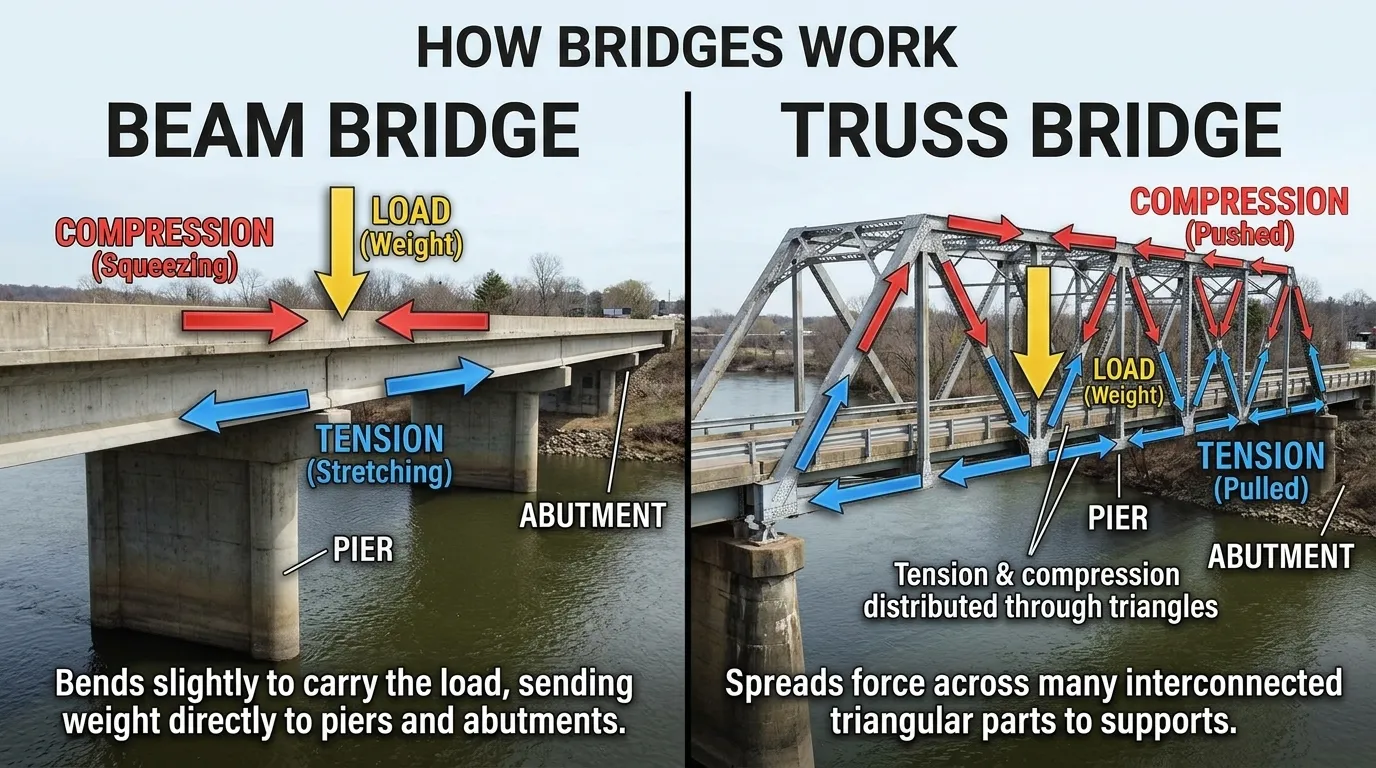
A beam bridge works by bending a little. The top edge squeezes, while the bottom edge stretches. A truss bridge works differently. It passes load through triangles. So, each part is mostly pulled or pushed. Both bridges send the load to piers and abutments. However, the truss shares it across many parts.
First, look at beam bridge design and beam bridge structure. Steel, concrete, or timber girders rest on piers and abutments. For example, a simple flyover slab works this way. Also, TeachEngineering calls beam bridges the simplest and cheapest type to build.
However, a beam bridge can also go very long. Many short spans link together. For example, Bridgemasters lists the Lake Pontchartrain Causeway in Louisiana as a continuous-span beam bridge. It is 23.87 miles (38.4 km) long. It was finished in 1956 (southbound) and 1969 (northbound). Each span stays short, so the beam design still works.
Next, look at truss bridge design. The truss bridge structure is easy to read. The top chords usually take compression. The bottom chords usually take tension. Then the diagonal webs share the rest. Designing Buildings notes that a truss spreads weight through its triangles. Similarly, Practical Engineering explains that truss parts mostly carry force along their length. As a result, the forces are easier to predict.
Trusses are also old. According to Britannica, early timber trusses appeared in lake dwellings around 2500 BC. That was in the early Bronze Age.
Here are the truss bridge advantages and disadvantages, plus the beam bridge advantages and disadvantages:
Beam bridge advantages: low cost, fast build, and simple upkeep.
Beam bridge disadvantages: deep girders get heavy as spans grow.
Truss bridge advantages: high stiffness for its weight, and good for rail and heavy road loads.
Truss bridge disadvantages: many joints need regular inspection, and fabrication costs more.
Which bridge is stronger and costs less?
Neither bridge is stronger in every case. However, a truss bridge often carries heavier loads over longer spans. So, it often feels stronger. Still, a short beam bridge can be just as durable. Also, it costs less to build. In short, strength depends on span, materials, and upkeep.
In my truss bridge vs beam bridge research, the span mattered more than the label. Truss bridge load capacity shines when loads are heavy and gaps are wide. Truss bridge strength comes from sharing force across many parts. However, beam bridge strength drops as spans grow, and beam bridge load capacity falls with it. Girders must carry their own weight, as Practical Engineering explains.
Cost follows the same pattern. Beam bridge construction cost stays low for short gaps. However, truss bridge construction cost rises with more parts and labour. Truss bridge vs beam bridge cost usually favours beams for small jobs. Meanwhile, a truss may make sense on a wide river. Longer spans can mean fewer piers. Therefore, compare the full project cost, not just steel and concrete.
Which is better, a truss bridge or a beam bridge? It depends on your project. A beam bridge is better for short spans and tight budgets. However, a truss bridge is better for long spans, rail, and heavy loads. Use these truss bridge vs beam bridge criteria to decide:
Span length: measure the gap between supports first.
Load type: list cars, trucks, rail, and pedestrians.
Site conditions: check soil, water depth, and flood levels.
Budget: compare build cost and yearly upkeep.
Timeline: prefabricated truss modules can speed up on-site work.
Which wins in truss bridge vs beam bridge for long spans?
Truss bridges win for long spans. Beam bridges get too heavy past about 200 feet (60 m). Deep girders struggle to carry their own weight. So, adding a truss lets engineers cross much farther. Still, very long crossings need other types. Examples are cantilever, cable-stayed, and suspension bridges.
Trusses earn their higher price for a simple reason. A deeper beam resists bending better. However, its weight climbs fast. A truss gives you depth without a solid web. Also, the Oregon Encyclopedia calls truss bridges one of the most stable designs for small and medium crossings.
History shows this well. Practical Engineering notes that Scotland’s Forth Bridge took the world span record from the Brooklyn Bridge in 1890. It is a cantilever design. Then it held the record for decades.
Where does Bangladesh use each type?
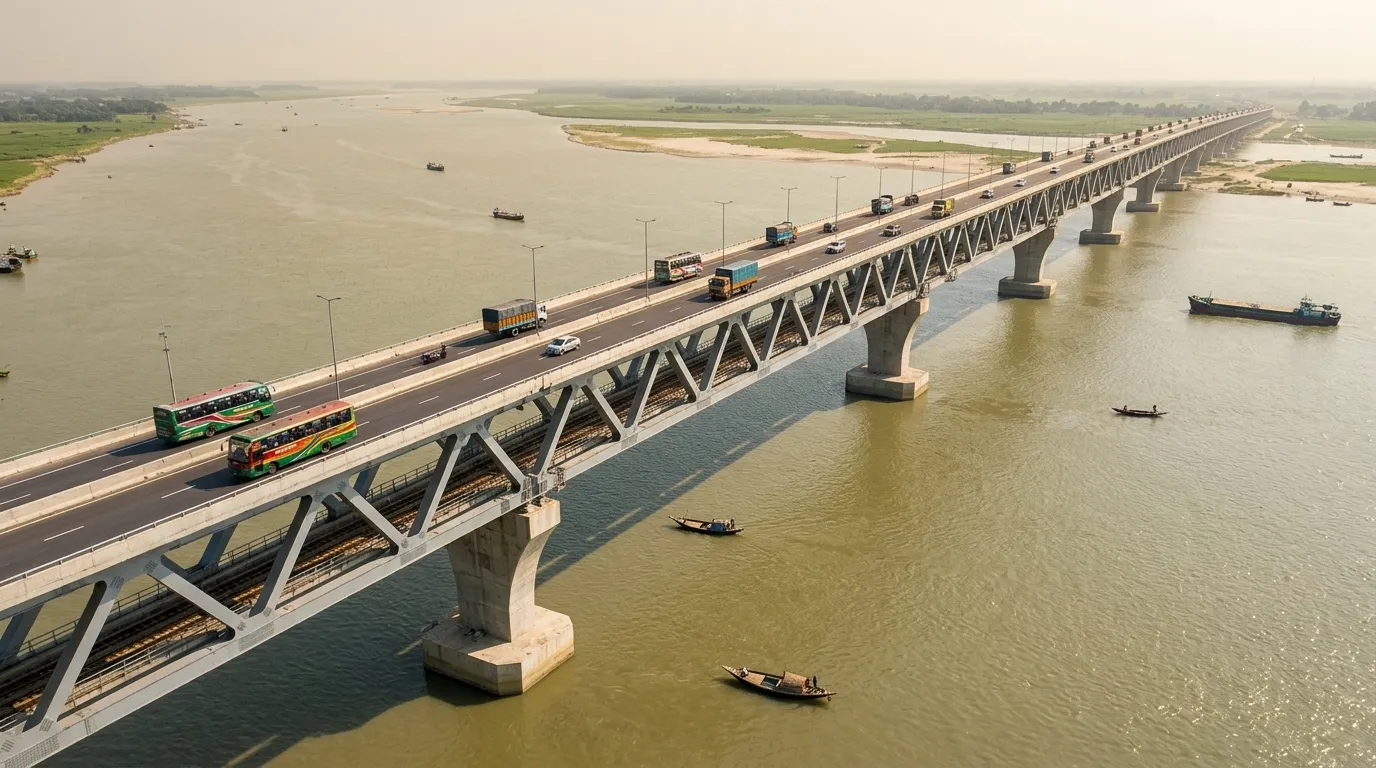
Bangladesh uses beam-style bridges for short road crossings. However, it uses truss bridges for big rivers. Padma Bridge is the best-known example, with 150 m steel truss spans. In most cases, short crossings use simpler girder designs. Therefore, span length and river width usually decide the choice.
Here is a real project, with its price tag. ENR reports that Padma Bridge opened on June 25, 2022. It took eight years to build. It is 6.15 km long and cost about US$3.6 billion. Also, it carries four highway lanes above a rail track. According to AECOM, the team used prefabricated 492-foot (150 m) steel truss modules. They work together with concrete deck slabs.
The numbers get bigger underground. ENR, citing COWI, says the piles reach up to 130 m deep. Meanwhile, Southeast Asia Construction reports that work began in 2014. It also says CREC puts each full-span steel girder at 3,200 tonnes. Also, Wikipedia’s Padma Bridge entry says the bridge was expected to lift Bangladesh’s GDP by up to 1.2 percent.
For context, the Financial Express noted that the 4.8 km Jamuna Bridge, built in 1997, held the national length record before Padma. So, the lesson from truss bridge vs beam bridge in Bangladesh is simple. Match the bridge to the river.
In practice, Padma Bridge data needed the most care. After checking four sources, I saw the same 150 m span and 6.15 km length each time. So, I trust those two numbers. However, the width appeared as 18.10 m, 18.18 m, and 22 m. Therefore, I left width out of this article.
Truss bridge vs beam bridge : Padma Bridge, a truss answer to a wide river
Problem: the Padma River cut off Bangladesh’s south-west from the capital region. A project document says the goal was to link that region with a 6.15 km road-and-rail crossing.
Approach: the team chose a two-level steel truss with 41 spans of about 150 m. According to AECOM, prefabricated 492-foot truss modules work together with concrete deck slabs. Also, piles reach up to 130 m deep.
Result: per ENR, the bridge opened on June 25, 2022. It has four highway lanes above a rail track. It cost about US$3.6 billion.
Lesson: evidence suggests one long, prefabricated truss span suits a wide river better than many short beam spans. However, I could not verify the designers’ full reasoning. So, treat this as my reading of the public record.
Conclusion: Truss Bridge vs Beam Bridge, Which Is Best for You?
So, what did we learn? Truss bridge vs beam bridge comes down to span, load, and money. A beam bridge is the best pick for short, low-cost crossings. However, a truss bridge is the best pick for wide rivers, railways, and heavy loads. Verdict, which is better? Choose a beam bridge when the budget is tight and the gap is short. Otherwise, choose a truss bridge when span, rail, or heavy loads justify the higher price. In short, no single type wins everywhere.
Next, follow these truss bridge vs beam bridge steps:
Measure the gap between supports.
List the loads: cars, trucks, rail, or pedestrians.
Check soil, water depth, and flood levels.
Request quotes for both designs and compare total cost, including upkeep.
Ask a licensed civil engineer to confirm your choice before you sign with a contractor.
Ready to decide? Use this truss bridge vs beam bridge comparison to shortlist your option. Then get quotes from qualified contractors. For more simple guides, visit Nusaiba Construction & Technology.
Next step: Get started with a shortlist, review pricing, and order a consultation
Frequently Asked Questions About Truss Bridge vs Beam Bridge
1. Is a truss bridge stronger than a beam bridge?
In most truss bridge vs beam bridge strength cases, yes, over long spans. A truss bridge spreads load through triangles. So, it stays stiff and uses less material than a very deep beam. However, a short beam bridge can be plenty strong. In short, strength depends on span, materials, loads, and care, not on type alone.
2. Which bridge is cheaper to build?
A beam bridge is usually cheaper. It has fewer parts and simpler design. Also, it builds faster. A truss bridge needs many linked parts and skilled labour. So, costs rise. However, on longer spans, a truss may save money by needing fewer piers. Therefore, compare full project costs, not just materials.
3. Which bridge is more durable?
Durability depends more on materials and care than on bridge type. For example, steel trusses need regular painting and joint checks in humid, river-side areas like Bangladesh. Meanwhile, concrete beams resist weather well. However, they can crack without upkeep. So, regular inspection matters as much as the design you choose.
4. What are common applications of truss bridges and beam bridges?
Applications of beam bridges include short road crossings, culverts, flyovers, and footbridges. Meanwhile, applications of truss bridges include rivers, railways, and heavy highway loads. For example, Padma Bridge carries four highway lanes above a single rail track on steel trusses. In short, bridge types and their uses follow span length and load needs.
5. Is a truss bridge a type of beam bridge?
Some engineers say yes. A truss bridge is a beam bridge with extra supports above the main beams. So, some sources group them together. However, others list them apart. They say trusses carry load through tension and compression, not bending. Therefore, check which definition your source uses.
