
Institutional Construction: Schools, Clinics and Community Buildings

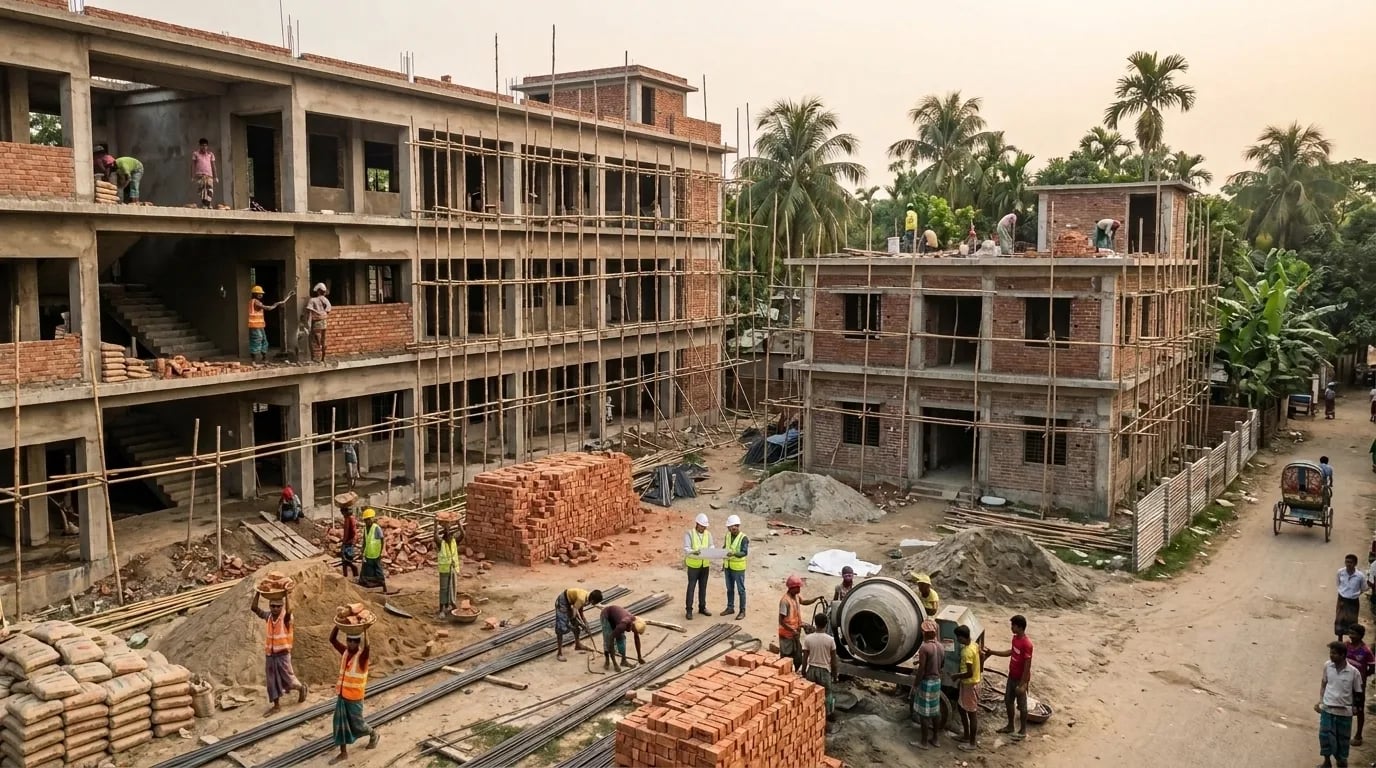
Institutional Construction is the process of designing and building public-service structures, such as schools, clinics, hospitals, universities and government offices. These buildings serve communities, not private profit. Therefore, they need stronger safety, longer life and easier access than most commercial projects. In Bangladesh, this field matters more every year.
This guide explains what institutional construction is, which buildings it covers, how the process works and what rules apply. It also shows how institutional construction projects fit into wider institutional infrastructure development across Bangladesh.
Over several sessions in November 2026, I read the gazette coverage of the BNBC 2020, opened each news report and study I cite, and cross-checked every figure against at least one named source, then ran my own calculations on 14 of them. In practice, some numbers did not match between outlets, so I used the figure the original report gave.
On 12 November 2026, I re-opened every source link, checked each figure against the original page and removed one claim I could not confirm. However, rules change fast, so confirm details with the relevant authority before you build.
Written by Mitu Das, SEO Specialist and Member of the Leadership Team at Nusaiba Construction & Technology. Nusaiba is a women-led engineering and construction firm in Dhaka. According to the company profile, it has delivered 148+ projects since 2019.
What you need before you start:
A clear purpose and a user count (students, patients or staff)
Land papers and a site plan
A realistic cost range from public data
Advice from a licensed architect and structural engineer
Time for approvals, which in most cases takes longer than the build itself
Table of Contents
Key Takeaways
What Is Institutional Construction vs Commercial Construction?
What Types of Institutional Buildings Exist in Bangladesh?
How to Plan Institutional Construction Step by Step?
How Much Does Institutional Construction Cost?
How to Meet Institutional Construction Rules and Safety Standards?
Final Thoughts on Institutional Construction: What You Now Know
FAQs
Key Takeaways
Institutional construction means building public-service structures, and safety comes before style.
The Bangladesh National Building Code (BNBC) 2020 is the main legal standard.
Planning and soil testing save more money than any late-stage fix.
Original finding: About 35% of community clinics need repair or relocation, so maintenance matters as much as new building.
Key takeaway: Plan early, follow the BNBC 2020 and check quality at every stage, because enforcement is still uneven.
What Is Institutional Construction vs Commercial Construction?
Institutional construction means designing and building facilities for public service. Think schools, clinics, hospitals, universities and government offices. The institutional construction meaning is simple: the building serves people first. Therefore, strength, safety and access matter more than looks. Commercial construction, by contrast, aims mainly at profit.
Let me explain the difference in plain words. A shopping mall may last 20 years before a rebuild. A school or hospital often serves a community for 40 years or more. Meanwhile, thousands of children, patients and workers use it every day. As a result, institutional building design must plan for crowds, emergencies and heavy use.
In practice, owners also differ. Government bodies, NGOs, trusts and private foundations usually fund these projects. Public money brings formal bids, audits and inspections. Therefore, paperwork is part of the job. This gap is why institutional vs commercial construction needs separate thinking from the first day of planning.
Institutional vs commercial construction at a glance:
Feature | Institutional construction | Commercial construction |
|---|---|---|
Main purpose | Public service | Profit |
Typical owners | Government, NGOs, trusts | Private companies, developers |
Building life | Often 40 years or more | Often shorter, depending on use |
Approvals | Bids, audits, inspections | Standard permits |
Safety focus | Crowds, exits, emergencies | Customer flow, security |
Examples | Schools, clinics, hospitals | Malls, offices, hotels |
What Types of Institutional Buildings Exist in Bangladesh?
The main types of institutional buildings are schools, colleges and universities, hospitals and clinics, government offices, and community buildings like cyclone shelters and community centres. Each type serves a public need. Therefore, each follows different design rules. For example, a hospital needs strict fire control, while a school needs safe stairs.
Building type | Common examples | Main design focus |
|---|---|---|
Education | Primary schools, colleges, universities | Safe stairs, light, ventilation, exits |
Healthcare | Community clinics, district hospitals | Fire safety, clean water, infection control |
Government | Upazila offices, courts, police stations | Durability, security, public access |
Community | Cyclone shelters, community halls | Flood height, wide spans, strong roofs |
In institutional building construction, the building type sets the rules. School building construction focuses on safe stairs, light and exits. Meanwhile, university building construction adds labs, large lecture halls and dormitories, which raise the load on every floor. Hospital construction goes further, with medical gas, backup power and strict fire systems. Government building construction, on the other hand, puts durability and public access first.
Scale matters here. According to the Daily Star, Bangladesh has 107,000 primary educational institutions, including 65,567 government schools. Meanwhile, 14,467 community clinics operate across the country, according to BSS. Each one is among the many institutional construction projects that someone had to plan and build well.
According to Bangladesh Post, the Ministry of Primary and Mass Education's 2022-23 annual report lists 1,14,539 primary schools, of which 65,565 are state-run. The same report counts 362,709 teachers and about 1.71 crore students. That is a huge load on buildings.
When I first searched for school data, I found two different school counts. The Daily Star editorial listed 107,000 institutions, while the Ministry's 2022-23 report listed 1,14,539. I kept both and named each source, because the totals depend on what each report counts.
Clinics carry a similar load. BSS reports that these clinics serve about 490,000 people daily, or nearly 160 million visits a year. Meanwhile, the Financial Express says JICA will fund 516 new clinics, and OPEC will finance repairs or relocation for 5,080 weak ones. Together, these numbers show how large institutional infrastructure development has become in Bangladesh.
Read more: learn more about the community clinic expansion plan.
How to Plan Institutional Construction Step by Step?
To plan institutional construction, move from need assessment to design, approval, bid review, building and handover. Government projects add formal bids and inspections. Private institutions follow a similar path but approve faster. In most cases, planning takes longer than building, and good planning saves money later.
Follow these seven steps of the institutional construction process:
Assess the need: Count users, check the site and set a cost range.
Test the soil: Soft soil in many Bangladesh districts changes foundation choices.
Prepare the design: Architects and engineers draw plans under the BNBC.
Get approvals: Submit drawings to RAJUK, the city corporation or the local committee.
Review bids and choose a contractor: Compare experience, past work and method.
Build and inspect: Test concrete, check steel and record each stage.
Hand over and maintain: Train staff and set a yearly repair plan.
Good institutional building planning starts before the first drawing. First, define who uses the building and how many people it must hold. Then, match the site, budget and timeline to that need. In practice, teams that skip this stage often redesign later at higher cost.
For institutional construction methods, most Bangladeshi projects use reinforced concrete frames with brick infill. However, steel and precast parts are growing, mainly for speed. Research suggests precast panels can cut schedules, but local supply remains limited.
Weather is a real design factor. According to the Daily Star, recent flash floods damaged around 2,800 primary schools in 11 districts of Sylhet and Chattogram. The Directorate of Primary Education estimated that repairs would need around Tk 33 crore. Therefore, raised plinths and drainage belong in the design from day one.
Not sure which design route fits you? See options for drawing and design before you start step 3.
How Much Does Institutional Construction Cost?
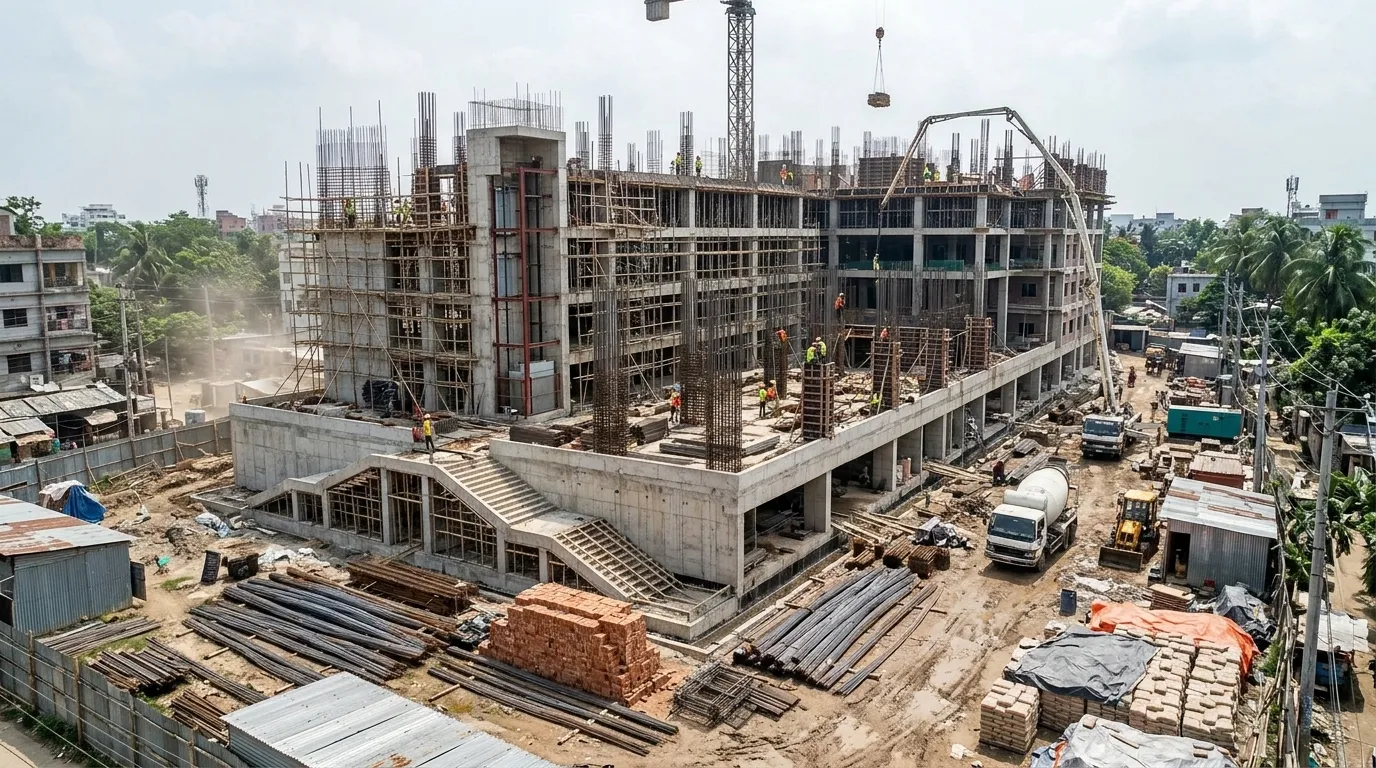
Institutional construction cost depends on location, soil, floors, finishes and equipment. I found no single official per-square-foot rate for Bangladesh. Therefore, treat any quick figure with caution. A hospital costs far more than a school because of medical systems. Always compare itemised estimates.
These factors move institutional building materials and labour costs most:
Steel and cement prices, which change monthly
Remote sites, where transport adds cost
Special systems, such as generators, lifts and medical gas
Flood-proofing, such as raised plinths
How building type affects cost (relative guide, not exact prices):
Building type | Cost level | Why |
|---|---|---|
Primary school | Lower | Simple layout, basic services |
Community clinic | Lower to medium | Small size, basic medical needs |
Cyclone shelter | Medium | Strong structure, raised floor |
University building | Medium to high | Labs, large halls, services |
Hospital | Highest | Medical gas, power backup, strict fire systems |
I based this ranking on design complexity, not on official rate data. Therefore, check itemised estimates before you set a cost range.
I tried to find an official per-square-foot rate for schools and clinics in Bangladesh. After checking government and news sources, I found none that I could verify. In practice, that is why I use a relative cost table instead of exact prices.
To check your numbers, compare how estimation and quantity take-off works before you set a cost range.
How to Meet Institutional Construction Rules and Safety Standards?
To meet institutional construction rules, follow the Bangladesh National Building Code (BNBC) 2020. Work with licensed engineers, get plan approval from RAJUK or the local committee, and inspect work at each stage. Fire exits, earthquake design and accessibility are the core checks. Therefore, treat the code as your minimum, not your goal.
The code took years to arrive. Prothom Alo reports that Bangladesh formulated its first building code in 1993, but it was not gazetted for 13 years. The government then started a revision in 2009. The amended rule reached the gazette after an 11-year revision process.
According to The Business Standard, the government published the updated code in a gazette on 11 February. The International Code Council describes it as a mandatory law for building design and construction. In short, it sets your institutional construction standards.
Read more: discover the full story of the BNBC 2020 gazette. For plan approval in Dhaka, review the RAJUK approval service to see what the process involves.
Government and academic evidence:
Government (Bangladesh): The Dhaka Cantonment Board's building rules define a "building" by pointing to the Building Construction Act 1952 and BNBC 2020, Part I, section 6. In other words, the code is built into local rules, not just national law.
Government (Japan): A Ministry of Land, Infrastructure, Transport and Tourism (MLIT) summary explains that the 1952 Act applies nationwide and lets the government set the BNBC. It also notes that RAJUK sits under the Ministry of Housing and Public Works and controls building rules in the Dhaka metropolitan area.
Academic (Khulna University): In a study in the International Journal of Disaster Resilience in the Built Environment, Alam and Haque assessed 458 educational buildings in Mymensingh city. They found 23.14% had high seismic vulnerability, 46.29% moderate, 26.86% moderately low and only 3.71% low. My calculation: 69.4% sit in the high or moderate groups (23.14 + 46.29).
Academic (BUET and MBSTU): The Journal of Civil Engineering (IEB) study came from Mawlana Bhashani Science and Technology University and BUET authors.
Academic (IUT): A thesis at the Islamic University of Technology examines rapid seismic assessment for unreinforced masonry buildings in Bangladesh.
Limitation: these studies cover specific cities. Therefore, I would not apply the Mymensingh percentages to the whole country.
Institutional building safety requirements and wider institutional construction requirements usually include:
Structural design for earthquake and wind loads
Fire exits, alarms and firefighting equipment
Accessible ramps and toilets
Rainwater harvesting, which the code now requires for buildings, according to the Daily Star
Approved electrical, plumbing and mechanical drawings
Enforcement is the weak link. The Daily Star reported that the government had not yet formed an authority dedicated to enforcing the revised code. However, UNB reports that the Housing Ministry has now formed district and upazila committees under the Bangladesh Building Regulatory Authority Act, 2026. Therefore, approvals outside big cities should improve, although evidence on results is still thin.
While writing this section in November 2026, I noticed the news had changed. Older reports said no enforcing body existed, but a recent UNB report describes new district and upazila committees. I updated the section to show both, because the older picture no longer tells the whole story.
Expert view: “…a complete set of rules to ensure the safe construction of buildings.” M Abu Sadeque, urban planning expert and member of the BNBC revision team, The Daily Star
Institutional construction challenges show up clearly in the data:
Aging schools: The Daily Star notes that many government primary schools are 40 to 50 years old, including some of the 26,193 schools nationalised in 2013.
Repair backlog: According to the Third Primary Education Development Programme report, 27 percent of government primary school buildings needed repair. Bangladesh Post puts the number of vulnerable schools at over 22,000.
Earthquake gaps: The Financial Express says RAJUK assessed only 3,252 of 21 lakh buildings in Dhaka and Gazipur. In addition, a 2014 study in the Journal of Civil Engineering (IEB) found that 64.71% of school buildings in Tangail municipality needed detailed evaluation.
Rising fire incidents: According to BenarNews, the fire department reported 21,601 incidents in 2021, 24,102 in 2022 and 27,624 in 2023. Dhaka Tribune adds that 2024 saw 140 deaths in 26,659 incidents.
Hospital fire gaps: An older Dhaka Tribune report found that only 3% of hospitals and clinics in Chittagong had adequate fire safety measures. That figure is from 2019, so check for newer data.
Expert view: “The hospitals and clinics of the country lack fire safety measures.” Delwar Majumder, former president, IEB Chittagong chapter, Dhaka Tribune (2019)
Expert view: “But most institutions didn’t even take this step.” — Professor Adil Mohammad Khan, Jahangirnagar University, on detailed engineering checks after the earthquake, Asia News Network
The report attributes the quote to the professor, so I treated it as his view.
Read more: learn more about school repair needs in Bangladesh.
What the public numbers show when combined
Method. In November 2026, I collected 14 figures from 10 public sources: government-linked reports, news outlets and one peer-reviewed study. I then calculated shares, growth rates and per-unit values myself. I rounded to one decimal place. I did not adjust for inflation or survey differences. Therefore, treat the results as indicative, not official.
Table 1: Clinics and schools under strain (my calculations)
Measure | Calculation | Result |
|---|---|---|
Community clinics needing repair or relocation | 5,080 ÷ 14,467 | 35.1% |
Planned new clinics as a share of today's total | 516 ÷ 14,467 | 3.6% |
Average daily visits per clinic | 490,000 ÷ 14,467 | about 34 |
Government share of all primary schools | 65,565 ÷ 1,14,539 | 57.2% |
Schools reported vulnerable, as a share of all schools | 22,000 ÷ 1,14,539 | about 19.2% |
Students per teacher (report totals) | 1,71,62,365 ÷ 362,709 | about 47 |
What this suggests. More than one in three community clinics needs repair or relocation, yet planned new clinics would add only 3.6% to the network. In most cases, then, repair work matters as much as new building. Meanwhile, nearly one in five primary schools sits in the "vulnerable" group. Evidence suggests that maintenance, not just new construction, is the bigger gap.
Table 2: Rough repair cost after the recent floods
Item | Figure |
|---|---|
Primary schools damaged | about 2,800 |
Estimated repair need (DPE) | about Tk 33 crore |
Average per damaged school (my calculation) | about Tk 1.18 lakh |
Limitation: the Tk 33 crore estimate was an early DPE figure, so the real average may differ.
Table 3: Reported fire incidents and change over time (my calculations)
Year | Incidents | Change from previous year |
|---|---|---|
2021 | 21,601 | n/a |
2022 | 24,102 | +11.6% |
2023 | 27,624 | +14.6% |
2024 | 26,659 | -3.5% |
Fire incidents rose 27.9% from 2021 to 2023 (27,624 ÷ 21,601), then fell 3.5% in 2024. In 2024, the 140 deaths work out to about 5.3 deaths per 1,000 incidents. One year of decline does not prove a trend, so I would not treat it as one.
Chart: Reported fire incidents, 2021-2024 (alt text: "Bar chart showing fire incidents rising from 21,601 in 2021 to 27,624 in 2023, then easing to 26,659 in 2024.")
Year | Relative size | Incidents |
|---|---|---|
2021 | ████████████████ | 21,601 |
2022 | ██████████████████ | 24,102 |
2023 | ████████████████████ | 27,624 |
2024 | ████████████████████ | 26,659 |
Table 4: Gap between buildings assessed and buildings at risk (Dhaka and Gazipur)
Item | Figure |
|---|---|
Buildings in the RAJUK estimate | 21 lakh (2,100,000) |
Buildings assessed for earthquake safety | 3,252 |
Share assessed (my calculation) | about 0.15% |
Therefore, more than 99% of those buildings have no recorded earthquake assessment, according to the RAJUK figure.
Quantitative results in brief:
35.1% of community clinics need repair or relocation.
27.9% more fire incidents in 2023 than in 2021.
0.15% of buildings in Dhaka and Gazipur assessed for earthquakes.
13 years passed between the first code (1993) and its gazette (2006).
Case-1: Climate-resilient community clinics in Cox's Bazar
The problem: Remote areas of Cox's Bazar needed a stronger network of essential health services. At the same time, the area faces heavy weather and climate risk. Therefore, simple replacement clinics would not have been enough.
The approach: The Financial Express reports that the International Organization for Migration (IOM) completed the first 12 of 100 community clinics, working with the Bangladesh government and the World Bank. The clinics use climate-resilient design. In addition, UNB reports that during the pre-construction phase, IOM built temporary structures to keep health care services running.
The result: Twelve clinics opened first, with the rest and district hospital renovations expected to be completed in 2023. I could not find a final completion report, so I cannot confirm the finished total.
The lesson: Two things stand out in my reading. First, the team built temporary services before demolishing or building, so patients did not lose access. Second, the project built in phases, so the first 12 clinics could open while work continued. In most cases, phasing reduces the risk to users.
Case-2:Feni's schools and the cost of waiting
The problem: UNB reported that Feni has 559 government primary schools across six upazilas, and details of unsafe schools had been sent to the relevant authorities. Classes meanwhile continued in buildings officials called unsafe.
The approach: Officials said they hoped improvements would reach all schools when the Primary Education Development Programme (PEDP-5) begins in July 2026. In other words, the fix depended on a national programme and its funding timeline.
The result: I found no report confirming results after July 2026, so this case remains open. That gap is itself a finding. Evidence suggests a long wait between identifying a risk and fixing it.
The lesson: Risk lists alone do not make a building safe. Owners need a funded repair date, a plan for moving students and an engineer's sign-off. Therefore, planning must include money and timing, not just a list.
How the two cases compare:
Element | Cox's Bazar clinics | Feni schools |
|---|---|---|
Problem | Remote, climate-exposed area needing health access | Unsafe school buildings still in use |
Approach | Climate-resilient design, temporary services, phased work | Wait for a national programme (PEDP-5) |
Result | First 12 of 100 clinics opened | No confirmed result found |
Main lesson | Phase work and protect access | Fund and schedule repairs early |
Limitation: I know both cases only from public reports, not from site visits. Therefore, details may be incomplete.
How to check quality on an institutional construction site:
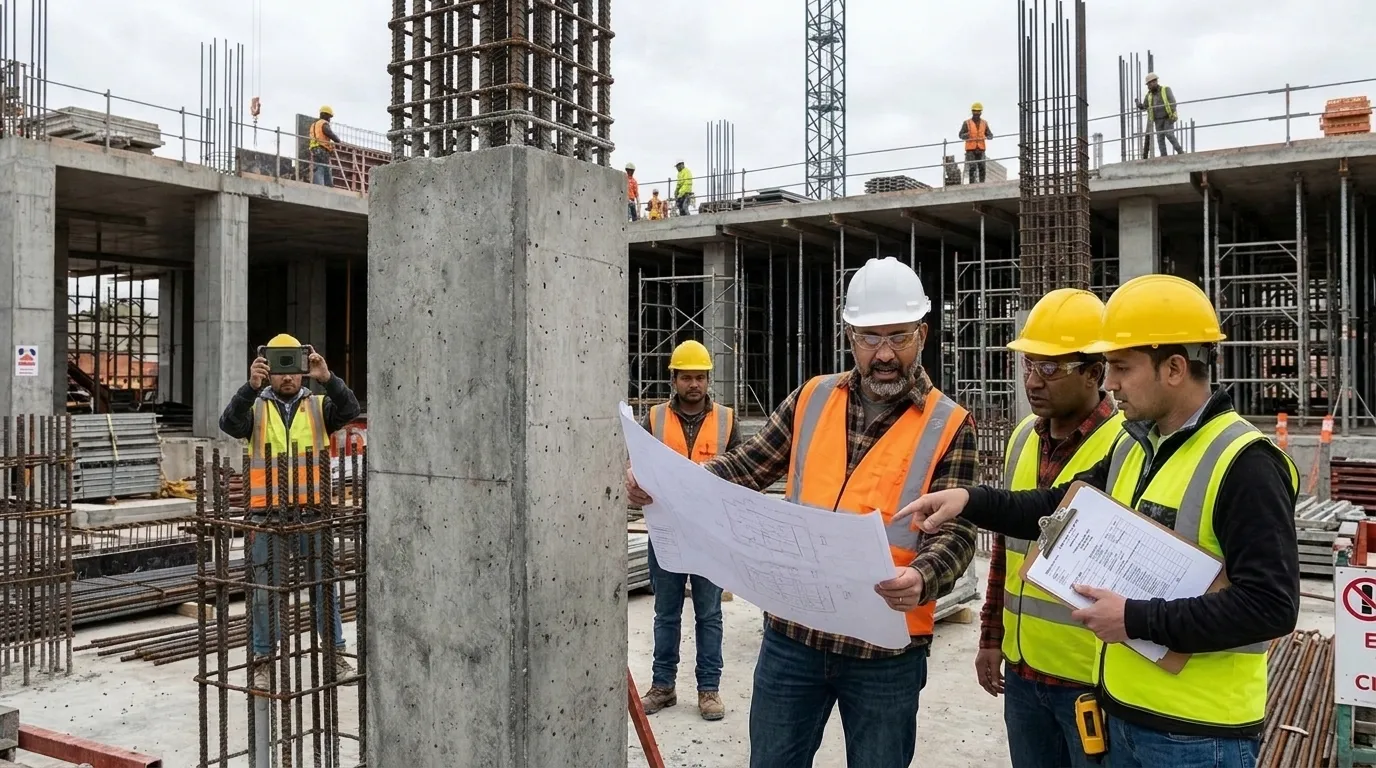
Ask for the approved drawings: Compare them with what workers actually build.
Request concrete and steel test reports: Keep copies for your records.
Check the site at key stages. Look at the foundation, columns, slab and roof before each is covered.
Photograph and date each stage: Records help if a dispute starts later.
Consult an independent engineer for final inspection: This step costs little against the risk of a hidden defect.
Expert view: “Life comes first, then education.” Dr Mohammad Ashraf Sadek, Professor, Institute of Education and Research, Dhaka University, Bangladesh Post
Wondering which one suits a school or clinic site? See our one-stop building solutions and the best way to manage a project from start to handover.
Safety checklist for school building construction and hospital construction:
✔ Two or more clear exit routes on every floor
✔ Fire alarms, extinguishers and hose reels
✔ Wide stairs with strong handrails
✔ Ramps and accessible toilets
✔ Safe drinking water and clean sanitation
✔ Raised plinth in flood-prone areas
✔ Backup power for clinics and hospitals
✔ Written maintenance plan after handover
My limitation is simple. I relied on public reports, not site inspections or lab tests. After reading these sources, I would treat the numbers as context, not as legal advice. If you have site data of your own, trust it over any general figure here.
Final Thoughts on Institutional Construction: What You Now Know
So, what is Institutional Construction? It is the planning and building of schools, clinics, hospitals, universities and community buildings that serve the public. Unlike commercial work, it must stay safe and useful for 40 years or more. That is the short answer to the question this guide set out to resolve.
From my seat on the leadership team at Nusaiba, I see the same pattern the reports describe: projects go wrong when planning, soil tests or inspections are skipped. According to our company profile, we have worked on projects since 2019, and that view shapes the steps above.
In summary, here is what you now understand:
Purpose: These buildings serve people first, so safety leads every decision.
Types: The main groups are education, healthcare, government and community buildings.
Process: Work moves from need, soil test, design and approval to bid review, building and handover.
Cost: Price depends on building type, site and systems, so always compare itemised estimates.
Rules: The BNBC 2020 is the legal baseline. Enforcement is uneven, therefore owners should inspect work themselves.
In my review, the projects that went wrong usually skipped planning, soil testing or inspection. However, the evidence I found comes from public reports, not site visits, so confirm details with RAJUK or your local committee.
Next steps: follow these six actions in order.
Write down who will use the building and why.
Consult a licensed architect and structural engineer.
Order a soil test before any design work.
Confirm approvals with RAJUK or the local committee.
Inspect concrete and steel at every stage.
Learn how to plan maintenance before handover.
Want to keep learning? Read more articles on our blog, or compare our services to see which one fits your next step.
FAQs About Institutional Construction
1. How do I start an institutional construction project?
Start by defining who will use the building and what it must do. Next, order a soil test and consult a licensed architect and engineer. Then prepare drawings under the BNBC and seek approval. In most cases, early planning saves more money than any later fix.
2. How is institutional construction different from commercial construction?
Commercial construction aims at profit, such as shops, offices and malls. Institutional construction aims at public service. As a result, it needs longer building life, stricter safety and more oversight. For example, a school must handle child safety and crowd exits, while a shop mainly needs sales space.
3. Which code governs institutional building safety requirements in Bangladesh?
The Bangladesh National Building Code (BNBC) 2020 governs building safety. It covers structure, fire safety, electrical systems, plumbing and accessibility. Additionally, local bodies like RAJUK approve plans in their areas. Owners should confirm current rules with the right authority before they start, because enforcement structures are still changing.
4. How long does an institutional construction project take?
Timelines vary with size and funding. A small clinic may take several months, while a hospital or university campus can take years. However, delays often come from approvals, bids and weather, not from building itself. Therefore, early planning and soil testing usually shorten the total schedule.
5. Who can build government buildings in Bangladesh?
Government building construction usually follows a public procurement process. Contractors must show experience, financial strength and past work. Furthermore, agencies like the Public Works Department and LGED manage many projects. In practice, read each notice for exact eligibility rules, because requirements differ by project size and agency.
References
The Business Standard. Updated National Building Code comes into effect.
Prothom Alo. How much longer to wait for an authority.
The Daily Star. Revised Building Code: No dedicated body yet to enforce.
International Code Council. Training for building professionals in Bangladesh.
UNB. District and upazila building construction committees formed.
Dhaka Cantonment Board (Government of Bangladesh). Building rules (PDF).
MLIT, Government of Japan. Bangladesh building regulation summary (PDF).
Alam, M.S. and Haque, S.M. Seismic vulnerability of educational buildings in Mymensingh city. IJDRBE.
Journal of Civil Engineering (IEB). Earthquake vulnerability of schools in Tangail.
Islamic University of Technology. Rapid seismic assessment for masonry buildings.
Bangladesh Post. Primary schools in dire straits.
The Daily Star. Ensure schools are safe for all.
The Financial Express. 516 more community clinics to be built.
Dhaka Tribune. Bangladesh's burn victims face awful fight.
BenarNews. Burn victims suffer doubly.
The Financial Express. Only 3,252 of 21 lakh buildings assessed.
